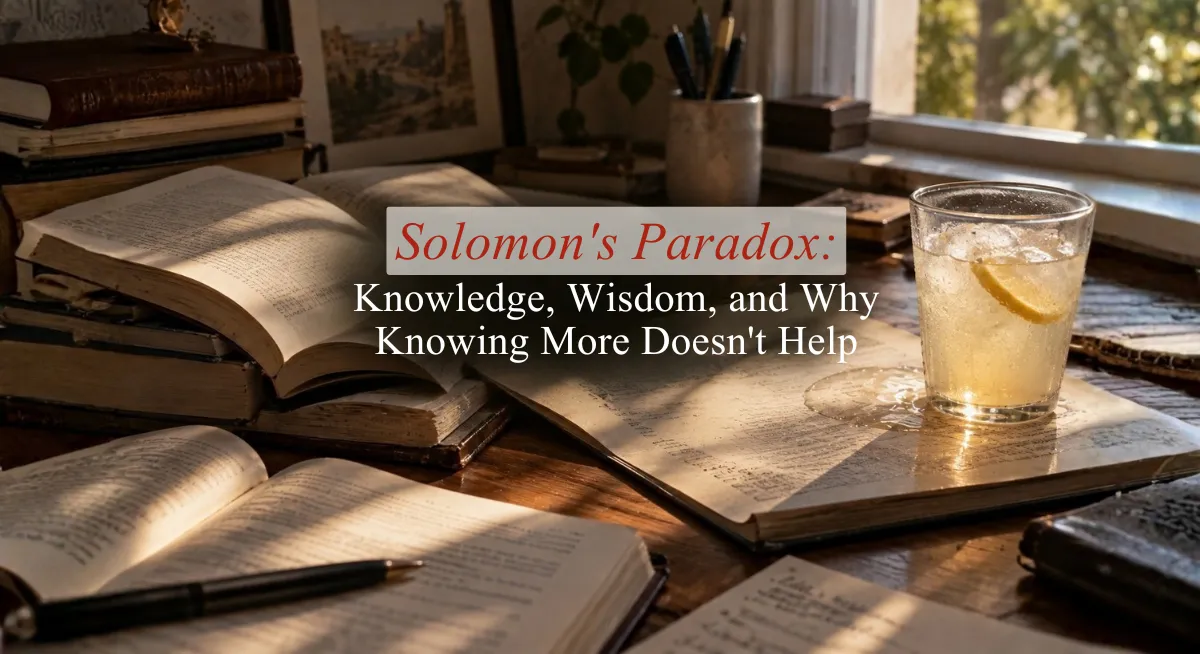
Solomon's Paradox: Knowledge, Wisdom, and Why Knowing More Doesn't Help
He gave the best advice in the ancient world and couldn't take his own. Psychologists named the effect after him.
You know exactly what your friend should do. You have no idea what you should do. Same brain.
A desk at the end of a long night. Books open and stacked at angles, three of them face-down to hold a place. A glass of lemonade sweating a ring into the page of one of them, because at some point you stopped reading and started sitting. The last thing you highlighted was four pages back.
I have a wall of those books. For most of my career my instinct when something hurt was to go get better information, and I was very good at that. I could diagnose somebody else's marriage, somebody else's org chart, somebody else's calling, and be right about it. People called me for that. When I left the C-Suite in 2023 I had a library and a blind spot, and the two were roughly the same size.
If you've searched "difference between knowledge and wisdom," "why doesn't knowing more make me happier," or "why smart people make bad decisions," this post is the one I'd hand you across a table.
Get the Gist Quick
Short version, because you've already got four books on this.
Knowledge is knowing what a lemon is. Wisdom is knowing it tastes good mixed with water and a little sugar. The gap between them has a name now, and the name is his. Solomon's paradox is the documented finding, across three experiments with 693 participants, that people reason more wisely about someone else's problem than their own, and that deliberately taking an outside view closes the gap.1 The naming is fair. Solomon judged a nation's hardest cases with a discernment people crossed continents to witness, and ran his own life into the ground. He asked God for an understanding heart, received more of it than anyone alive, and still finished by writing that increasing knowledge only increases sorrow. Under The Sun, wisdom is heavy. Under The Son, Wisdom becomes Guidance, which is the difference between carrying the answer and following Someone who has it.
The first thing we do as humans is learn. Very early, we're taught that knowledge leads to Meaning. Grades become identity. Achievement becomes proof that we matter.
It didn't finish him well. He started great and ended writing that the greater his wisdom, the greater his grief.
The research is more precise than the proverb. Wise reasoning does track with well-being. Raw intelligence doesn't. And the searching is where the distress lives, not the wisdom.
And the paradox has his name on it now, because the man who advised the ancient world couldn't advise himself.
And now... the rest of the story.
The Offer Nobody Else Ever Got
The first thing we do as humans is learn. From the moment a child opens its eyes, the world becomes a classroom. Very early, we're taught that knowledge leads to Meaning. Grades become identity. Wisdom becomes power. Achievement becomes proof that we matter. From the nursery to the university, the message is clear. If you know enough, understand enough, and accomplish enough, then fulfillment will follow.
Solomon knew that hunger well. When he became king, God came to him in a dream and made him an offer no man has ever received before or since. "What do you want? Ask, and I will give it to you!" (1 Kings 3:5).
He could have asked for long life, riches, or the death of his enemies. He didn't. He Prayed: "So give Your servant an understanding heart to judge Your people to discern between good and evil. For who is able to judge this great people of Yours?" (1 Kings 3:9, NASB).
The request pleased God, who gave Solomon Wisdom unlike any before him and added riches and honor besides. Word spread. Foreign rulers traveled great distances just to hear him speak. He became known as the wisest man alive.
And yet, years later, after a lifetime of learning, ruling, writing, and searching without God, he arrived at a haunting conclusion.
"I applied my heart to seek and to search out by wisdom all that is done under heaven. It is an unhappy business that God has given to the children of man to be busy with. I have seen everything that is done under the sun, and behold, all is vanity and a striving after wind" (Ecclesiastes 1:13-14, ESV).
How did the gift turn sour? Solomon started great and didn't finish strong. Lust replaced humility. Foreign wives stole his heart and turned him toward their gods. And when a man turns from God, everything else comes apart.
The very gift he asked for let him rule God's people with Righteousness for a time. It also opened his eyes to the world's pain. Wisdom revealed beauty and it revealed unbearable grief. "The greater my wisdom, the greater my grief. To increase knowledge only increases sorrow" (Ecclesiastes 1:18).
The Effect That Carries His Name
Now the part I didn't expect to find in a psychology journal.
Researchers ran three experiments with 693 participants and documented something they called Solomon's paradox: people reason more wisely about another person's problems than about their own. Given a difficult situation involving someone else, participants showed better perspective-taking, more recognition of uncertainty, more willingness to compromise. Given the structurally identical situation in their own life, that capacity dropped.
Then, they fixed it. Instructing participants to take a self-distanced perspective, to reason about their own situation as though it belonged to somebody else, eliminated the asymmetry. This was experimental rather than correlational, which means the causal language is earned.1
One finding in that paper cuts directly against the proverb, so I'll name it. The asymmetry was comparable for younger adults and for adults aged 60 to 80. There were no age differences in wise reasoning about personal conflicts. Whatever we mean by "with age comes wisdom," it isn't that. The paper says so explicitly.
Whose advice would you take, if it came from you?
The name isn't a coincidence. Solomon judged Israel's hardest cases with a discernment people traveled continents to witness, and ran his own life into the ground. He could see everyone's situation but the one he was standing in.
I called this pattern something less flattering in Why Smart People Self-Sabotage. It turns out it has a formal name and an experimental literature.
Wise Reasoning Works. Being Smart Doesn't.
This is the finding that reframes the whole chapter.
Researchers took a stratified random sample of 241 adults across three age bands and measured two different things: wise reasoning and verbal intelligence. Then they looked at well-being.
Wise reasoning went with a better life across the board. Less brooding was the strongest of them, then fewer bad moods, then better relationships, then plain satisfaction with life. Those associations held in multivariate models controlling for verbal ability and agreeableness.
Raw intelligence showed “no systematic relationship to the well-being indicators.” None of them.2
Same people. Same study. One of those capacities tracked with a better life and the other didn't.
Two honest limits. Every one of those links is real but modest, and the whole thing is a single American county measured once rather than followed over time. Treat it as one well-designed study finding, in one population, that the thing Solomon asked for isn't the thing we usually chase.
Because "an understanding heart to discern between good and evil" isn't an IQ request. It's a request for judgment under pressure about right and wrong, which is closer to what these researchers were measuring than to anything a transcript records.
The Searching Is Where the Weight Is
Solomon's line about wisdom increasing grief has a modern analogue, and locating it precisely matters.
Across 147 studies and 92,169 participants, researchers separated two things people do with Meaning: having it and searching for it. Having Meaning lined up with well-being at .42, on a scale where 1.0 would mean the two rise together perfectly and 0 would mean no connection at all. That's a strong link in this kind of research. Searching for Meaning came in at −.12.3 The minus sign is the whole story. The more people were still looking, the slightly worse they felt. The two point in opposite directions, and the search effect is small, which is worth saying rather than inflating.
A separate meta-analysis pooling 108 studies and 76,892 people looked at Meaning and psychological distress, and found the same split. Distress was negatively associated with having Meaning and positively associated with searching for it. The distinction worth carrying: the absence of Meaning tracked most strongly with depression, while the searching tracked most strongly with anxiety.4
These are correlations. Nobody has shown that searching produces distress, and distress driving the search is at least as plausible a reading. What the data supports is that the two states travel together.
Which is a more precise diagnosis than Solomon's own sentence. He had accumulated more knowledge than anyone alive, and he was still searching. The grief attached to the searching, not to the knowing.
He gave three more warnings on the way out. Death erases the distinction: "Since I will end up the same as the fool, what's the value of all my wisdom?" (Ecclesiastes 2:15). Completeness is unavailable: "I realized that no one can discover everything God is doing under the sun. Not even the wisest people discover everything, no matter what they claim" (Ecclesiastes 8:17). And the tab keeps running: "But, my child, let me give you some further advice: Be careful, for writing books is endless, and much study wears you out" (Ecclesiastes 12:12).
One more measurement, and it complicates the intuitive version rather than confirming it. Across 172,228 respondents in 36 European countries, education's well-being advantage was real. It also leveled off as national prosperity rose, and in the most affluent countries the highly educated reported slightly lower happiness.⁵ So learning isn't a scam. Its return saturates, and then bends.
Learning and Wisdom Under The Son
Solomon didn't see the curveball coming. His conclusion that all is vanity under the sun was the setup for The Son, Jesus.
Jesus came as Wisdom itself (1 Corinthians 1:24). Those who listened were astonished, saying they had never heard anything like His teachings (Mark 1:22). The Greek Bible has a name for Him. The Logos. The Word. Not words on a page, but the very Wisdom and Reasoning of God. "In the beginning the Word (Jesus) already existed. The Word was with God, and the Word was God. He (Jesus) existed in the beginning with God... and nothing was created except through Him" (John 1:1-3).
Solomon spent his life chasing knowledge in order to rule. He asked for Wisdom and got more of it than any man alive, and in the end all his smarts left him empty. Jesus came as The Eternal Logos, the literal Living Word. He came not to fill heads with information but to fill hearts with Himself.
His Wisdom isn't something you memorize. It's Someone you meet, Believe in, and follow.
The disciples were explicit that they weren't passing along a theory. "We proclaim to you the one who existed from the beginning, whom we have heard and seen. We saw Him with our own eyes and touched Him with our own hands. He is the Word of life" (1 John 1:1). They were introducing a Person.
Solomon looked around and sighed that all is vanity, just chasing the wind. John pointed to Jesus and said their Joy was made complete in Him (1 John 1:4). Solomon's wisdom left him trapped in futility. Christ's Wisdom sets you Free. Solomon's knowledge made him weary. The Knowledge of Jesus gives you Eternal Life.
The King says: learning is good, wisdom is better, and wisdom without God is nothing more than chasing the wind.
The Son says: Wisdom isn't just something you learn. It's Someone you follow.
Learning and Wisdom, Through the P2-Driven Framework
Get Clear means using the one intervention with experimental support behind it. Self-distancing. Write the situation you're stuck in as though it belonged to somebody else, in the third person, with their name on it. Then, read your own advice. That's not a journaling exercise. It's the manipulation that eliminated the asymmetry in the lab.
Align with God's Heart is where Wisdom becomes Guidance. The shift is from being the one who has to know to being the one who asks. Solomon's Prayer is still the model, and notice how narrow it was. Not information. An understanding heart to discern between good and evil. "So give Your servant an understanding heart" (1 Kings 3:9, NASB).
Establish Rhythms of Fitness is what Solomon lacked, and it killed him slowly. He had the insight and lost the practice. Insight without rhythm decays, which is why the man with the most understanding available finished worst. Talent Without Clarity Creates Frustration is the shorter version of that failure.
Live Your Legacy Today is the answer to Ecclesiastes 2:16, where the wise and the foolish are both forgotten. Solomon was right that knowledge doesn't outlive you. Faithfulness does. Your Dash (that tiny line between your date of birth and your death) is chiseled by ordinary obedience, not by what you managed to understand.
Rhythms for the Next Thirty Days
Write your own situation in the third person. One page, their name instead of yours, then your advice to them. This is the self-distancing manipulation from the experiments and it's the highest-value practice in this post.
Stop searching for one week and practice having. Since presence and search run in opposite directions, spend the week naming what you already have rather than hunting what you're missing. Same twenty minutes, opposite direction.
Pray Solomon's Prayer, narrowly. Give Your servant an understanding heart to discern between good and evil. Not clarity about outcomes. Judgment about right and wrong.
Finish one book before starting another. Ecclesiastes 12:12 targets the endless queue rather than the reading. Pick the one and close it.
Live Your Legacy Today
The library didn't help. That's the part I'd want a younger version of me to hear.
Every book I bought during the hard stretch was a real book with real information in it, and I could have taught the material back to anybody who asked. What I couldn't do was apply one page of it to the man driving home. I gave excellent counsel to people whose situations were structurally identical to mine and then pulled into my own driveway with nothing.
Solomon judged a nation and lost a life. They named the effect after him for a reason.
And I still buy the book first. That's my reflex, it's fast, and I catch it maybe half the time. The difference now is that I know what the reflex is for, which isn't the same as being free of it.
Wisdom under The Sun is heavy. Under The Son it has a name, and the name is a Person.
Enjoy the lemonade. Don't stop there.
Going Deeper
This post covers Learning and Wisdom, chapter four of Your Purpose & Principle Driven Life 2.0, and it's the first chapter past the free sample. If you've been reading the first three, this is where the book takes over.
Get the book. Your Purpose & Principle Driven Life 2.0. Redefine Success · Align with God's Heart · Live Your Legacy Today. Twenty-three chapters, twenty-three free companion videos. Solomon's story runs from here through the empire, the wealth, the pleasure, and the verdict. Get it here.
Last Monday was The Man Who Had Everything and Called It Meaningless, and the series opens at How Do You Know If Your Life Matters.
And if you're the person who can solve everyone's problem except the one you're standing in, that's the conversation. Book a Discovery Call.
FAQ: Knowledge, Wisdom, and Solomon's Paradox
What's the difference between knowledge and wisdom?
Knowledge is knowing what a lemon is. Wisdom is knowing it tastes good mixed with water and a little sugar. Knowledge is information held. Wisdom is judgment applied, usually under pressure and usually about something that matters. The research treats them as genuinely distinct constructs, and in one stratified sample of 241 adults, wise reasoning predicted life satisfaction, lower negative affect, and better relationships while measured intelligence predicted none of them.
What's Solomon's paradox?
A documented effect named after the king. Across three experiments with 693 participants, people reasoned more wisely about another person's problems than about their own, showing better perspective-taking and more recognition of uncertainty when the situation belonged to somebody else. Instructing them to take a self-distanced view of their own situation eliminated the gap. The naming is apt. Solomon adjudicated a nation's hardest cases and couldn't govern his own appetites.
Does wisdom come with age?
Not according to the study that named the paradox. The self-other asymmetry in wise reasoning was comparable for younger adults and for adults aged 60 to 80, and the paper names the adage it contradicts. Years supply experience. Whether that experience becomes wisdom depends on what you do with it, and self-distancing is one thing that demonstrably helps.
What does Ecclesiastes 1:18 mean?
"The greater my wisdom, the greater my grief. To increase knowledge only increases sorrow." Solomon is describing what happens when understanding is turned on a broken world without God in the frame. You see more, including more of the pain, and the seeing doesn't fix any of it. Modern research locates the weight slightly differently. Across 147 studies and 92,169 people, having Meaning went with a better life while searching for it went the other way. Solomon had enormous knowledge and was still searching. The grief attached to the search.
Is it wrong to want to learn more?
No. Learning is a gift and Solomon says so directly. The failure is in asking learning to bear ultimate weight, which it can't. Worth knowing that education's well-being return also saturates: across 172,228 respondents in 36 European countries, education's happiness advantage leveled off as national prosperity rose, and in the most affluent countries the highly educated reported slightly lower happiness. Learning isn't a scam. It just isn't the destination.
How do I actually get Wisdom from God?
Solomon's Prayer is the pattern and it's narrower than most of our Praying. He asked for an understanding heart to discern between good and evil, not for information or for outcomes. James 1:5 says to ask, plainly. And the practical move that has experimental support behind it's self-distancing: write your own situation as though it were someone else's and read back what you'd tell them. You often already know. You're just standing too close to hear yourself.
