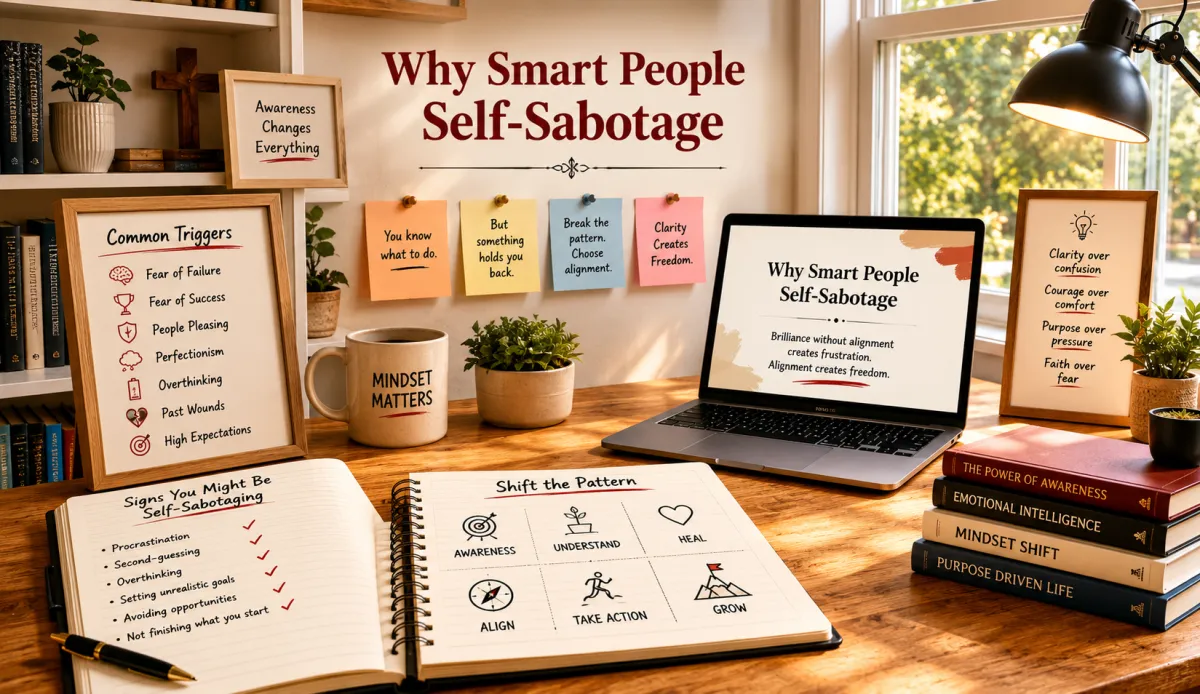
Why Smart People Self-Sabotage
The Pattern Nobody Talks About, And Why Intelligence Without Alignment Makes Things Worse
If you’ve ever searched “why smart people self-sabotage,” “self-destructive patterns,” or “smart but stuck,” you already know the frustration. You’re not unintelligent or incapable. You can see the right move, explain it to someone else, and then do the exact opposite yourself. You know what to eat, how to budget, when to hold your tongue, and what your marriage needs, and you still don’t do it. It’s not a knowledge problem. That’s something deeper, and it won’t get fixed by reading another book about it.
Get the Gist Quick
Here’s the short version, because if you’re a self-saboteur, you’ve probably already skipped to the part that confirms what you suspect about yourself.
You’re smart. You know it, and so do others. You can assess a situation faster than most, anticipate problems before they arrive, and build a plan that works on paper. Then you torpedo it, not because you’re lazy or stupid, because somewhere between knowing and doing, something inside you hits the brakes.
Maybe it’s the promotion you quietly undermined by picking a fight with your boss the week before the decision. Maybe it’s the marriage conversation you’ve been avoiding because if you actually said what you’re thinking, things would have to change. Maybe it’s the workout plan or the budget or the morning Prayer habit that lasts eleven days and then vanishes like it never existed.
Self-sabotage isn’t a behavior problem. It’s a clarity problem with a bodyguard. The behavior is just the bodyguard doing its job, protecting something you haven’t examined yet. Usually a fear and often one you’re smart enough to dress up as something more respectable.
That’s why Get Clear is the first phase of the P2-Driven Framework, not because clarity is easy, but because everything you build without it every rhythm, relationship pattern, and career move gets constructed on top of something you’ve never looked at honestly. And smart people are the best in the world at building impressive structures on unexamined foundations.
If any of that landed, keep reading. The rest of the story is where it gets specific.
And now… the rest of the story.
The Sabotage Pattern Hiding in Plain Sight
Back in January, we explored Why So Many Capable People Feel Stuck. That post hit may have a nerve because “capable but stuck” describes a massive number of Christians who look like they’ve got it figured out and feel like they’re drowning. Self-sabotage is the more aggressive cousin of that stuckness. Stuckness is passive. Self-sabotage is active. You’re not just stalled, you’re pulling the emergency brake on your own progress.
Here’s the part that makes smart people especially vulnerable: intelligence gives you a better story for why you did it. You’re not “avoiding the conversation” – you’re “picking the right time.” You’re not “undermining your promotion” – you’re “standing on principle.” You’re not “blowing up your budget” – you’re “investing in quality of life.”
Smart people don’t just self-sabotage. They narrate it. They build airtight cases for the very behavior that’s destroying what they say they want. And because the story sounds reasonable, nobody challenges it, including them.
Why Intelligence Makes It Worse
You’d think being smart would protect you from self-destructive patterns. It doesn’t. It just makes the patterns more sophisticated.
A person with average self-awareness might procrastinate and know they’re procrastinating. A smart person procrastinates and calls it “waiting for more data.” A person with limited emotional vocabulary might lash out and feel guilty. A smart person lashes out, rationalizes it as “boundary-setting,” and feels righteous instead of convicted.
Intelligence without Alignment doesn’t prevent bad decisions. It justifies them faster. It gives you a PhD-level defense for staying exactly where you are, even when where you are is killing your marriage, your health, your Faith, or your Calling.
We talked about this in a different context when we looked at When Success Pulls You Away From God. The smarter and more successful you are, the easier it is to build a life that works without God in it or at least without God at the center of it. Self-sabotage often shows up right at the point where real Alignment would require you to surrender something your intelligence built, and smart people don’t surrender easily.
The Fear Underneath the Pattern
Self-sabotage almost always has a fear at the root. This isn’t a surface fear or “I’m afraid of failure.” It’s something deeper – something you might not have words for yet.
Fear of exposure: if you actually succeed at the level you’re capable of, people will see the real you. And you’re not sure the real you can hold up under that kind of scrutiny.
Fear of sustained excellence: you can sprint. You can deliver under pressure, but the idea of being consistently excellent over years as a spouse, a parent, a leader, a follower of Christ feels like a standard you’ll eventually fail to meet. So, you fail now, on your own terms, before the stakes get higher.
Fear of change: self-sabotage keeps your world predictable. Messy, but predictable. Growth means stepping into unknown territory, and your intelligence has been trained to minimize unknowns.
Paul named it plainly: “I do not do the good I want to do, but the evil I do not want to do – this I keep on doing” (Romans 7:19, NIV). That’s a first-century apostle describing the exact loop every smart self-saboteur lives in. The issue isn’t information. It’s something operating beneath the information and intelligence alone can’t reach it.
Get Clear: Name the Pattern Before It Names You
In The Four Questions Every Adult Must Answer, we walked through the foundational framework: Who am I? Why am I here? How should I live? Where do I belong? Self-sabotage thrives in the gap between knowing those answers intellectually and living them daily. Smart people can articulate beautiful answers to all four questions and still make choices that contradict every one of them.
Getting clear means naming the specific pattern – not the general category. “I self-sabotage” isn’t clear enough. You need the specifics: “I pick fights with my spouse when things are going well because closeness feels vulnerable.” Or: “I overspend after a good financial month because I don’t trust stability.” Or: “I skip Prayer when God starts answering, because answered Prayer means I’m accountable to do something with it.”
That’s the kind of honesty that breaks the cycle. Not more information. Not another podcast episode about habits. Specific, unflinching clarity about what you’re doing, when you’re doing it, and what you’re protecting by doing it.
Align with God’s Heart: Surrender the Narration
Here’s where faith-based coaching diverges from every self-help book you’ve ever read. The secular answer to self-sabotage is “build better habits” or “develop more self-discipline.” And those aren’t wrong, but they’re incomplete, because the engine driving self-sabotage isn’t a lack of discipline. It’s a lack of surrender.
Smart people are excellent narrators of their own lives. They control the story. Alignment with God’s heart means letting Him edit the story – including the parts you’ve carefully constructed to protect yourself. “Trust in the LORD with all your heart and lean not on your own understanding” (Proverbs 3:5, NIV) is not a passive verse. It’s a direct challenge to every intelligent person who’s built their life on their own understanding and called it wisdom.
Surrender doesn’t mean you stop thinking. It means you stop letting your thinking be the final authority. You bring your intelligence under the authority of the One who gave it to you. And when He says “go,” you go, even when your analysis says “wait.”
Live Your Legacy Today: Stop Rehearsing and Start Building
Self-sabotage is, at its core, rehearsal. You’re rehearsing failure so it doesn’t surprise you. You’re rehearsing smallness so success doesn’t expose you. You’re rehearsing conflict so intimacy doesn’t cost you.
Legacy is the opposite of rehearsal. Legacy is building something real, in real time, with real consequences and trusting God with the outcome. It’s choosing the uncomfortable conversation over the comfortable avoidance. It’s holding the budget through month two. It’s showing up to Prayer when you’d rather scroll. It’s staying consistent when every instinct says bail.
Your Legacy isn’t formed in the dramatic moments. It’s formed in the ordinary ones you stop sabotaging. The Tuesday morning you don’t pick a fight. The Friday night you don’t blow the budget. The Sunday you show up to Church even though you’re not “feeling it.” Those moments, the ones nobody sees, are the ones that build something that lasts.
You’re not too smart to self-sabotage. You’re too smart to keep pretending it’s something else. Name it. Bring it to God, and start building the life you keep almost having.
Going Deeper
In Your Purpose & Principle Driven Life 2.0, there’s an entire chapter on the gap between knowing and doing – the space where self-sabotage lives and thrives. The book walks you through a framework for identifying the specific fears driving your patterns, bringing them honestly before God, and building daily rhythms that replace rehearsal with reality. It’s not available yet, but this post is the conversation it’s designed to start.
What Coaching From AI Bots Misses
An AI can diagnose your self-sabotage pattern in seconds. It can name the cognitive distortions, map the behavioral loops, and generate a twelve-step action plan before you finish describing the problem. What it can’t do is look you in the eye when you’re halfway through your polished explanation and say, “That’s a great story. Now tell me what’s actually going on.”
Self-sabotage survives on narrative. Smart people have the best narratives. What breaks the cycle isn’t more analysis – it’s a relationship with someone who cares enough to challenge the story you’re telling yourself. AI can process your patterns. It can’t call you on your excuses.
→ If you’re ready for that kind of honesty, book a discovery call: P2Driven.com/discovery-call
FAQ: Self-Sabotage, Intelligence, and Faith
Why do smart people self-sabotage?
Because intelligence without Alignment gives you the ability to justify destructive patterns. Smart people don’t lack information – they lack the clarity and surrender required to act on what they already know. Self-sabotage is usually driven by an unexamined fear that intelligence alone can’t reach.
Is self-sabotage a sin?
Self-sabotage isn’t a single behavior – it’s a pattern rooted in fear, pride, or unbelief. Some expressions of it may involve sin; others may simply reflect wounds or unprocessed experiences. The answer isn’t condemnation. It’s honest examination before God and a willingness to let Him address what’s underneath.
How do I stop self-sabotaging?
Start by naming the specific pattern, not the general category. Identify when it happens, what triggers it, and what you’re protecting by doing it. Then bring that honest inventory to God and to a trusted coach, mentor, or counselor. Self-sabotage breaks when it’s exposed to both truth and relationship.
Can faith-based coaching help with self-sabotage?
Yes. Faith-based coaching creates a space where you can name patterns without shame, examine fears in light of Scripture, and build new rhythms that replace self-destructive defaults with God-honoring ones. A coach stays in the process with you, which is exactly what smart self-saboteurs need, because they’re experts at quitting processes.
What’s the difference between self-sabotage and burnout?
Burnout is usually the result of overextension, doing too much for too long without recovery. Self-sabotage is the result of misalignment, actively undermining your own progress because of an unexamined fear. They can overlap, but the root causes and solutions differ. Burnout needs rest and recalibration. Self-sabotage needs clarity and surrender.
