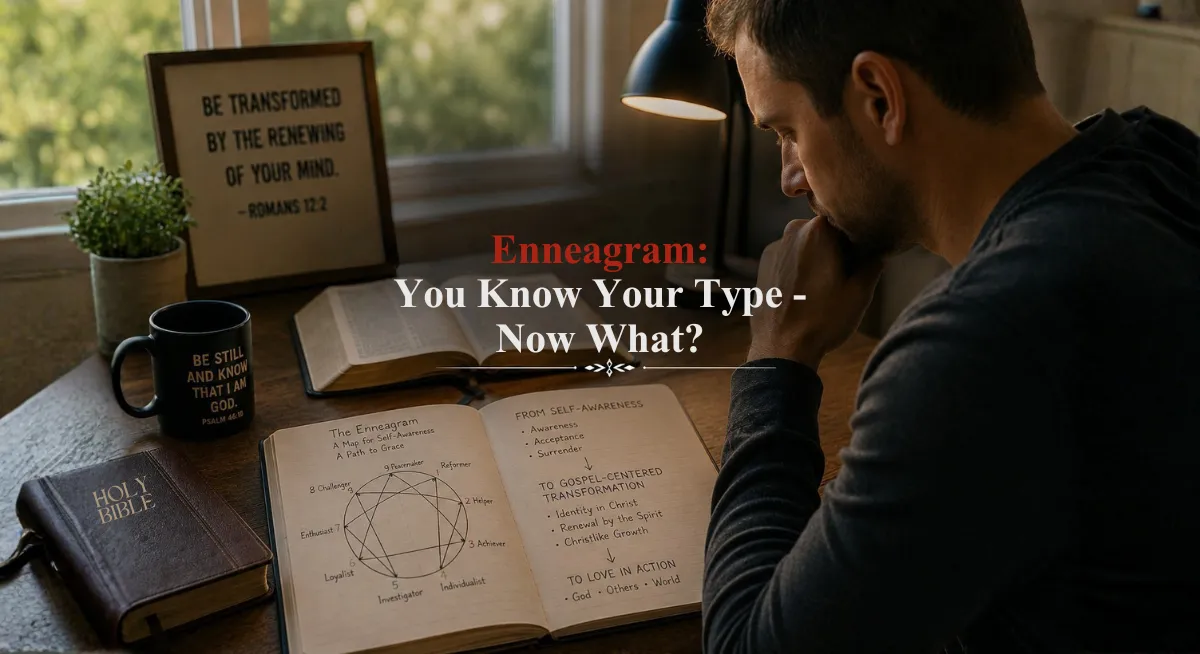
Enneagram: You Know Your Type – Now What?
Turning Self-Awareness Into Transformation
I love it when the email arrives three months after someone took their first iEQ9 assessment. Some version of it comes in every week. "I loved learning my type. It felt like someone finally described me. I've read the book, the blog posts, the chapter on my type. I recognize myself on every page. And I'm looking up, three months in, and honestly not sure I've changed anything. Is this normal?" The answer is “yes,” and the reason is worth understanding, because most Christians who come to the Enneagram stop exactly there and spend the next decade re-reading their type without being formed by it. If you've searched "applying your Enneagram type," "Enneagram not changing me," or "what to do after you know your type," this post is the one I'd hand you across a table. Knowing your type is Step One. The last fifteen years of Christian Enneagram books have been good at Step One. Most Christians have never been taught Steps Two through Ten, and that is where Transformation actually lives.
Quick Answer: Self-awareness is the beginning of Transformation, not the engine of it. You can see your pattern with stunning accuracy and still run the pattern, and most Christians discover this fact at about the three-to-six-month mark after their first Enneagram deep dive. The gap between seeing and being changed is the gap the classical Christian spiritual formation tradition fills, and the tradition has always known that self-awareness is step one of ten, not the whole ten.
The path forward is a four-step pathway, repeated over years, inside the broader rhythms of Scripture, Prayer, community, and service. Notice the pattern in real time. Name it to God in Prayer. Act against the pattern toward the Holy Idea your type most resists. Build rhythms that synthesize it through service. These four steps are where the self-awareness turns into formation, and the P2-Driven Framework holds them inside a life that moves from Clarity through Alignment and Fitness into visible Legacy.
Keep reading for the full breakdown.
And now… the rest of the story.
Why Knowing Your Type Doesn't Change You
A lot of Christians assume, without realizing they assume it, that clear self-knowledge will produce change on its own. You'll see the pattern, the pattern will lose its grip, and a new person will emerge. This is almost never how it works. Seeing a pattern doesn't weaken it. Seeing a pattern clearly while continuing to run it actually strengthens the neural grooves the pattern lives in. Self-awareness without formation produces better-informed autopilot.
The classical Christian tradition has known this for centuries. As we walked through in The Integrative Enneagram and Spiritual Formation, spiritual formation is the long, deliberate, Spirit-led process by which a person is conformed to Christ, and it involves specific practices, real community, sustained time, and embodied participation. The Enneagram diagnoses the pattern with precision. The formation re-patterns it. These are two different kinds of work, and confusing them is why so much Christian Enneagram reading produces insight without Transformation.
Paul wrote about the gap directly. "For I do not do the good I want, but the evil I do not want is what I keep on doing" (Romans 7:19, ESV). Paul knew his pattern. He named it with remarkable clarity. He also kept running it. His solution wasn't more self-awareness. It was Christ in him, formed over time, through the Spirit's re-patterning work. "Wretched man that I am! Who will deliver me from this body of death? Thanks be to God through Jesus Christ our Lord!" (Romans 7:24-25, ESV). That sequence is the whole point. See the pattern, name it, turn to Christ for the re-patterning, participate with the Spirit in the work. Knowing your type well is a gift. It is not a substitute for that sequence.
The Three Common Stalls
Most Christians who stay stuck after learning their type are stuck in one of three specific ways. Naming them usually unlocks the next move.
Stall 1: Identifying with the Type
The type becomes identity. "I'm a Four" or "I'm a Three" starts to function as the self rather than as a description of the autopilot the self has been running. Once the type is identity, it becomes a defense rather than a mirror. You defend it, share it, post about it, wear it. The Enneagram type starts showing up in conversations the way a zodiac sign does, and the self that was supposed to be re-formed in Christ has been quietly narrowed into a nine-flavor personality. As we covered in The Enneagram Isn't the Answer – It's the Mirror, the type is diagnostic, not definitional. Christ is your identity. The type names the pattern that identity is being freed from.
Stall 2: Using the Type to Categorize Others
The Enneagram in the wrong hands becomes a way to label your spouse, boss, mother-in-law, or teenage kid without their consent. This is seductive because it feels like insight and it protects you from having to do the harder work on yourself. Every time you explain someone else's behavior through their type, you are likely avoiding an honest look at your own pattern. The Enneagram is a self-awareness tool. Diagnosis of others is not its purpose, and Christians who spend more time typing others than working their own type almost never grow through the Enneagram. The work is for you. The typing of others is a distraction from the work.
Stall 3: Using the Type as an Excuse
Some Christians use the type to explain why they can't change. "I'm a Seven, so I can't sit with hard things." "I'm a Nine, so I just go along." "I'm an Eight, so my temper is who I am." None of those sentences are Gospel. The Gospel promises Transformation into Christlikeness for every type. The pattern is real, and the pattern is not a life sentence. Any use of the Enneagram that produces resignation rather than agency has slipped into a secular framing that the Christian tradition doesn't endorse.
The Four-Step Application Pathway
Once the stalls are named, the pathway from self-awareness to Transformation has four steps, repeated over years. Each step is simple. The combination across time produces the change that reading your type for ten years never will.
Step 1: Notice the Pattern in Real Time
The first step is catching the pattern while it is happening, not after. A Type 3 notices the image-management pulse mid-email. A Type 6 catches the anxiety spiral at minute four. A Type 9 feels themselves beginning to merge with the opinion in the room. A Type 1 sees the inner critic starting to sharpen. Real-time noticing is the skill, and it is formable through practice. Most Christians I coach develop reliable real-time awareness of their type's pattern within two to four months of deliberate work. Before that, the noticing is retrospective, which is a fine beginning and not yet the full skill.
Step 2: Name and Bring it to God in Prayer
Noticing without naming stays intellectual. The second step is bringing the pattern to God specifically, by name. Not general Prayers about sanctification. Specific Prayers about the specific pattern in the specific moment. "Father, the image-management engine is running again. I confess it. Form Hope in me instead." "Lord, the scan is going. I confess the fear. Form Faith in me instead." "Father, I am disappearing again. I confess the sloth. Form Love in me instead." The specificity is the spiritual practice. Each type has a Passion (the pattern) and a Holy Idea (the Gospel Truth that counters it), and the Prayer names both by name. That's not generic devotional language. It's classical Christian formation Prayer, applied to the specific person God made.
Step 3: Act Against the Pattern Toward the Holy Idea
Naming without acting stays internal. The third step is a small, specific action that moves against the Passion and toward the Holy Idea. A Type 2 receives help rather than offers it. A Type 5 stays embodied in the room instead of retreating to process later. A Type 7 stays with the sadness instead of pivoting to the next idea. A Type 8 softens and yields in a moment they would normally push through. The action is often uncomfortable. The discomfort is the formation happening. The Spirit's re-patterning work usually proceeds through small, repeated counter-actions over long periods of time, and every counter-action weakens the old pattern's grip a little further.
Step 4: Build Rhythms that Sustain the Counter-Action
A single counter-action doesn't form a person. Rhythms do. The fourth step is building the ongoing practices that support the type's specific formation work. Classical disciplines suited to your Center. Scripture read with your type's Holy Idea in mind. Community that notices your patterns and invites you toward them with Love. Sabbath. Confession. Specific accountability. These rhythms are the scaffolding the re-patterning happens on across months and years, and they're what separate the Christian who actually grows through the Enneagram from the one who keeps reading about their type.
How This Looks in Each Center
For full type-by-type breakdowns, see the Complete Guide to the Nine Types. At the Center level, the application looks like this.
Body Center types (8, 9, 1) apply the four-step pathway around the integration of will and yielding. The real-time noticing is usually about the body's impulse to assert, control, or disappear. The Prayer names the anger underneath (even when it looks like Peace or rightness). The counter-action involves softening, receiving, or showing up differently than the instinct would have directed. The sustaining rhythms tend to be fasting, submission, silence, and Sabbath.
Heart Center types (2, 3, 4) apply the pathway around the re-ordering of identity away from image and toward Belovedness. The real-time noticing catches the identity-management pulse (needing to be needed, needed to succeed, needing to be unique). The Prayer brings the shame to Light and receives the Father's specific Love. The counter-action involves hiddenness, Gratitude, or receiving rather than performing. The sustaining rhythms are secrecy, celebration, solitude, and Thanksgiving.
Head Center types (5, 6, 7) apply the pathway around moving from the head into embodied trust. The real-time noticing catches the flight into analysis, the scan for danger, or the leap to the next idea. The Prayer names the fear and casts it on the Father. The counter-action involves physical presence, staying with what is, or acting before the doubt resolves. The sustaining rhythms are embodied Worship, contemplative Prayer, confession, and fixed-hour Prayer.
None of this is comfortable at first. The counter-actions feel foreign by design, because they are precisely the actions your pattern has been organized against for years. The discomfort is the sign that formation is happening, and Christians who stay with the discomfort long enough start to notice that the pattern's grip is loosening in specific rooms of their life.
The Role of Community, Coaching, and Time
The four-step pathway works best inside community, coaching, and time. None of these can be shortcut, and skipping any of them is how Christians stall out at six months.
Community is load-bearing. A spouse, a close friend, a small group, or a spiritual director who knows your type and cares enough to say hard things is worth more than any number of books. The early Church knew this. Spiritual formation has never been a solo project. You need someone who can see what you can't see, name what you're missing in real time, and Love you enough to keep asking the question you've been avoiding.
Coaching accelerates the work. A trained coach or spiritual director can compress years of formation into months by naming the pattern as it's happening and helping you move from step to step without the usual stalls. This isn't a replacement for community. It is an addition to it, and it serves the formation that the community, Scripture, and Spirit are producing. Every serious Christian tradition has had some version of this role, because some version of it has always been needed.
Time is the third factor, and the one Christians most resist. The re-patterning work is slow. Most types require one to three years of steady formation work before the pattern's grip noticeably loosens in specific rooms. The work never fully ends; formation is the shape of a Christian life, not a project with a completion date. What you can expect, with the pathway and the support, is a visible difference within the first year, noticed first by the people who live with you rather than by you. You often feel the same. They notice the change.
Application Through the P2-Driven Framework
The Framework holds the whole pathway in a repeatable architecture.
In Get Clear, you move past surface type-reading into specific diagnosis. You name the Passion, the Holy Idea, and the specific rooms where the pattern runs most visibly in your current season. "I'm a Three" is not clarity. "The Three pattern is running deceit through how I represent my ministry results to the elder board, and it surfaces specifically when I'm tired" is.
In Align with God's Heart, you Surrender the Passion and ask the Father specifically to form the Holy Idea against it. Alignment is specific Prayer, not general devotional language. The Spirit moves in the specific places you let Him. General Surrender produces general growth. Specific Surrender produces specific Transformation.
In Get Fit, you build the rhythms. Classical disciplines suited to your Center. A coach or director who walks with you. Community that knows your pattern and Loves you through it. Scripture read with your type's Holy Idea in mind. Sabbath. Confession. These rhythms aren't optional for lasting formation. They are the structure the re-patterning depends on.
In Live Your Legacy Today, you recognize that your formation is the most visible gift you are giving the rooms you inhabit. Kids who grow up with a parent who has clearly been formed into someone different across their childhood carry a different template into adulthood. Teams that watch a leader be re-patterned in front of them learn to expect the same work from themselves. The Legacy isn't the insight about your type. It is the Christ being formed through the pattern, in the specific rooms the pattern used to run unchecked.
Live Your Legacy Today
The honest word for Christians on Thursday morning is this.
Knowing your type is a gift. It is also not the point. The Gospel promises Transformation into Christlikeness, and the Enneagram, used inside the classical Christian formation tradition, is a precision tool for that Transformation. What most Christians have been missing isn't more information about their type. It's the four-step pathway and the rhythms and the community that turn self-awareness into formed character.
Start with Step 1 this week. Notice the pattern in real time, even once. Bring it to Prayer by name. Take one counter-action. Build one rhythm. Do that again next week. Do it again the week after. Three years from now, the people who live with you will tell you what changed, and the Gospel will have done exactly what it has always been doing: forming Christ in you, one pattern at a time, one Tuesday at a time, for as long as you are willing to participate with the Spirit in the work.
Self-awareness is Step One. Formation is Steps Two through Ten. Notice the pattern. Name it to God. Act against it. Build rhythms that sustain the counter-action. The Gospel does the re-patterning. You do the showing up.
Going Deeper
In my upcoming book, Your Purpose & Principle Driven Life 2.0, the four-step pathway is walked through in full, with type-specific applications, practice plans, and Scripture anchors. The book is a working tool for Christians who are ready to stop reading about their type and start being formed by what the type has been trying to show them. If this post has named something you've been stuck on, the book is the extended conversation this post has been setting up.
What Coaching From AI Bots Misses
A Christian who has learned their type can ask an AI bot for a list of ways to grow through it. The bot will produce a capable summary. The Christian will read it and understand more about their type without being formed by it. The pattern the post opened with, three months in, nothing has changed, is exactly the pattern that more information tends to reinforce rather than interrupt.
The bot can't notice the real-time pattern in your specific Monday morning. The bot doesn't know which counter-action is the one you've been avoiding. The bot can't sit with you in the discomfort that usually surfaces when a Christian starts actually working against their type's strategy for the first time. Formation is relational, embodied, and slow. None of those are qualities a chatbot is positioned to provide.
A coach does what the bot can't. A coach notices the pattern in real time. A coach names the specific counter-action you've been avoiding. A coach sits with you through the discomfort and stays in the room when the old pattern tries to fire back up. That kind of accompaniment is how spiritual formation has always actually happened, and no automated tool is going to substitute for it. The fastest path from self-awareness to Transformation runs through a coach, a director, a mentor, or a wise friend. The slowest path is the one the bot offers, and it is the one most Christians are still on.
→ If you want a coach who will walk with you through the four-step pathway until Transformation actually takes hold, book a discovery call: https://p2driven.com/discovery-call
FAQ: Applying Your Enneagram Type
How long should it take before I see change?
Visible change usually appears within three to six months of committed four-step work, and the people closest to you often notice it before you do. The deeper formation continues across years. Early change often shows up in specific rooms first, a less reactive response at home, a lower-stakes counter-action at work, a moment where the old pattern almost fires and then doesn't. Those small wins accumulate into a visibly different person over time.
What if I can't seem to catch the pattern in real time?
Start with retrospective noticing. Look back at the day and name where the pattern ran. Over time, the noticing moves earlier, from the end of the day, to an hour later, to minutes later, to real time. The skill is formable with practice. Coaching accelerates it significantly because the coach can name the pattern while you're describing a moment you didn't see it in.
Is it wrong to ever mention my type in public or social media?
No, and the question worth asking is why you are mentioning it. Sharing briefly to explain a pattern, invite honest feedback, or point someone toward a tool they may find useful is often fine. Mentioning it often enough that it starts functioning as identity is where the stall begins. A good test is whether you are using the type to be more honest with yourself or to be more interesting to others.
My spouse and I are different types. How do we use this in our marriage?
Work your own type, not your spouse's. The healthiest Enneagram-informed marriages are the ones where each spouse is doing the four-step work on their own pattern, with their spouse as a trusted observer rather than as a target of analysis. Sharing what you are working on, asking for specific help, and receiving the counter-action your spouse has been waiting for you to take is where the Enneagram genuinely serves a marriage. Typing your spouse so you can explain their behavior to yourself is where it harms one.
What if I think I mistyped myself?
Take a proper iEQ9 assessment rather than free online quizzes. Mistyping is common with surface-level tools because the types are motivational rather than behavioral. If the iEQ9 confirms a different type than you first thought, work the new type. The four-step pathway is the same regardless. What matters is the pattern you are actually running, not the one you identified with initially.
