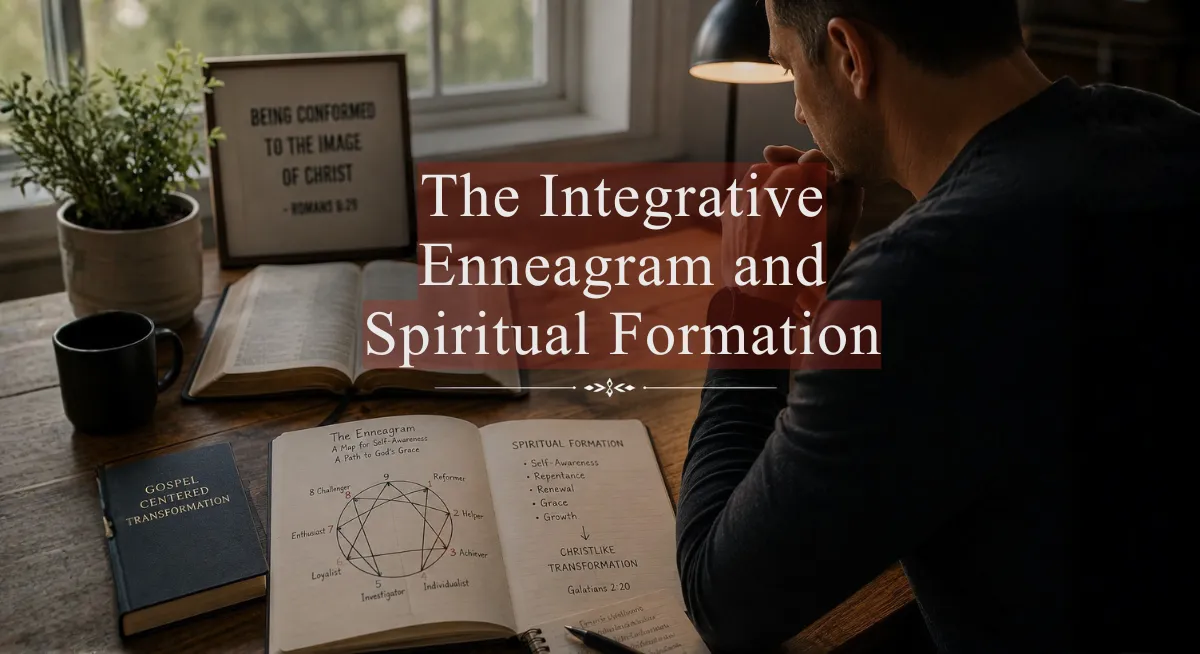
The Integrative Enneagram and Spiritual Formation
How a Modern Diagnostic Tool Recovers an Ancient Christian Tradition
You can meet two different Christians who have both taken the same Enneagram assessment. The first spends a decade studying their type, attending retreats, reading Christian Enneagram books, talking about their wing and subtype at small group, and at the end of the decade knows themselves in remarkable detail. The second spends the same decade letting the type locate the specific sin pattern underneath their autopilot, brings that pattern to daily Prayer, practices spiritual disciplines aimed at that pattern, and at the end of the decade is a different person. Same tool. Same commitment. Radically different outcomes. The difference isn't the Enneagram. The difference is whether the Enneagram was used as a self-knowledge system or inside the Christian spiritual formation tradition. If you've searched "Enneagram and spiritual formation," "Enneagram and Christian Transformation," or "how to use the Enneagram to grow spiritually," this cornerstone post is the one I'd hand you across a table. Used well, inside a Gospel framework, the Enneagram is one of the most precise tools the modern Church has for the specific work of being formed into Christlikeness. Used poorly, it's a nine-flavor personality quiz. Let me walk through the difference.
Quick Answer: Spiritual formation is the long, deliberate process of being conformed to the image of Christ, through the work of the Spirit, inside specific practices, over years. It is not the same as Bible study or even Prayer, though those are part of it. Formation is what Paul described when he said, “we are being transformed into the same image from one degree of glory to another” (2 Corinthians 3:18, ESV). The Gospel saves instantly. Formation takes a life. The modern Church has sometimes confused the two, and the Christians who notice the gap are often the ones looking for tools that make formation specific rather than general.
Every type has a Passion (a characteristic sin pattern that runs the autopilot), a Holy Idea (the specific Gospel Truth that counters it), and a formation pathway (the disciplines and rhythms that open the self to the Spirit's re-patterning work). Used this way, the Enneagram isn't replacing Scripture. It is serving it. The P2-Driven Framework holds the tool in its proper place, and what results is a Transformation more specific, more Gospel-shaped, and more durable than generic formation practice usually produces.
Keep reading for the full breakdown.
And now… the rest of the story.
What Spiritual Formation Actually Is
Most Christians have absorbed a truncated definition of spiritual formation. They imagine it as Bible reading, Prayer, and Church attendance. Those are part of formation, and they are not the whole of it.
Classical spiritual formation is the process by which a person is conformed to Christ over the course of a life. Dallas Willard called it "the process by which the inmost being of the individual takes on the quality or character of Jesus himself." The process involves the Spirit as the agent and the Believer as a participant. It includes specific practices, rooted in Scripture and refined by two thousand years of Christian experience, that open the self to the Spirit's re-patterning work. It doesn't happen automatically. It happens through deliberate, sustained, personal participation with God.
Paul described formation as Transformation by "the renewing of your mind" (Romans 12:2, NIV), and as we walked through in Renewing the Mind God's Way, this kind of renewal is a deep and specific re-patterning of the thoughts, desires, and habits of the whole person. Formation is not primarily about information. It is about being re-made from the inside, across time, in community, through practices that place the self in the way of Grace.
If that definition sounds demanding, it is. It was meant to be. The New Testament doesn't offer a low bar for Christian life. It offers Christlikeness, and it spends most of its pages on what that looks like in practice. The modern Church has sometimes made formation sound optional, or reserved for advanced Christians, or available only through dramatic spiritual experience. None of that matches either the New Testament or the historical tradition. Formation is the shape of a normal Christian life. What the Enneagram adds is specificity about how that life will be formed in your particular case.
Why the Enneagram Fits Spiritual Formation Uniquely Well
A lot of Christians have been taught to be suspicious of personality tools, and the suspicion is often warranted. Most personality frameworks describe behavior without diagnosing the motivations underneath. They tell you how you act without naming what you Worship. The Enneagram is different, and the difference is precisely what makes it useful for formation.
The Enneagram names motivation. It identifies the specific fear that runs your autopilot, the specific strategy you built to manage that fear, and the specific sin pattern the strategy becomes when it runs without grace. That's not a Myers-Briggs description. That's a diagnosis of the heart. Scripture is deeply interested in the heart, and any tool that gives specific access to what the heart is actually doing is useful to the formation work the Spirit is already doing inside a Believer.
As we covered in The Enneagram and Faith: Why Self-Awareness Is a Spiritual Discipline, self-knowledge has been treated as a spiritual discipline in the Christian tradition from the beginning. "Know thyself" predates Christianity, but early Christian writers (John Calvin most famously) insisted that self-knowledge and knowledge of God are inseparable. You can't know what the Gospel is doing in you if you don't know what you need the Gospel to do. The Enneagram is a diagnostic mirror that gives specific names to the pattern requiring Transformation. That specificity is what generic formation advice lacks, and what most modern Christians' spiritual progress has been missing.
The Classical Christian Roots of the Enneagram
This is where Christians often get nervous about the Enneagram, usually because of a half-remembered concern about Sufi mysticism or the Gurdjieff tradition. The historical picture is more interesting than that, and the Christian roots are older and deeper than the modern revival.
Evagrius of Pontus, a fourth-century desert father, developed a list of eight thoughts (logismoi) or characteristic temptations that the monk had to reckon with as part of formation. Pope Gregory the Great, in the sixth century, shaped Evagrius's work into what became the seven deadly sins tradition of Western Christianity. The tradition assumed that specific sins require specific cures, and that the Christian life involves naming the specific pattern most active in your own heart and pursuing the specific virtue that counters it. That pattern of diagnosis-plus-specific-formation is directly inherited by the Enneagram.
The nine-type Enneagram as a personality typology is a twentieth-century development, mostly attributed to Óscar Ichazo and then to Claudio Naranjo, with the Christian adaptation carried by Jesuits, Franciscans, and later by Protestant writers. What emerges in the modern Christian Enneagram, when it is used well, is a recovery of the ancient Christian instinct that sin is not generic. Each person runs a characteristic pattern, and formation works best when it is aimed at that specific pattern.
This is why the Integrative Enneagram (iEQ9), the clinical-grade assessment we use inside the P2-Driven Framework, is particularly well-suited for this work. It is precise enough to support the kind of specific diagnostic that formation requires, and it resists the surface-level personality-quiz quality that makes many Enneagram tools unhelpful. Used inside the classical tradition, it becomes one of the most useful instruments a Christian coach or spiritual director has.
The Three Centers as a Spiritual Formation Lens
As we laid out in The Three Centers of Intelligence: Head, Heart, and Body, the nine types are organized into three Centers, each governed by a core emotion and mapping to a distinct dimension of the person.
The Body Center (Types 8, 9, 1) is the center of instinct and will, where the emotion of anger runs underneath the strategies. The formation work here addresses what the person does with power, boundaries, and expression. Scripture speaks to this Center through the teaching of meekness, gentleness, and submission, not as weakness, but as power under the Father's control.
The Heart Center (Types 2, 3, 4) is the center of image, identity, and relationship, where the emotion of shame runs underneath the strategies. The formation work here addresses what the person does with worth, approval, and belonging. Scripture speaks to this Center through the adoption teaching, the Father's delight, and identity as "children of God" (1 John 3:1, ESV).
The Head Center (Types 5, 6, 7) is the center of analysis, pattern, and planning, where the emotion of fear runs underneath the strategies. The formation work here addresses what the person does with trust, certainty, and control. Scripture speaks to this Center through the Shepherd imagery, the repeated command not to fear, and the teaching of Sabbath rest as trust in God's provision.
The formation pathway is always personal, and it usually includes work in all three Centers, with the primary work happening in the type's home Center. The spiritual disciplines that best support each Center are different, and the integration across Centers is the long work of a lifetime. This is not a failing of the human being. It's the design. God made people whole, and formation restores the whole person.
The Formation Pathway for Each Type
Each of the nine types has a characteristic Passion (the specific sin strategy), a Holy Idea (the Gospel Truth that counters the Passion), and a formation pathway (the disciplines and rhythms that open the self to Transformation). Below is a brief sketch of each. For fuller breakdowns, see the Complete Guide to the Nine Types.
Type 1 – The Strict Perfectionist
Passion: anger, especially self-directed and moralized. Holy Idea: Perfection, already given in Christ rather than achieved through effort. Formation pathway: learning to rest in imputed righteousness, receiving Grace before improving, letting Scripture name holiness as union with Christ rather than performance. Classical disciplines: silence and solitude, Sabbath as radical cessation, confession without self-punishment.
Type 2 – The Considerate Helper
Passion: pride, concealed behind self-sacrifice (the pride of being indispensable). Holy Idea: Freedom, especially the freedom of being Loved without earning it. Formation pathway: learning to receive, allowing others to serve you, hearing the Father say "you were Loved before you ever helped anyone." Classical disciplines: solitude, fasting from helping, rest as an act of trust.
Type 3 – The Competitive Achiever
Passion: deceit, in the form of curated image that has become mistaken for the self. Holy Idea: Hope, the confident expectation that who you are in Christ precedes what you achieve. Formation pathway: hidden practice, good done in secret (Matthew 6), de-coupling identity from output. Classical disciplines: secrecy as a discipline, fasting from reputation-management, Sabbath without accomplishment.
Type 4 – The Intense Creative
Passion: envy, expressed as a persistent sense of being less-than or missing what others have. Holy Idea: Originality, the Father's unique and specific Love for each Believer. Formation pathway: Gratitude as a daily practice, presence to what is rather than longing for what is not, rootedness in the Body of Christ. Classical disciplines: Thanksgiving, Eucharistic presence, journaling Gratitude.
Type 5 – The Quiet Specialist
Passion: avarice, the hoarding of resources (especially mental energy and information). Holy Idea: Omniscience, but God's, not yours. The Father knows all, so you don't have to. Formation pathway: embodied participation, generosity with time and attention, physical presence over observation. Classical disciplines: hospitality, service, physical Worship, embodied Prayer.
Type 6 – The Loyal Sceptic
Passion: fear, often masked as vigilance or responsibility. Holy Idea: Faith and Trust in the Father whose character doesn't betray. Formation pathway: courage through Prayer, Scripture spoken over scenarios, Faithful action in the presence of doubt. Classical disciplines: Psalm memorization, fixed-hour Prayer, communal Worship as anchoring.
Type 7 – The Enthusiastic Visionary
Passion: gluttony, expressed as the consumption of experiences to avoid pain. Holy Idea: Plan, the Father's ordering of time, present presence as enough. Formation pathway: staying with discomfort, naming sorrow without re-framing it, sustained attention to one thing. Classical disciplines: silence, contemplative Prayer, Lenten fasting as acceptance of limit.
Type 8 – The Active Controller
Passion: lust, in its classical sense of intensity and power, not primarily sexual. Holy Idea: Truth, or more precisely, innocence, the strength that bends before God and softens toward the vulnerable. Formation pathway: tenderness, weakness accepted, submission to others' wisdom. Classical disciplines: confession, accountability in community, the discipline of yielding.
Type 9 – The Adaptive Peacemaker
Passion: sloth, not laziness but spiritual inertia, the sedating of the self to maintain external harmony. Holy Idea: Love, the Father's specific Love for the named self. Formation pathway: right action, the courage to show up visibly, daily assertion of preference. Classical disciplines: daily examen, regular declaration of position, taking stands in small matters as rehearsal for large ones.
Traditional Spiritual Disciplines by Center
Classical spiritual formation has always known that different dispositions require different practices. The disciplines aren't interchangeable. What re-patterns a Type 5 is not what re-patterns a Type 7, and assigning one set of practices to every Christian is why so much formation work stalls.
For Body Center types (8, 9, 1), the disciplines that tend to do the most work are those that soften will and open the self to being acted upon by God. Fasting. Sabbath. Submission. Service. Silence. These disciplines interrupt the Body Center's natural impulse to assert or control, and teach the self to be receptive to the Spirit's movement rather than driving everything.
For Heart Center types (2, 3, 4), the disciplines that most help are those that root identity outside the gaze of others and inside the Father's Love. Secrecy. Solitude. Celebration. Rest. These disciplines interrupt the Heart Center's pull toward image and let the true self, the one hidden with Christ in God, become load-bearing rather than the curated self.
For Head Center types (5, 6, 7), the disciplines that do the most work are those that move the self from the head into embodied, present-moment participation with God. Confession. Contemplative Prayer. Embodied Worship. Physical presence. These disciplines interrupt the Head Center's flight into analysis and bring the self back into the room with the Spirit.
The practices overlap across Centers, and the integration is the long work. No Christian grows by doing only the disciplines suited to their type. Over a lifetime, formation calls the whole person into practices that are genuinely uncomfortable for their native Center, and the discomfort is the formation doing its work.
Common Pitfalls in Enneagram-as-Formation
The Enneagram used well is a gift. Used poorly, it produces a particular set of problems that have become common enough to name. As we covered in The Enneagram Isn't the Answer, It's the Mirror, the core error is treating the tool as the source of Transformation rather than a diagnostic that serves it. A few specific pitfalls follow from that error.
Using the Enneagram as Identity
The type is diagnostic, not definitional. A Christian whose identity is anchored in "I'm a Four" has substituted a personality type for the self hidden with Christ in God. The Enneagram should make you more aware, not more defined by what it names.
Typing Other People without Their Consent
The Enneagram's precision becomes weaponized when it is used to categorize a spouse, coworker, or child without invitation. Typing is a self-awareness tool for the self, and the diagnostic work belongs to the person doing the formation, not to the observers around them.
Substituting Self-Knowledge for Transformation
The first Christian in this post's opening portrait spent a decade studying their type without being changed by what they saw. That is the most common Enneagram failure in modern Christianity. Knowing your pattern doesn't change it. Practices aimed at your pattern, over years, with the Spirit's help, inside community, do change it.
Using the Enneagram Instead of Scripture
Scripture is primary. The Enneagram is a tool. Any use of the Enneagram that displaces the Word, the Spirit, or the Church has moved beyond its proper role. The Enneagram serves Scripture. It doesn't compete with it, and treating it as a replacement produces a self-aware Christian who is still undiscipled.
Spiritual Formation Through the P2-Driven Framework
The Framework holds the tool in its proper place and turns formation into a repeatable architecture.
In Get Clear, the Enneagram locates the pattern. Your type, wing, subtype, and Passion get named with precision. This is the diagnostic work, and it needs to be specific. "I struggle with sin" is not a diagnosis. "My Type 3 Passion runs deceit through my career, specifically in how I represent my results to my board," is.
In Align with God's Heart, the Holy Idea meets the Passion. You stop asking God generally to make you better and start asking Him specifically to form the Holy Idea of your type against the Passion of your type. Lord, form Hope in me against deceit. Form Love in me against sloth. Form Faith in me against fear. Alignment is Gospel-specific rather than generic.
In Get Fit, the classical disciplines aimed at your type and Center become your rhythm. You stop doing everyone else's formation practice and start doing the specific practices the Spirit uses most reliably to re-pattern your particular autopilot. Fitness here is formation fit to the self God made.
In Live Your Legacy Today, the re-patterned life becomes visible. A Christian who has been formed over years through this kind of specific, Gospel-anchored, type-aware work becomes a recognizable presence in their family, workplace, and church. The Legacy isn't the type. It's the Christ who has been formed in the specific person God made. That's what the Enneagram has always been aiming at, in its Christian uses, since the desert fathers first named the thoughts they had to reckon with.
Live Your Legacy Today
The honest word for Christians on Thursday morning is this.
You don't need another personality-quiz answer. You need formation. Formation is slow, specific, Spirit-led, community-supported, and unmistakable over years. The Enneagram, used inside the classical Christian tradition and anchored to Scripture, accelerates that work by making it specific to the person God actually made rather than the generic Christian no one actually is. Your type is not your destination. Christ is. The Enneagram is one of the clearest mirrors the modern Church has for showing you exactly what the Spirit is re-patterning, and that clarity, over a lifetime, produces a Transformation most Christians still think is out of reach. It isn't. It is specific, repeatable, and available, and this post has been a map toward it.
The Enneagram used inside the Christian formation tradition is a precision tool. It names the exact pattern the Spirit is already at work against, and it hands you the exact disciplines most likely to open you to the re-patterning that produces Christ in you.
Going Deeper
In my upcoming book, Your Purpose & Principle Driven Life 2.0, a full extended section is given to spiritual formation by Enneagram type, with detailed rhythms, Scripture, and classical practices for each of the nine. The book is a working tool for Christians who want formation to be specific and sustained rather than general and episodic. If this cornerstone has named something you've been looking for, the book is the extended conversation this post has been setting up.
What Coaching From AI Bots Misses
A Christian interested in Enneagram-based spiritual formation can ask an AI bot for a comprehensive guide and will receive something impressively long. It will describe the types, the Passions, the Holy Ideas, the classical disciplines, and a reasonable summary of the tradition. The Christian will read it at 9:47 p.m. in a browser tab, feel well-informed, and close the tab. Nothing will be formed.
The bot can't walk with you over years. The bot can't notice when the Type 3 Passion is running through your ministry in a specific way this quarter, or when a Type 6 is about to let fear drive a decision the Spirit is asking them to wait on, or when a Type 9 is disappearing again from their own marriage. Formation is embodied, specific, slow, relational, and Spirit-led. None of those are things a chatbot is positioned to provide.
A coach does what the bot can't. A coach sees the specific pattern moving through this week, names it without shaming it, walks with you into the classical practice that addresses it, and stays in the room across months as the Spirit does the re-patterning work. That kind of companionship is the ancient Christian pattern of the spiritual director, updated for modern life, and it remains the work no automated tool will ever replace.
→ If you want a coach who uses the Integrative Enneagram inside the classical Christian formation tradition, book a discovery call: https://p2driven.com/discovery-call
FAQ: The Enneagram and Spiritual Formation
Is the Enneagram Biblical?
The Enneagram isn't in the Bible. Neither is Myers-Briggs, DISC, or any modern personality tool. The question is whether its use is compatible with Scripture, and whether the diagnostic it offers serves or competes with Scripture's authority. Used as a tool inside a Gospel framework, the Enneagram is compatible and often useful. The ancient Christian tradition of the eight thoughts and seven deadly sins is older than most denominations, and the modern Enneagram inherits that diagnostic instinct. Scripture remains primary. The Enneagram serves it.
Does every Christian need the Enneagram to grow spiritually?
No. Christians have been formed into Christlikeness for two thousand years without it. The Enneagram is a tool that makes formation more specific for those who use it well. It is not a requirement, and treating it as one would be a category error. Some Christians flourish in formation without ever taking an Enneagram assessment. What matters is the formation, not the instrument.
Aren't Passions and Holy Ideas just renamed virtues and vices?
Essentially, yes, and the continuity is the point. The Enneagram as a Christian formation tool stands in the same tradition that developed the seven deadly sins and their corresponding virtues. The update is the specificity. Rather than saying sloth is a human temptation in general, the Enneagram identifies sloth as the particular Passion of Type 9 and pairs it with right action as the Holy Idea that counters it. Same tradition. More precise application.
What about claims that the Enneagram has occult or New Age roots?
The modern Enneagram was synthesized by figures outside the Church, and some of those figures held views Christians would disagree with. The same is true of many intellectual tools Christians use daily, from medical science to psychology to economics. The question is what you do with the tool, not whether every figure in its history was a Believer. The Christian use of the Enneagram today, particularly in its Integrative form, is rooted in classical Christian formation categories and accountable to Scripture. The tool's misuse elsewhere doesn't disqualify its Faithful use here.
Where should I start if I want to use the Enneagram for formation?
Take a proper iEQ9 assessment rather than a free quiz. Read The Enneagram and Faith for the foundational framing. Study your specific type deeply, including its Passion and Holy Idea. Begin with one or two classical disciplines suited to your Center. Find a coach, spiritual director, or mentor who can walk with you over months rather than in a single conversation. Stay in Scripture, Prayer, and community. Formation is the work of a lifetime, and the first year of intentional formation will often feel slower than the decade of study the first Christian in this post's opening portrait went through. The slower version is the one that actually forms Christ in you.
