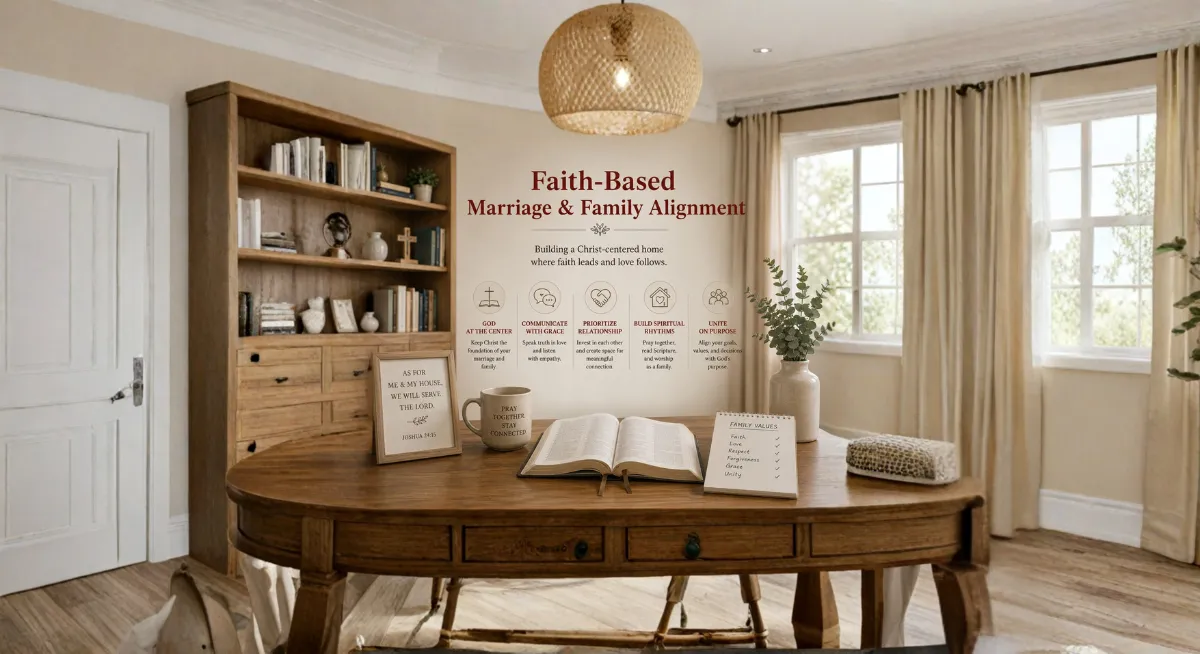
Faith-Based Marriage & Family Alignment
The Cornerstone Guide to Building a Marriage and Family That Walk in the Same Direction
If you've searched phrases like “faith-based marriage and family alignment,” “biblical marriage and family,” or “how to align your family with God,” you're probably not looking for another list of parenting tips or date-night ideas. You've read those articles. You've tried those suggestions. And somewhere underneath the advice, you know that the real question isn't tactical, it's directional. A marriage and a family aren't two separate projects you're running side by side. They're one system. When the marriage drifts, the family feels it. When the family fractures, the marriage absorbs it. Faith-based Alignment is what holds both together, not through better communication skills or stricter rules, but through shared direction toward God. This is the full Cornerstone guide, the framework for building a marriage and family that walk in the same direction across every season life throws at them.
Get the Gist Quick
Short version, because if you're reading a long post about marriage and family, you're probably already tired.
Most Christian families aren't in crisis. They're in drift. Two people who love each other, who love their kids, who love God, and who somewhere along the way stopped checking whether they were all headed toward the same thing. Careers accelerate. Kids' schedules swell. Ministry obligations pile up. Nobody announces the drift. It just happens, one unprotected evening at a time.
The fix isn't more effort. It's Alignment. Shared direction toward God, expressed through shared rhythms, shared submission to His design, and shared responsibility for the Legacy you're building whether you meant to or not.
Faith-based marriage and family Alignment rests on four pillars that match the P2-Driven Framework. You Get Clear on where you're actually headed. You Align with God's Heart for marriage and family specifically. You Get Fit by building rhythms that make Alignment sustainable. And you Live Your Legacy Today, in small decisions that nobody else notices but that shape the family your kids remember.
Here's the whole picture, because if you're going to do this work, you need the whole map.
And now… the rest of the story.
Why Marriage and Family Are One System, Not Two
Let's start with what most Christian advice gets wrong.
Marriage advice usually treats the marriage as a standalone project. Schedule date nights. Learn love languages. Use “I” statements. Prioritize each other. Family advice usually treats the family as its own project. Have family dinners. Lead devotions. Set clear rules. Spend quality time. Both tracks are useful. Both tracks miss the same thing.
The marriage is the keel of the family. It's the submerged structure that everything else is balanced on. When the keel is sound, the boat absorbs rough water. When the keel is compromised, no amount of deck maintenance matters. Your kids might not be able to articulate what's off when the marriage is drifting, but they can feel it. It shapes how safe they feel, how emotionally regulated they become, how they learn to handle conflict, and what they'll unconsciously reproduce in their own future homes.
In Functional Families That Aren't Thriving, we walked through how a family can run smoothly on the outside while quietly going hollow at the core. The activities happen. The schedule holds. Everyone shows up. And underneath, something essential has gone missing. That's what drift looks like from the inside, and it almost always starts in the marriage.
That's not meant to be condemning. It's meant to be clarifying. If you want a thriving family, you have to tend the marriage. If you want a marriage that lasts, you have to let the family it's raising be part of the test of whether the marriage is Aligned. The two can't be separated in practice, even when we try to separate them on paper.
The Four Pillars of Faith-Based Family Alignment
Here's the framework. Four pillars, each of which maps to a phase of the P2-Driven Framework. Families thrive when all four are present. Families drift when one or more go missing.
Pillar 1: Shared Direction (Get Clear)
Alignment starts with a question most families never stop to ask. Where are we actually headed? Not the calendar. Not the to-do list. Not the five-year career plan. Where is this marriage and this family headed as a shared project, over the arc of the lifetime God has given us?
Most Christian couples assume they're Aligned because they share Faith, values, and vocabulary. That assumption is how drift starts. Shared Faith doesn't automatically produce shared direction. Two people can both be Christians, both love Jesus, both read their Bibles, and still be running their home in two different directions because they've never sat down and named the direction together. As we explored in Marriage as Spiritual Alignment, the strongest marriages aren't built on compatibility. They're built on a compass heading, and the compass heading has to be explicit to be useful.
Clarity in a marriage and family sounds like specific conversations most couples avoid. What is this family for? What are we trying to build? What kind of adults are we raising these kids to become? What does God seem to be asking us to be to each other in this season? What does He seem to be asking us to be for the world together? These aren't dinner-conversation questions. They're anniversary-trip questions. They're off-site questions. They're conversations that require enough stillness and space to actually hear the answers.
Families that have these conversations don't necessarily agree on everything, but they know where they're headed. Families that don't have them drift, not because anyone's a bad person, but because unexamined direction always becomes someone else's direction. Culture decides. The school calendar decides. The career trajectory decides. And the family ends up somewhere it never chose.
Pillar 2: Shared Submission (Align with God's Heart)
The second pillar is the hardest, because it requires something modern culture has trained all of us out of. Both spouses, submitted to a Lord bigger than either of them. Paul's instruction in Ephesians is pointed here. “Submit to one another out of reverence for Christ” (Ephesians 5:21, NIV). Mutual submission isn't a suggestion. It's the posture that makes everything downstream possible.
When both spouses are genuinely submitted to Christ, the family has a third voice that's louder than either of the parents. That voice doesn't belong to the husband or the wife. It belongs to the One they've both agreed precedes them. That matters more than it sounds, because it means the conflicts in the marriage don't get resolved by whoever has more leverage. They get resolved by whoever can best name what God is asking in this specific moment.
That's a different family than most people grew up in. In most homes, the strongest personality sets the tone, or the money sets the tone, or the most exhausted parent sets the tone on any given night. In an Aligned family, the tone is set by shared submission. Nobody wins. Everyone listens. And the kids learn early that both parents answer to someone bigger than themselves.
This is also the pillar that makes repair possible. When someone messes up, shared submission means the correction doesn't come from the other spouse. It comes from the Lord both spouses have agreed to listen to. That removes the power struggle. It also means the offender doesn't have to be defensive, because they're not being corrected by their rival. They're being corrected by the One they already trust to have their best interests in mind.
Shared submission isn't weakness. It's the structural reason strong marriages survive the storms that break weaker ones.
Pillar 3: Shared Rhythms (Get Fit)
The third pillar is where most good intentions break down. Rhythms.
Alignment isn't a one-time decision. It's a set of protected practices you return to, week after week, year after year, whether you feel like it or not. These are the load-bearing structures that hold a marriage and family together when life's weight falls on them unexpectedly.
There are four rhythms every Aligned family needs. They're not the only ones. They're the essential ones, without which the Alignment collapses quietly over time.
A weekly marriage check-in. Fifteen minutes, no screens, no logistics. Just two honest questions: How are you doing? and How are we doing? This one rhythm catches drift before it calcifies. It's not dramatic. It's directional.
A shared Prayer rhythm. Not performative. Not scheduled like a meeting. Just honest. Something shifts when spouses stop Praying past each other and start Praying together about the things they're actually afraid of. Walls come down that no communication technique can dismantle.
A protected family Sabbath rhythm. One day a week where the tyranny of the urgent gets benched. No catching up. No meetings. No productivity. Just being a family. If a Sabbath feels impossible, that's probably the clearest sign you need one. The family that can't stop is the family being formed by what won't stop.
A regular recalibration rhythm. Two or three times a year, a longer conversation, ideally away from home, about where the marriage and family are. What's working? What isn't? What does God seem to be asking of us in this season? Without this rhythm, the drift just accumulates.
These rhythms aren't tips. They're load-bearing structures. The families I've watched thrive across decades had these rhythms. The families I've watched fall apart almost always had one or more of them missing long before the crisis hit.
Pillar 4: Shared Legacy (Live Your Legacy Today)
The fourth pillar is the one that integrates everything else. Legacy isn't what you leave behind. Legacy is what you're building today, in small decisions that nobody flags as historic but that shape the family your kids will remember.
Every family is leaving a Legacy whether they mean to or not. Your kids are already absorbing how you handle conflict, whether you apologize when you're wrong, how you treat your spouse when you're tired, whether Faith produces intimacy in your home or just coexistence, what gets your attention first in the morning, and what gets your energy last at night. They're taking notes you're not writing, and someday they'll hand those notes to their own spouses and kids.
Aligned families carry their Legacy consciously. Unaligned families carry it accidentally. Both are real. The first builds what the parents intended. The second builds what nobody would have chosen on purpose.
Legacy work in the present tense sounds like specific questions. What are we teaching our kids about God through the way we live? What are we teaching them about marriage through how we treat each other? What are we teaching them about Faithfulness through our presence? What are we teaching them about Grace through how we handle failure? These questions aren't academic. They get answered every day, by the thousand small choices that accumulate into the family culture your kids will one day call home.
Four Common Misalignments Families Don't See Coming
Here's what the breakdown usually looks like from the inside. These aren't the dramatic failures. These are the slow ones, the ones that catch families off guard because they don't show up in any of the metrics we usually track.
Misalignment 1: Parallel Faith, Separate Directions
Both spouses are Christians. Both attend Church. Both believe the right things. But they're not praying together, not processing Scripture together, not making decisions together about how their shared Faith shapes their shared home. They're running parallel spiritual lives in the same house, and the family is quietly growing up without a visible Alignment between the two adults at its center.
The kids notice. They may not name it, but they pick up the signal that Faith is private, not shared. When they become adults making their own Faith decisions, they'll often replicate the pattern, practicing individually without ever learning how Faith lives out in a marriage.
Misalignment 2: Calendar Drift
The calendar is the most honest theological document in the house. It shows what actually matters, whatever you say matters. When the kids' activities start eating into marriage time, ministry starts eating into family time, and work starts eating into everything else, the family's stated values and lived values separate. Nobody decided this. Everyone contributed.
In Drift in Marriage, we named how marriages come apart through a thousand small decisions nobody flags as dangerous. The calendar is where most of those decisions get made. A family with an Aligned calendar is a family with Aligned priorities. A family whose calendar runs them is a family being run by whoever writes the schedule.
Misalignment 3: Uneven Submission
One spouse has submitted deeply to Christ and is growing. The other is running on Christian habits without much active Surrender. The Aligned spouse is quietly carrying both the spiritual weight and the relational weight of the home, and resentment starts building even though neither spouse quite sees it yet.
This one is hard because the less-Aligned spouse isn't doing anything obviously wrong. They're just coasting on the momentum of previous decisions instead of actively growing. The Aligned spouse has to resist the urge to pull the other forward through pressure. The work is Prayer and invitation, not coercion. The unAligned spouse has to resist the urge to let the other carry what both were meant to carry together.
Misalignment 4: The Ministry Trap
The family is doing great, from a public-facing ministry perspective. They serve. They lead. They host. They mentor. Other families look up to them. And behind closed doors, the parents haven't had a real conversation in three months, the kids are angry and don't know why, and everyone is exhausted. The ministry has become the identity. The home has become the overlooked cost.
This one is especially dangerous in pastoral families, missionary families, and Christian leader families, but it shows up in any home where visible ministry becomes a substitute for private Alignment. The fix isn't less ministry. The fix is more Alignment, which sometimes requires less ministry for a season while the family catches up with the schedule it's been running.
What Alignment Looks Like in Different Seasons
Alignment isn't one thing. It takes different shapes in different seasons of family life. The rhythms stay the same. The expression shifts.
Season 1: Young Kids (0-10)
This is the fatigue season. Sleep is short. Bandwidth is thin. The marriage has to get protected intentionally, because there's no margin for it to happen automatically. Alignment in this season looks like a ten-minute check-in after the kids are in bed, not a three-hour date night you're too tired to enjoy.
Family Alignment in this season is less about deep conversations and more about tone. Kids are learning how the family feels before they can articulate what it teaches. A calm tone, a consistent bedtime, a predictable rhythm of meals and prayers, a Sabbath that actually slows down, these are the Alignment work of the young-kid years.
Season 2: School-Age and Tweens (10-14)
This is the observation season. Kids are watching more than participating. They're absorbing how the parents handle conflict, money, extended family, disappointment, and Faith doubt. The marriage rhythms become visible to the kids in this season, even when the kids don't comment on them.
Alignment in this season looks like modeling repair. Apologize in front of the kids when you've snapped at your spouse. Let them see the marriage being tended in real time. Don't fake Alignment. They can tell, and they're building their own marital expectations on what they observe.
Season 3: Teens (14-19)
This is the pressure season. The kids are now pushing on the family's stated values to see if they hold up. The marriage gets tested against bigger stakes, college decisions, identity questions, Faith wrestling, dating conversations, disagreements about discipline, and the simple fact that teenagers naturally destabilize family rhythms.
Alignment in this season looks like presenting a unified front even when you disagree privately, then processing the disagreement with your spouse later. It also looks like genuine humility, owning the places where you got it wrong in earlier seasons, and inviting the teen into the ongoing work of building an Aligned family rather than presenting a finished product.
Season 4: Launching and Empty Nest
This is the recalibration season. The marriage that was held together by the shared project of raising kids now has to rediscover why it's together. Many marriages struggle here, not because the marriage is bad but because the shared project has quietly been the kids for twenty years, and now the project is gone.
Alignment in this season looks like asking the direction question fresh. What's this marriage for now? What's God asking of us in this chapter? How do we stay involved in our adult kids' lives without imposing? What Legacy do we want to keep building with the years we have left?
Couples who have been doing the Alignment work all along move through this season more smoothly. Couples who haven't often hit a crisis here, because the absence of the kids exposes the absence of Alignment that was there the whole time.
Why the Gospel Holds Everything Else Together
Here's the part that matters more than the framework.
None of these pillars work without the Gospel at the center. Shared direction collapses into competing agendas without a shared Lord. Shared submission becomes resentment without shared Grace. Shared rhythms become performance without shared Faith. Shared Legacy becomes anxiety without shared hope.
The Gospel is what makes the whole structure livable. “Therefore, as God's chosen people, holy and dearly loved, clothe yourselves with compassion, kindness, humility, gentleness and patience. Bear with each other and forgive one another” (Colossians 3:12-13, NIV). Paul wrote that to a community, but it maps onto a marriage and family as directly as anything in Scripture.
An Aligned family isn't a family without conflict. It's a family whose conflicts are processed through the Gospel. Forgiveness is practiced. Grace is extended. Repair is modeled. Mistakes are absorbed without breaking the whole structure, because the structure was never the people. The structure was always the Gospel the people were both standing on.
That's the part that sustains Alignment across decades. Not better techniques. Not more discipline. The Gospel, received daily, extended daily, lived daily, by two spouses who have both stopped trying to be their own saviors.
When to Get Professional Help
One caveat before we close. Alignment work isn't a substitute for clinical help when clinical help is needed. If your marriage has wounds that are actively bleeding, abuse, addiction, infidelity, untreated trauma, or mental health conditions affecting the relationship, start with counseling. As we explored in Christian Marriage Coaching vs. Counseling: Which Do You Actually Need?, coaching and counseling aren't interchangeable. Wounds need healing. Drift needs direction. Know which one you're dealing with and get the right help for the right problem.
Many families need both. A counselor for the clinical work. A coach for the Alignment work. The sequence usually runs counseling first, coaching second, as the wounds stabilize and the family rebuilds direction on healthier ground. There's no shame in needing both. The shame is in refusing help that would have worked.
Live Your Legacy Today
Here's the Tuesday morning version of all this.
You don't have to build a perfectly Aligned family. You can't. Nobody can. What you can do is build an Aligned family that repairs faster than it drifts, that returns to direction after it wanders, that extends Grace without keeping score, and that keeps submitting to the Lord bigger than both spouses through every season life throws at the home.
The work starts tonight, not next month. Ask your spouse the two honest questions. Pray one honest Prayer together before bed. Notice one thing in the calendar that's taking more from your marriage than it's returning. Name one rhythm you've let slip. Repair one place you've been quietly cold.
Small decisions. Made Today. Repeated Tomorrow. For the rest of your life together.
That's how Aligned families are built. Not by getting it perfect. By getting it pointed in the right direction and refusing to stop re-pointing every time drift shows up.
Going Deeper
In my upcoming book, Your Purpose & Principle Driven Life 2.0, we walk through the Alignment work of marriage and family in significantly more depth. The book unpacks how the Get Clear, Align, Get Fit, and Live Your Legacy Today phases apply to both spouses individually and to the marriage and family collectively, with practical rhythms, Scriptures, and conversation guides for every season. Faith-based marriage and family Alignment is one of the central themes of the book, because it's one of the primary places the Framework gets tested in real life. It's not available yet, but this series is the conversation it's designed to extend.
What Coaching From AI Bots Misses
An AI bot can generate you a beautifully worded family mission statement in ninety seconds. It can draft conversation guides for your next anniversary trip, create a family rhythms plan with time blocks, and produce a pristine list of Scriptures on marriage and parenting. What it can't do is sit with you and your spouse when one of you is quietly crying and the other doesn't know why.
That's where the actual Alignment work happens. A coach notices when one spouse goes quiet on the hardest question. A coach names the pattern in the marriage that neither of you could see from inside it. A coach stays in the room while the two of you work through the conversation you've been avoiding for six months, and helps you keep working through it until the avoidance ends and the Alignment begins.
Families aren't rebuilt by plans alone. They're rebuilt by honest conversations, held by somebody trained to hold them, over enough time to rewire the habits that got you drifting in the first place. An AI bot can give you a plan. A coach walks with you as you live it out.
→ If you're ready to do Alignment work in your marriage and family, book a discovery call: https://p2driven.com/discovery-call
FAQ: Faith-Based Marriage & Family Alignment
What does “faith-based family alignment” actually mean?
Faith-based family Alignment is the ongoing practice of building a marriage and family that are moving in the same direction toward God. It rests on four pillars: shared direction (clarity about where you're headed), shared submission (both spouses submitted to Christ together), shared rhythms (protected practices like check-ins, Prayer, Sabbath, and recalibration), and shared Legacy (conscious awareness of what you're building today). It's not a program. It's a posture the family returns to, week after week, across every season.
How is family Alignment different from family devotions or Bible study?
Devotions and Bible study are practices. Alignment is the underlying direction the practices serve. A family can do devotions every night and still be misAligned if the parents' marriage is drifting, the calendar is running the home, or the Gospel hasn't shaped the emotional tone of the house. Devotions are a good rhythm. Alignment is what makes the rhythm produce actual Transformation rather than just religious habit.
We're busy. Where do we even start?
Start with a fifteen-minute weekly marriage check-in. Two questions: How are you doing? How are we doing? No logistics. No screens. That's it. This one rhythm catches drift before it calcifies and tends to surface everything else that needs attention over time. If you can't find fifteen minutes a week, that's not a time problem. That's a priority problem, and the fifteen minutes will help you see it.
My spouse isn't as spiritually engaged as I am. How do I do this work without pushing?
Carefully, and mostly through Prayer and example. Pressure produces resentment, not Alignment. Invite your spouse into specific rhythms rather than calling them to abstract change. Start with the easiest rhythm first, usually a weekly check-in, and build from there as trust grows. Some spouses come slowly. Some come through watching. Some come through crisis. Your job is Faithfulness, not results, and the Spirit is almost always doing work you can't see in the spouse you're concerned about.
What if we've already drifted significantly? Can we recover?
Yes, almost always, if both spouses are willing. Drift accumulates slowly, and recovery usually takes longer than the drift did, but the direction can change. The work starts with honesty, naming where you actually are, not where you wish you were, and then building one rhythm at a time. Many families have made this turn. A trained coach can accelerate the process significantly. If there are clinical issues in the mix, counseling comes first. If it's pure drift, coaching works.
Does this work if only one spouse is Christian?
Shared submission to Christ requires both spouses. If only one spouse is Christian, the Alignment work shifts into a different shape. The Christian spouse can still practice personal rhythms, pray for their spouse, serve the family well, and maintain their own walk with God. Full family Alignment as described here requires both spouses' cooperation. Paul addressed this reality in 1 Corinthians 7:12-14, where he encourages the Christian spouse to remain in the marriage and live faithfully, trusting God with the outcome. A good coach or pastor can help navigate the specifics.
How long does it take to align a family?
Alignment is a direction, not a destination. Real change in marriage and family dynamics usually takes twelve to eighteen months of consistent Alignment work to feel substantial, and years to become the new normal. Small changes happen faster. Deep changes take time. The good news is that the process itself is meaningful, every faithful week builds something real, even when the visible markers feel slow.
What if my spouse won't do any of this?
This is harder, and worth taking seriously. Start with what's within your own control. Individual coaching or counseling for yourself can help you clarify what you can change, what you can't, and how to love your spouse well in a season where they aren't engaging. Sometimes one spouse doing the work becomes the slow catalyst for the other to join later. Sometimes it doesn't. Either way, your own growth isn't wasted, and neither is your Faithfulness.
