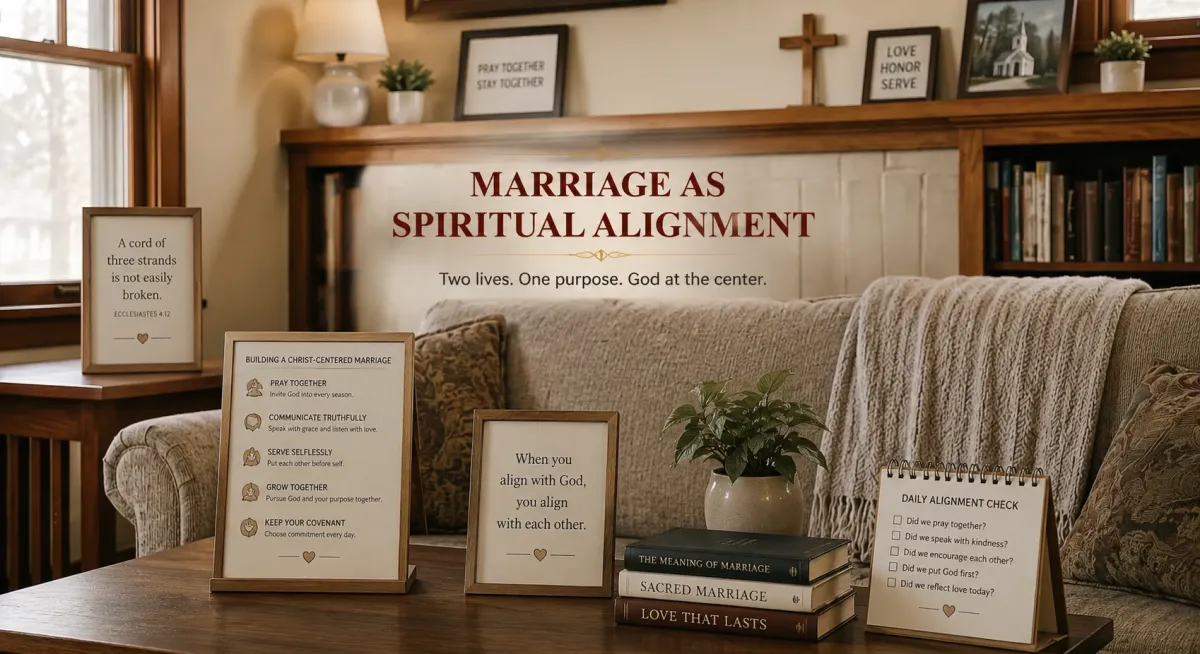
Marriage as Spiritual Alignment
Why the Strongest Marriages Aren’t Built on Compatibility – They’re Built on Shared Direction Toward God
If you’ve searched phrases like “Christian marriage alignment,” “marriage as discipleship,” or “spiritual growth in marriage,” you’re probably not looking for another date-night tip sheet. You’re looking for something underneath the tips. Something that explains why two people who love God and love each other can still feel like they’re building separate lives under the same roof. The answer isn’t more romance. It’s more Alignment – the kind that treats your marriage as a spiritual practice, not just a relational one.
Get the Gist Quick
Here’s the short version, because I know you’ve got about ninety seconds before something pulls your attention sideways.
Your marriage started with Alignment. You were pointed in the same direction, Praying the same Prayers, dreaming the same dreams. Then life happened, not in one dramatic collapse, but in a thousand small decisions that nobody flagged as dangerous. Careers expanded. Kids arrived. Responsibilities multiplied. And at some point, the marriage that used to be the mission became the thing that survived between missions.
Most people try to fix that with effort. More talks. More dates. More trying. And effort isn’t wrong, but it’s incomplete. Because the issue was never how hard you were trying. The issue was what you were oriented toward. When two people are individually chasing God but never checking whether they’re chasing Him together, you get two parallel spiritual lives in the same house. Faithful. Busy. Disconnected.
Marriage as spiritual Alignment means something different. It means your marriage isn’t a contract to maintain. It’s a covenant to steward. It means discipleship doesn’t just happen in small groups and quiet times. It happens at 10 p.m. on a Tuesday when you choose honesty over avoidance. It happens when you Pray together – not eloquently, just honestly. It means the strongest marriages aren’t the ones with the best communication skills. They’re the ones where both people keep turning toward God together, especially when turning toward each other feels hard.
If that sounds like what you’re after, the rest of the story goes deeper.
And now… the rest of the story.
The Myth of Compatibility
Somewhere along the way, the culture convinced us that the foundation of a good marriage is compatibility with shared interests, similar personalities, and aligned love languages. That stuff is great, of you have it – it’s just insufficient.
Compatibility is a starting condition. Alignment is an ongoing practice. You can be wildly compatible on paper and still drift apart when life gets heavy, because compatibility doesn’t tell you what to do when your spouse is grieving and you don’t know what to say. It doesn’t tell you how to navigate a financial crisis when you’re both afraid. It doesn’t tell you who leads when neither of you can see the next step.
In Marriage Drift and Realignment, we walked through how drift doesn’t announce itself. It shows up in small, polite erosions, the Prayers you stopped sharing, the stress you stopped splitting, the vulnerability you replaced with efficiency. Compatibility didn’t prevent any of that, direction did.
The couples who stay close over decades aren’t the ones who matched perfectly at the altar. They’re the ones who kept orienting toward the same thing, and that thing wasn’t each other. It was God.
Marriage as a Discipleship Relationship
Here’s the reframe most Christian marriage conversations miss: your marriage is a discipleship relationship. It’s not a business partnership with romantic benefits or a coparenting arrangement with shared finances. It’s a discipleship relationship of two people who are actively shaping each other’s formation in Christ.
Paul describes it in Ephesians 5 with language the Church has debated for centuries, but the core of it is unmistakable: “Submit to one another out of reverence for Christ” (Ephesians 5:21, NIV). Before the passage ever gets to husbands and wives, it starts with mutual submission, two people oriented under the same authority, choosing deference over dominance, service over self-interest.
That’s not a management strategy. It’s a spiritual posture, and it changes everything about how you approach conflict, decision-making, forgiveness, and growth inside a marriage. When your marriage is a discipleship relationship, disagreements aren’t just relational problems to solve. They’re formation opportunities. When your spouse sees a blind spot you can’t, that’s not criticism, it’s the kind of sharpening Proverbs 27:17 talks about. When Forgiveness costs you something, that’s not weakness, it’s The Cross showing up in your living room.
A few months ago, we explored how Jesus reduced the entire Law to two commands: Love God. Love People. Everything else hangs on those. Marriage is where that framework gets tested daily. It’s easy to Love God in a worship service. It’s harder to Love your spouse when they’ve hurt you and haven’t apologized yet. It’s easy to Love people in theory. It’s harder to love the specific person who forgot to switch the laundry and left the garage open for the third time this week. That’s where Faith gets formed and Love becomes real.
What Spiritual Alignment Actually Looks Like
Spiritual Alignment in marriage isn’t a mystical feeling. It’s a set of observable, practicable postures that two people choose to hold together. Here’s what it looks like when it’s working:
Shared Prayer That’s Honest, Not Performative. This is the single most underutilized rhythm in Christian marriages. Couples Pray before meals, Pray at Church, and Pray over their kids, but rarely Pray together, alone, and vulnerably. Something shifts when you stop performing for God and start talking to Him together about the things you’re afraid of, the things you’ve failed at, and the things you can’t control. Walls come down that no counseling technique can dismantle.
Mutual Confession Without Weaponization. James 5:16 says to confess your sins to each other and Pray for each other so that you may be healed. That’s a discipleship practice, not a relational luxury, but it only works in an environment where confession leads to Prayer instead of ammunition. If your spouse confesses a struggle and you bring it up in the next argument, you’ve just guaranteed they’ll never confess again. Alignment requires safety, and safety requires trust.
Decisions Filtered Through “What is God asking us to do?” Instead of “What do I want?” This one sounds simple until you’re staring at a job offer that would double your income but uproot your family or deciding whether to take the promotion that demands sixty-hour weeks. When both people bring those decisions to God together, not just independently, the quality of the decision changes, not because God sends a neon sign, but because seeking His direction together keeps you oriented toward the same compass heading.
A Rhythm of Realignment, Not Just Resolution. Most couples wait until something breaks to have a real conversation. Aligned couples build in regular check-ins that catch drift early. We talked about this in What Your Calendar Teaches Your Family – your calendar reveals your real priorities. A weekly fifteen-minute check-in with no screens and no logistics does more for a marriage than most couples realize. It’s not dramatic. It’s directional.
The Covenant Underneath the Relationship
Here’s where this gets theological, and it should, because marriage is theological.
“Therefore what God has joined together, let no one separate” (Mark 10:9, NIV). That’s not a rule. It’s a design statement. God didn’t design marriage to be managed. He designed it to be stewarded as a covenant that reflects something about His character to the world.
Covenant changes the operating system. In a contract, you perform because you’re obligated. In a covenant, you serve because you’re committed. In a contract, failure triggers consequences. In a covenant, failure triggers Grace, not cheap Grace that ignores the wound, but costly Grace that chooses repair over retreat.
When your marriage operates on covenant instead of contract, Forgiveness isn’t optional and vulnerability isn’t risky – they’re required. The goal isn’t to avoid conflict. It’s to let conflict refine you instead of dividing you. That’s spiritual Alignment, two people under the same covenant, moving toward the same God, being shaped by the same Spirit, even when they disagree about where to eat dinner.
Ecclesiastes puts it in structural terms: “Though one may be overpowered, two can defend themselves. A cord of three strands is not quickly broken” (Ecclesiastes 4:12, NIV). That third strand isn’t decorative. It’s load-bearing. When God is woven into the structure of your marriage, not just referenced on Sundays, but operationally present in the Tuesday decisions, the marriage holds weight it couldn’t carry alone.
Live Your Legacy Today
Your marriage is modeling something right now. Your kids are watching how you handle stress together. Your friends are observing whether your Faith produces intimacy or just coexistence. Your Church community is absorbing whether the Gospel makes marriages thrive or just survive.
The Legacy of your marriage isn’t formed at the anniversary party. It’s formed on a random Wednesday when you choose curiosity over criticism, when you Pray together even though you’re exhausted. It grows when you say “I was wrong” before anyone asks you to, and when you protect fifteen minutes of connection in a week that’s trying to squeeze it out.
That’s Legacy in the present tense. That’s spiritual Alignment with skin on it. It doesn’t require perfection. It requires direction with two people who keep turning toward God together, especially when turning toward each other feels costly.
Your marriage wasn’t designed to survive on compatibility. It was designed to thrive on Alignment. Start with that.
Going Deeper
In my upcoming book, Your Purpose & Principle Driven Life 2.0, there’s an entire chapter on what happens when marriage operates on covenant Alignment instead of contractual obligation and why the shift from managing a relationship to stewarding a discipleship partnership changes everything downstream. The book walks through how to rebuild shared spiritual practices, how to move from parallel lives to a unified mission, and how to build rhythms that keep Alignment from becoming another thing on the list. It’s not available yet, but this post is the conversation it’s designed to start.
What Coaching From AI Bots Misses
An AI can define covenant theology in seconds. It can list twelve principles for a healthy Christian marriage and generate a communication framework before you finish your coffee. What it can’t do is sit in the room when you and your spouse are trying to say something honest and the words won’t come. It can’t feel the weight of what’s unsaid between two people who love each other and have slowly stopped knowing each other.
Spiritual Alignment in marriage isn’t an information problem. It’s a presence problem, the kind that requires a coach who understands what’s underneath the silence and knows how to help you build something in it. AI can outline the theology. It can’t walk with you through the application.
→ If you’re ready for that conversation, book a discovery call: P2Driven.com/discovery-call
FAQ: Marriage and Spiritual Alignment
What does spiritual Alignment in marriage mean?
Spiritual Alignment means two people actively orienting their marriage toward God, not just individually pursuing Faith, but building shared spiritual practices, shared decision-making rhythms, and a shared mission rooted in covenant. It’s the difference between two people who happen to attend the same Church and two people who are discipling each other daily.
How is this different from marriage counseling?
Marriage counseling typically addresses conflict resolution and communication patterns. Spiritual Alignment coaching goes underneath those to address direction – what your marriage is oriented toward and whether both people are pulling in the same direction. It’s not therapy. It’s a framework for building a covenant marriage that reflects God’s design.
What if my spouse isn’t interested in spiritual Alignment?
You can’t force Alignment, but you can model it. Start with your own posture by Praying for your spouse, rebuilding your own rhythms of fitness, and inviting conversation without pressuring. Often, when one person begins to genuinely change, the other takes notice. Alignment begins with one person choosing to orient toward God and trusting that He’s capable of moving in both hearts.
Does spiritual Alignment mean we have to agree on everything?
No. Alignment isn’t agreement on every issue. It’s agreement on direction. You can disagree about parenting approaches, financial priorities, or how to spend a Saturday and still be aligned if both of you are bringing those disagreements to God together and seeking His wisdom over your own preferences.
