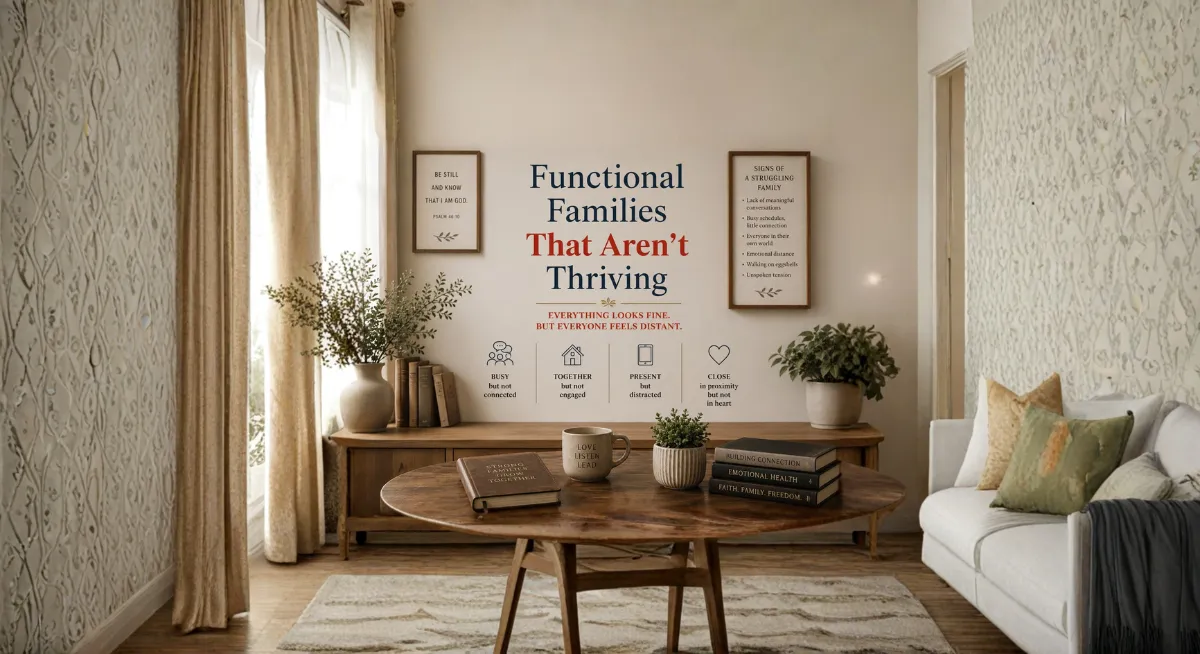
Functional Families That Aren’t Thriving
When Everything Works on Paper and Nothing Works in the Room
If you’ve been searching for why my family feels disconnected, Christian family coaching, or family not thriving despite success, you’re not looking for a parenting hack or a family devotional plan. You’re looking for an honest answer to a question that’s been sitting in your chest for a while now: why does a family that looks this good feel this hollow? The mortgage is current. The kids are in good schools. Sunday mornings happen. Nobody’s in crisis, but something underneath all of it feels thin, like you’re managing a household instead of building a home.
Get the Gist Quick
Here’s the short version, because you’re probably reading this between carpool and a conference call.
Your family is functional. Congratulations! The bills are paid, the calendar is full, the kids are fed, and nobody’s calling a counselor. From the outside, it looks like you’ve got it together. From the inside, it feels like you’re running a small corporation with people who share your last name.
Functional isn’t the same as thriving. Functional means the system works. Thriving means the people inside the system are actually known, connected, and growing. Most Christian families are so busy being functional that they’ve quietly stopped being intentional, and the distance between those two words is where families slowly come apart.
The problem isn’t effort. You’re not lazy, disengaged, or careless. The problem is Clarity. You’ve been so focused on keeping things running that you haven’t stopped long enough to ask whether what’s running is actually what you want to build. That’s a Get Clear question, and it’s the doorway to everything else.
And now… the rest of the story.
The Family That Works but Doesn’t Connect
There’s a family most people would admire. Two working parents or one at home and one in the office. The kids in activities with Church on Sunday. Vacations are planned. Dinner happens, even if it’s in shifts. The house is clean enough. The report cards are solid. The family Christmas card looks great.
Nobody’s worried about this family. That’s the problem.
Because underneath the functionality, something is quietly eroding. Not dramatically in a way that makes the news or triggers a pastoral visit. It’s just a slow thinning of connection that everybody feels and nobody names.
The parents talk about logistics more than they talk about each other. The kids know their schedules better than their parents’ stories. Dinner conversation, when it happens, sounds more like a status update than a relationship. Everyone’s accounted for but nobody is deeply known.
That’s the gap between functional and thriving, and it’s wider than most families realize.
How Good Families Drift Without Noticing
Family drift doesn’t require a villain. It doesn’t need an affair, an addiction, or a bankruptcy. It just needs busyness left unchecked long enough to become the family’s operating system.
Here’s what the drift looks like in real time: Conversations shrink from dreams to logistics. “What do you want to be when you grow up?” becomes “Did you finish your homework?” Nobody decided to stop asking the deeper questions. The schedule just squeezed them out.
Presence gets replaced by proximity. You’re in the same house but not in the same moment. Phones are open. Screens are on. Bodies are near each other, but attention is somewhere else entirely. The family is together in geography and apart in every way that matters.
Spiritual rhythms become spiritual logistics. Family devotions, if they happen at all, feel like another item on the to-do list. Prayer before meals is recited, not lived. Church attendance is tracked like a metric instead of experienced as worship. The Faith of the household becomes functional instead of formational.
In What Your Calendar Teaches Your Family, we named the uncomfortable Truth: your calendar reveals your real hierarchy of values, not the one you profess but the one you practice. If someone printed your family’s last ninety days and laid it on the kitchen table, what story would it tell? Would it tell the story you intend to live, or the one you’ve drifted into?
The Cost Nobody Calculates
Here’s what functional families rarely stop to measure: the relational cost of sustained efficiency.
Your kids are learning what adult life costs. They’re watching your pace, your stress, your availability, and your priorities. They’re forming conclusions about what love looks like under pressure, what Faithfulness produces, and whether the life you’re building is one they’d want to inherit.
We addressed this head-on in What Burnout Teaches the People Watching You: your exhaustion isn’t private. It radiates. The people closest to you are absorbing it whether you’ve said a word about it or not. That principle doesn’t just apply to burnout. It applies to the entire pace and posture of your family life.
If the curriculum of your home teaches efficiency over intimacy, productivity over presence, and scheduling over spontaneity, your kids will graduate from your household believing that’s what Love looks like. They won’t remember your quarterly targets. They’ll remember whether you looked up when they walked into the room.
That’s not a guilt trip. I’m not interested in shame. I’m interested in Clarity, because once you see what’s actually being taught, you can change the lesson.
Get Clear: Name What’s Running Your Home
The first step isn’t a new family devotional plan or a chore chart overhaul. The first step is Clarity. You can’t rebuild what you haven’t honestly assessed, and most functional families have never paused long enough to ask the hard questions.
Start here:
What is our family actually organized around? (Be honest. If the answer is “the kids’ activities,” that’s data, not a verdict.)
When was the last time we had a conversation that wasn’t about logistics?
Do my kids know what I Believe, or do they just know what I schedule?
Is our Faith something we practice together, or something we attend separately?
If this pace continued for five more years, what kind of family would we become?
Those questions aren’t meant to shame you. They’re meant to expose the operating system so you can decide whether it’s the one you actually want running your home. Clarity isn’t comfortable. It’s the doorway.
Align with God’s Heart: Rebuild the Mission
Once you’ve named what’s running the house, the next step is Alignment, not more effort or another system. It’s Alignment with the heart of God for your family.
God didn’t design the family to be a logistics operation. He designed it to be the primary formation environment for human beings. “Start children off on the way they should go, and even when they are old they will not turn from it” (Proverbs 22:6, NIV). That verse isn’t about finding the right curriculum. It’s about building a home where formation happens naturally, through presence, rhythms, and lived Faith.
Alignment in a family context means answering one question together: What kind of people are we becoming under this roof? I’m not talking about what kind of achievements are we collecting or schedules are we managing but what kind of people, character, and Love live here.
That’s a conversation most functional families have never had, because the schedule hasn’t left room for it. Alignment creates the room.
Get Fit: Build the Rhythms That Form a Family
Fitness in a family isn’t about adding more activities. It’s about building rhythms that sustain the connection your family needs to actually grow.
In Burnout Recovery for High-Functioning Christians, we explored the difference between relief and recovery, and between adding more habits and subtracting what’s draining you. The same principle applies to your family. Before you add a family devotional or a weekly game night, ask what you need to subtract first. What commitment is bleeding your family’s time? What activity exists because of guilt, not Calling? What obligation sounds noble but produces nothing except another line on the calendar?
Subtraction creates space. Space creates margin. Margin creates the possibility of actual connection.
Then protect the rhythms that matter. One device-free meal a day. One real conversation per week that isn’t about logistics. One Sabbath practice with actual boundaries. One moment every evening where someone in your house feels genuinely seen.
These aren’t dramatic interventions. They’re architectural decisions. They’re just small, repeated, and compounding decisions over time into a family culture that forms people instead of just producing schedules.
Live Your Legacy Today: What Your Home Is Teaching Right Now
Legacy isn’t something you leave at the end. It’s something your family is absorbing right now, through your patterns, pace, and presence.
If your home teaches that busyness equals importance, your kids will inherit that theology. If it teaches that vulnerability is weakness, they’ll carry that into every relationship they build. If it teaches that Faith is something you attend instead of something you live, they’ll treat God the way they learned to: as a scheduled appointment, not a daily reality.
But if your home teaches that presence outranks performance, that questions are welcome, that rest is holy, and that people matter more than productivity, your kids will carry that into adulthood. They won’t just know what you Believed. They’ll know what it looked like when someone actually lived it.
You’re already building a Legacy. The only question is whether you’re building it by design or by default.
Going Deeper
In my upcoming book, Your Purpose & Principle Driven Life 2.0, the family is treated as the primary formation environment for the P2-Driven Framework. The book walks through how Clarity exposes the operating system running your household, how Alignment rebuilds a shared family mission rooted in Scripture, how Fitness creates the sustainable rhythms that form character over time, and how Legacy transforms when you stop managing a household and start building a home. It’s not available yet, but this post is a window into the conversation the book is designed to deepen.
What Coaching From AI Bots Misses
An AI bot can generate a family devotional plan, a chore chart, and a communication framework in thirty seconds. All of it will be formatted neatly, technically sound, yet missing the point entirely.
Because the issue in a functional-but-not-thriving family isn’t information. It’s the conversation nobody’s having. It’s the question that’s been sitting in the room for months while everybody steps around it. It’s the moment when one parent looks at the other and says, “I don’t think this is working,” and the other one doesn’t flinch.
A coach creates space for that conversation. Not because they have all the answers, but because they’re not inside the system. They can see what the people inside it can’t. An algorithm doesn’t do that. A relationship does.
→ If you’re ready to move your family from functional to thriving, book a discovery call: https://p2driven.com/discovery-call
FAQ: Functional Families That Aren’t Thriving
What’s the difference between a functional family and a thriving one?
A functional family meets its obligations. Bills are paid, schedules are managed, responsibilities are covered. A thriving family does all of that while also maintaining genuine connection, spiritual formation, and intentional presence. Functional is about the system working. Thriving is about the people inside it growing.
How do I know if my family is drifting?
If your family conversations have shrunk to logistics, if spiritual rhythms feel like obligations instead of anchors, if everyone’s accounted for but nobody’s deeply known, those are drift signals. The simplest test: when was the last time someone in your house asked a question that wasn’t about the schedule?
Is this a parenting problem?
Not exclusively. Family drift is a structural problem, not a parenting failure. It’s usually caused by sustained busyness, unexamined priorities, and the slow erosion of intentional rhythms. It’s a Clarity problem first, then an Alignment problem, then a Fitness problem.
Can faith-based coaching help with family alignment?
Yes. Faith-based coaching creates a structured space for families, or the parents leading them, to name what’s actually happening, clarify what they want their home to model, and build sustainable rhythms that support genuine connection. A coach helps you see the operating system you’ve been running without realizing it.
Where do I start if my family feels functional but not connected?
Start with one honest conversation. Not a lecture, not a family meeting, and not a new plan. One conversation where you say, “I think we’re running well, but I’m not sure we’re growing.” That’s Clarity. Everything else builds from there.
