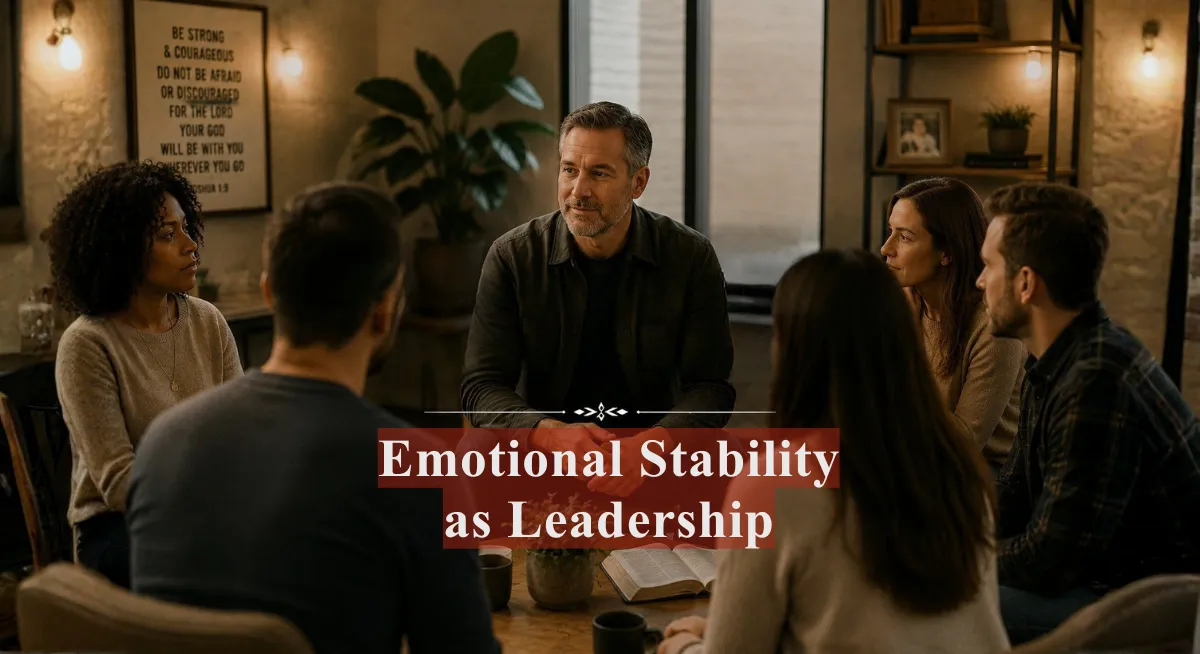
Emotional Stability as Leadership
Why Your Nervous System Is the Weather of Every Room You Lead
The senior leader you remember most vividly from your first job isn't remembered for the decisions they made. You remember how they acted when things went sideways. The morning the quarterly numbers came in wrong. The night the hospital called. The meeting where a junior employee was in tears. The board phone call at 6 p.m. on a Friday. What that person's face did, what their voice did, what their body did in the middle of pressure, is what you absorbed about leadership, and you've been unconsciously copying it or reacting against it ever since. It's not a workplace phenomenon. It's a universal human pattern. Kids watch their parents the same way. Congregations watch their pastors. Teams watch their managers. The nervous system of the leader is the weather system of the room they lead. If you've searched "emotional stability leadership," "Christian leadership emotional regulation," or "why do leaders lose their composure," this post is the one I'd hand you across a table. Emotional stability isn't the absence of feeling. It is the Spirit-fed capacity to regulate feeling so the rooms you lead can breathe, and it is the most durable Legacy a Christian leader leaves behind.
Quick Answer: Leaders are watched far more for their emotional responses than their decisions. A family, team, congregation, or company eventually forgets most of the decisions a leader made. They do not forget the tone of voice on the hardest days. That tone gets absorbed into the nervous systems of everyone in the room, and they carry it forward into their own leadership, their own parenting, and their own rooms. That is not a soft claim. It is the single most reliable pattern of how leadership shapes the people on the receiving end of it.
The work is formable, not merely personality-dependent. Most Christians in leadership have never been trained in the rhythms that build emotional stability. They inherited their emotional defaults from a family of origin, a stressful season, an undiagnosed wound, a body run on insufficient sleep, or some combination of all of those. None of that is permanent. The P2-Driven Framework, applied with Get Clear honesty and Get Fit discipline, forms emotional stability that holds in the rooms where it matters most. That stability becomes the Legacy you leave, longer after the decisions are forgotten.
Keep reading for the full breakdown.
And now… the rest of the story.
What Emotional Stability Actually Is
Most people assume emotional stability is calmness, but that’s only part of it. A fully-sedated person is calm. That is not the Christian virtue we’re looking for.
Emotional stability is the capacity to feel what is real without being ruled by it. You notice the flash of anger, the spike of anxiety, the wash of sadness, the disappointment, the fear, and you respond from a ground underneath those emotions rather than being moved around by them on the surface. Feeling is not suppressed. Feeling is present, named, and stewarded. Paul's "self-control" is not the muting of feeling. It is the integration of feeling with action that reflects the Spirit's formation, not the amygdala's reaction.
The shorthand I use with leaders is this. Emotional stability is your nervous system under the Spirit. The nervous system is involved, because regulation is physiological before it is merely moral. The Spirit is involved, because lasting regulation is not willpower. It is Transformation. Any approach that works on one without the other produces a stoic leader with a brittle shell or a spiritual leader who keeps surprising their people with outbursts. The Christian pattern is both, and it is formable across time.
Why Leaders Lose It
Emotional stability breaks down in predictable ways, and naming them is the beginning of repair. Most Christian leaders I've coached who struggle with composure are running some combination of these five engines.
Sleep Deprivation
The nervous system becomes a different organ on five hours of sleep for three consecutive nights. Decisions get worse, patience shortens, emotions get bigger and closer to the surface. Most leaders underestimate how much of their stability is simply physiological. A rested leader is a different person than a tired one, and Sabbath is the Christian tradition's way of refusing to let you forget that.
Chronic Stress Without Margin
A leader with too much input and not enough space to process becomes reactive by default. The overloaded nervous system hands control to the amygdala, and reactive emotion runs the room. As we walked through in Emotional Fitness Under Pressure, pressure is not the enemy of stability. Pressure without margin is. Leaders who don't protect margin discover the cost in their relationships before they recognize the cause.
Unhealed Wounds Surfacing Sideways
When a present moment triggers an old wound, the reaction is disproportionate to the present cause. The sharp exchange with a colleague isn't about the colleague. It is about a pattern from a father, a coach, a former boss, a first marriage. Unhealed wounds leak into leadership until they are named and worked through, and Christian leaders are often the slowest to do this work because they have over-spiritualized their emotional life.
Isolation Without Safe Relationships
A leader with no one to tell the Truth to eventually becomes a leader who tells the Truth to the wrong person at the wrong moment. The release valve wasn't there for the pressure, so the pressure blew through a weaker seam. As we covered in Christian Mental Health Coaching, community is not a soft comfort. It is load-bearing infrastructure, and its absence destabilizes even strong leaders.
Identity Anchored to Performance
A leader whose identity rises and falls with how today went is a leader whose emotional baseline depends on outcomes they don't fully control. Every bad day becomes an existential threat. Every critique becomes a referendum. Every slow quarter becomes a crisis of self. That engine will crack the composure of any Christian given enough time. The fix is not a better coping strategy. It is an identity reordered around being Loved by the Father before anything is ever accomplished.
The Gospel Foundation: Christ's Emotionally Integrated Life
Scripture gives Christian leaders a model that most books on leadership ignore. Jesus had the fullest emotional life of any human being on record, and the most integrated response to it.
He wept openly at Lazarus's tomb (John 11:35). He was "moved with compassion" when He saw the crowds (Matthew 9:36, KJV). He was angry in the Temple and turned over the tables, and did not lose His composure with the Pharisees who tried to trap Him. He asked the Father to take the cup from Him in Gethsemane, and submitted to it anyway. He slept in the back of a boat in a storm that terrified His fishermen disciples. The range is wide, and the response is consistently from ground, not from reactivity. That is emotional stability in its fullest form.
Paul wrote from that tradition. "Be angry and do not sin; do not let the sun go down on your anger" (Ephesians 4:26, ESV). Notice the order. Anger is permitted. Action from anger is stewarded. The sun going down on it is guarded against. That sentence is a whole theology of emotional integration, written to ordinary Believers, not elite leaders. Emotional stability is the normal Christian life, and Christian leadership is simply that formation put into a seat that lots of people are watching.
Peter's encouragement is worth naming too. "Humble yourselves, therefore, under the mighty hand of God so that at the proper time he may exalt you, casting all your anxieties on him, because he cares for you" (1 Peter 5:6-7, ESV). The anxiety is real. Peter doesn't pretend it isn't. He directs it somewhere. That directing is the spiritual practice underneath emotional stability. Leaders who cast their anxieties habitually are leaders whose rooms are quieter, because the anxiety isn't leaking into the rooms from the leader's unprocessed interior.
What Rooms Learn From an Unstable Leader
This is the hardest paragraph to write honestly, and it is the one that most moves Christian leaders I coach to take this work seriously.
Every room led by an emotionally unstable leader learns the same lesson over time. The people in the room learn to manage the leader. They become experts at reading the leader's mood, editing what they bring forward, protecting the leader from information that might produce a reaction, and softening the Truth until the leader can receive it without losing their composure. The leader doesn't usually see this happening. The people around them do, and they carry the cost quietly. As we walked through in What Your Marriage Is Modeling, the nervous system of the adults in a home becomes the emotional climate the kids develop in. The same is true of a workplace, a ministry, and a board.
What looks like respect or deference in a room with an unstable leader is often something else. It is the room protecting itself. The kids save the hard stories for the other parent. The team stops bringing the bad data to the meeting. The board omits the uncomfortable question from the agenda. The spouse stops mentioning the concern. The leader, meanwhile, interprets the calm as evidence that everything is fine, and the composure continues to erode in private while the room performs stability around them. That pattern is avoidable, and naming it is the first step toward avoiding it.
Emotional Stability Through the P2-Driven Framework
The Framework gives stability an architecture it can be built on.
In Get Clear, you name which of the five engines is running in you: Sleep, Margin, Unhealed Wounds, Isolation, and Performance-Based Identity. One or two will ring immediately. Clarity is naming the specific mechanism rather than resolving to be calmer in general. I need to be more patient is not a diagnosis. I am running on six hours of sleep and no margin, and my wounds from my father surface under criticism is. The specific named engine is what formation works on.
In Align with God's Heart, you Surrender the engine to the Father and ask Him specifically to form the Fruit of the Spirit in that exact place. Father, form self-control in me where sleep has been missing. Form Peace in me where identity has been performance. Form patience in me where the wound is still open. Prayer that specific invites specific re-patterning, and the Spirit does work in named places that He rarely does in general.
In Get Fit, you build the rhythms. Sleep protected like a spiritual discipline, because it is one. Margin reclaimed even at the cost of output. Professional help for the wound that has been running the leadership. One or two trusted friends who can tell you the Truth. Prayer rhythms where anxiety is cast on the Father before it leaks into the room. Fitness here is physiological and spiritual at once, and both are required.
In Live Your Legacy Today, you recognize that your stability is what your people remember. Decisions get forgotten. Strategies get replaced. What stays in the nervous systems of your spouse, kids, team, and congregation is how you handled the hardest moments. A leader whose emotional stability held through pressure leaves a Legacy that compounds in rooms the leader never sees, generations after they are gone.
Rhythms That Build Emotional Stability
A handful of rhythms do most of the work:
Protected Sleep
Seven to eight hours consistently, treated as a spiritual discipline rather than a productivity loss. A leader who sleeps is a leader whose nervous system has the capacity to be regulated. Skipping this rhythm makes every other rhythm less effective.
Daily Margin
Fifteen to thirty minutes of unscheduled space daily, ideally in silence or contemplative Prayer, where the nervous system can down-regulate from the day's input. Leaders who run from meeting to meeting to email to kitchen to conflict with no margin are guaranteed to leak reactivity by 8 p.m.
A Pause Between Rrigger and Response
The old Christian practice of breath Prayer works here. When the trigger lands, take a breath, Pray "Lord, have mercy" or "not my will, but Yours," and respond from the ground underneath rather than the surface reaction. Even two seconds of pause changes what the room receives.
Regular Casting of Anxiety
Peter's instruction is a daily practice, not a one-time event. Hand the anxieties to the Father in Prayer every morning. Name the specific ones. Give them over. A leader whose anxieties have been cast doesn't need the room to carry them.
Professional Support for the Wound
A counselor, therapist, or trained coach for the unhealed places that leak sideways into leadership. This is not a failure of Faith. It is the Christian tradition's oldest form of soul care updated with modern clinical tools, and it has saved more Christian leaders than any leadership book.
One Truth-Telling Friendship
Someone outside the hierarchy who can notice when the composure is starting to slip and say so early. Isolated leaders are unstable leaders. The cost of finding one honest friend is lower than the cost of not having one.
These rhythms will feel inefficient before they feel transformative. That's the signal you're doing them correctly.
Live Your Legacy Today
The honest word for Christian leaders on Monday morning is this.
Your nervous system is the weather of every room you lead. Your spouse is adjusting to it. Your kids are adapting to it. Your team is shaping their work around it. Your congregation is absorbing it every Sunday. You don't get to opt out of that pattern. You only get to choose whether the weather you produce is the one God had in mind for those rooms or the one your wounds, sleep deprivation, and unhealed places have been producing instead.
Emotional stability is formable. It is Spirit-given, practice-sustained, community-supported, and physiologically grounded. Most Christian leaders I coach could be in a different place within a year of naming the engine and committing to the rhythms. The Legacy you leave isn't the last strategic plan. It is the last Tuesday your kids watched you hold your composure in a hard moment, and the thousand Tuesdays like it that formed the way they'll hold theirs.
The leader's nervous system is the weather the room is growing in. Emotional stability isn't a personality trait. It's a Legacy, formed by the Spirit, protected by rhythm, and remembered longer than any decision you'll ever make.
Going Deeper
In my upcoming book, Your Purpose & Principle Driven Life 2.0, a full section is given to emotional stability as leadership formation, with specific rhythms, Scripture, diagnostics, and practices suited to the particular ways different personalities lose composure. The book was written for Christians in leadership who want stability to be an actual formed characteristic of their life rather than a performance they hope holds in public moments.
What Coaching From AI Bots Misses
A Christian leader can ask an AI bot for a list of emotional regulation techniques and will receive a capable summary. The bot will offer breathing exercises, a reading list, and a few Scripture references. The leader will read the list at 11:38 p.m. and try the breathing exercise once during the next conflict, which will land better than it would have without the breath. The underlying pattern will continue.
The bot can't see the specific engine driving your instability. The bot doesn't know your father raged at you when you were seven, or that your oldest kid looks like him, or that the sleep problem is tied to an anxious pattern you haven't named yet. The bot can't ask the uncomfortable question that unlocks the next stage of formation. The bot won't notice that you've been performing stability for three weeks while the real engine is still running underneath. Formation work happens in the specific, and it happens in relationship.
A coach does what the bot can't. A coach watches the pattern over months. A coach names the engine by its actual name. A coach sits with you through the shame that comes up when you see what the rooms have been absorbing. A coach walks beside you into the specific rhythms that build stability in your specific person, and holds you accountable to them across the seasons where the old engine wants to fire back up. That kind of companionship is how Christian leadership formation has always actually worked, and no automated tool substitutes for it.
→ If you want a coach who will help you form the kind of emotional stability the rooms you lead are waiting for, book a discovery call: https://p2driven.com/discovery-call
FAQ: Emotional Stability and Christian Leadership
Is emotional stability a personality trait or a formable skill?
Both. Some people have a baseline temperament that is easier to work with. The skills, rhythms, and Spirit-formed self-control that produce lasting stability are formable across every personality type, with different paths for different people. A high-reactivity personality can grow into deep stability through the right formation. A calm personality can still leak instability through specific unhealed places. Personality is not destiny.
How do I know if my instability is hurting my family, team, or congregation?
Ask them and listen without defending. Ask your spouse to describe what they pay attention to in your mood. Ask your closest team member what topics get softened before they reach you. Ask your oldest kid what they wish the ordinary Tuesday at home sounded like. The answers will usually be diplomatic and specific, and they will be accurate. Your people already know. You have simply not asked in a way that invites Truth.
I have tried to be more patient and keep failing. What am I missing?
You are probably working on the response without addressing the engine. Reactivity that keeps returning is usually being fueled by one of the five engines: sleep, margin, wound, isolation, or identity. Patience practice alone cannot overcome a body that has been sleep-deprived for three years, a wound that is still fresh, or an identity still running on performance. Name the engine. Address the engine. The patience will follow.
Is it un-Christian to consider the body and nervous system in spiritual formation?
No. The Incarnation is the theological opposite of that concern. God entered a body. Paul called presenting the body a form of "spiritual worship" (Romans 12:1, ESV). The Christian tradition has always cared about sleep, food, physical rhythms, and embodied practice. Ignoring the body in Christian formation is a modern mistake, not a historical norm. Stability is physiological and spiritual at once, and the Gospel is comfortable with both.
How long does it take to become more emotionally stable?
Visible change usually appears within three to six months of committed work, with deeper formation happening across years. The early months are often about naming engines and installing rhythms. The deeper months are about letting the Spirit heal what the engines were protecting. The timeline varies by person, and the work compounds over time. What changes quickly is the awareness. What takes longer is the formed character underneath the awareness.
