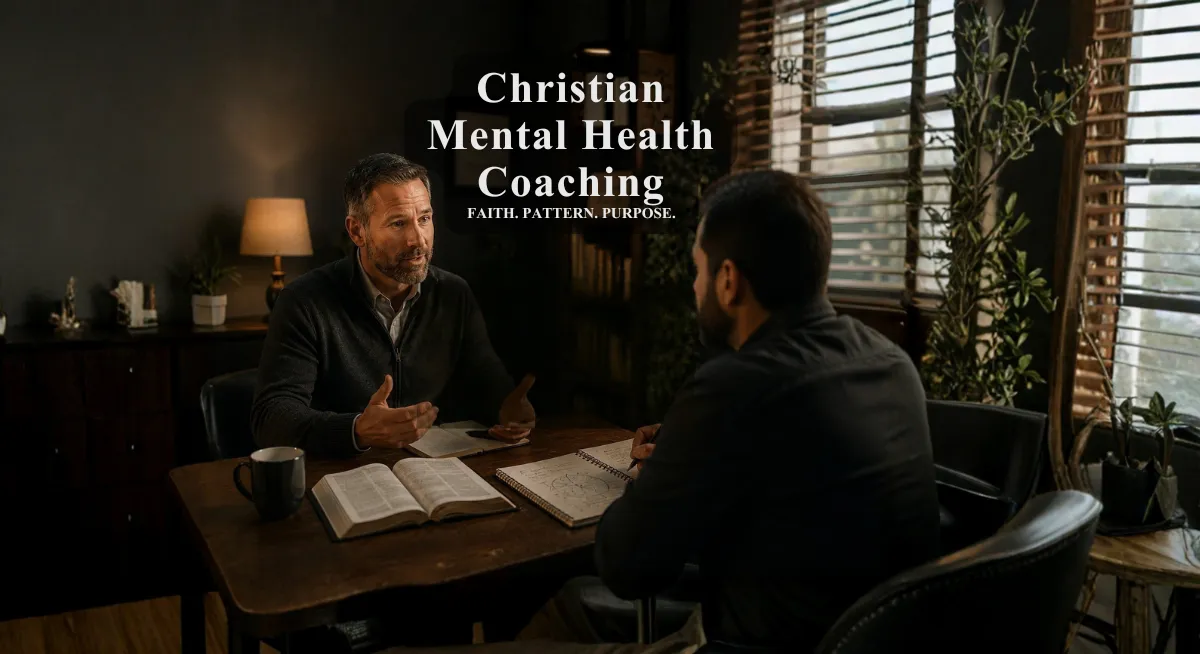
Christian Mental Health Coaching
Faith-Integrated Work on the Mental and Emotional Patterns That Keep You Stuck
Quick Answer: Christian mental health coaching is structured, Faith-integrated work on the mental and emotional patterns that keep capable Christians stuck. The coach brings a trained process, you bring the Faith that shapes how you see everything, and together you address what therapy alone can't reach and what daily Faith alone hasn't shifted.
They've been in therapy before, or considered it, or tried it for a while and found it useful but somehow incomplete. They've read the books on anxiety, on boundaries, on attachment. They Pray about their struggles, they know the verses, and they still find themselves caught in the same mental loops that were running five years ago. They want growth that integrates their Faith with their emotional life, not growth that brackets the Faith as a private matter separate from the psychology.
What they're describing is Christian mental health coaching, a structured, Faith-integrated approach to the mental and emotional patterns that keep capable Christians stuck. If you've searched "Christian mental health coaching," "faith-based mental health coach," or "Christian anxiety coach," this post walks through what the work actually is, who it helps, and when counseling is the better fit.
Get the Gist Quick
The short version, because if you're reading an article about Christian mental health coaching, you've likely been carrying something heavy for a while.
Christian mental health coaching is structured, forward-focused work for Christians who want to address persistent mental and emotional patterns within a Faith-integrated framework. The coach brings a trained process. You bring the Faith that shapes how you see everything. Together, you work on what's actually keeping you stuck, using Scripture, Prayer, and Christian practices as part of the method. Barna research found that 42% of practicing US Christians reported struggling with mental illness in the past year1, which is higher than the general population. The need is real, and the Church has been slow to build a category of help that meets it.
Coaching fits best when you're functional but stuck. Anxious without being clinical. Overwhelmed without being in crisis. Spiritually hungry but practically tired. It serves Christians who've done the therapy work and want to integrate what they learned into their walk with God, or who've never done therapy and want to start with a process that takes their Faith seriously from the first session.
Coaching has clear limits. Clinical issues need clinical care. A competent coach refers out when therapy is the better fit, and many Christians benefit from doing both at different seasons or in tandem.
Keep reading for the full picture of what Christian mental health coaching looks like in practice.
And now… the rest of the story.
What Is Christian Mental Health Coaching?
A clear definition matters, because the term gets used loosely.
Christian mental health coaching is an ongoing structured partnership with a trained coach who helps you identify, understand, and address the mental and emotional patterns shaping your life. The coaching process is forward-focused, goal-oriented, and built around specific changes you want to make. The Christian part means Faith is the operating system of the work, not a slogan painted on top of secular tools.
A Christian mental health coach works with patterns like persistent anxiety, low-grade depression, burnout, perfectionism, people-pleasing, emotional regulation, overthinking, loneliness, grief that's become stuck, and the quiet mental habits that undermine peace even in Christians who Love the Lord. The coach brings process. You bring life. The Spirit does the interior work the process alone can't produce.
As I wrote in Renewing the Mind God's Way, Paul's instruction to be Transformed by the renewing of the mind is a Transformation strategy, not a self-help project. Christian mental health coaching is the practical outworking of that strategy over time, with a trained guide helping you stay in the process longer than you would on your own.
How Does Coaching Differ From Therapy and Secular Coaching?
Three categories get confused with each other often. Worth separating them clearly.
Therapy is clinical work. A licensed therapist (LCSW, LMFT, LPC, psychologist) can diagnose and treat mental health conditions, process trauma, and provide clinical interventions for conditions that require them. Therapy is often retrospective, exploring how past experiences shape present patterns. Essential for clinical issues.
Secular coaching is forward-focused work without a Faith framework. A secular coach can help you set goals, clarify values, and build practices. What they can't do, structurally, is integrate your Faith into the process. For Christians whose Faith is the most foundational layer of identity, bracketing it leaves the deepest layer untreated.
Christian mental health coaching is forward-focused work inside a Faith framework. The coach is trained in a specific process and brings Christian theology, Scripture, Prayer, and Christian spiritual practices into the work as primary tools rather than optional add-ons. The goal is integrated growth, where Faith and mental health are parts of the same Transformation. Whole-person formation, not parallel projects.
As we walked through in Christian Marriage Coaching vs. Counseling, mixing up coaching and counseling costs people months of misdirected effort. The same principle applies here.
When Does Christian Mental Health Coaching Fit Best?
Coaching works well for Christians in a specific set of seasons and situations.
Stuck in recurring mental or emotional patterns. Anxiety that comes in waves without clear triggers. Overthinking that exhausts you. People-pleasing that leaves you resentful. Patterns your Faith is honest about, that don't seem to shift on their own.
Moving past a crisis into ongoing growth. You've stabilized after a hard season. The acute work is done. You want a structured process to keep growing rather than drifting back into the same old shape.
Integrating therapy work into daily Faith. You've been through therapy, learned valuable things, and want to bring those insights into rhythms and practices that keep them alive in your walk with God.
Leading through pressure without breaking. You're in a demanding role, ministry or career, and the pace is shaping your mental and emotional life in ways you want to examine before the pressure produces something you'll regret. Lifeway Research found that 53% of Protestant pastors have experienced symptoms of depression, and only 28% sought professional help², a gap that coaching can close for some leaders, refer out for others, and at minimum, surface honestly.
In Burnout Recovery for High-Functioning Christians, we walked through how capable Christians end up in situations that coaching can address when therapy isn't the right tool. Mental and emotional drift often calls for structured attention and accountability over time, rather than clinical intervention.
Preparing proactively for a known challenge. A transition is coming (empty nest, career shift, retirement, launching a ministry, caring for aging parents). You want to enter it mentally and emotionally conditioned.
When Is Counseling the Better Fit?
A trustworthy Christian coach knows their lane and refers out without hesitation when counseling fits better. A few categories call for therapy first.
Active clinical diagnoses. Severe depression, generalized anxiety disorder, PTSD, bipolar disorder, OCD, and similar conditions. These respond to clinical interventions that coaching can't provide.
Trauma surfacing. Childhood trauma, abuse history, sexual assault, violent events, major losses. Processing these requires trauma-informed clinical expertise.
Suicidal ideation or self-harm. Reach out to a counselor, a pastor, or a crisis line today. Coaching can support the work later. The crisis itself is for professionals.
Eating disorders, active addictions, and severe emotional dysregulation. Clinical conditions with specialized treatment protocols.
Many Christians benefit from both at different seasons. Counseling to stabilize. Coaching to build forward. The two together often do more than either alone, and a good coach communicates with your therapist when appropriate so the work stays coordinated.
How Does Christian Mental Health Coaching Work in Practice?
The process varies by coach and by client. A typical engagement has four parts.
An initial assessment identifies where you are, where you want to go, and what patterns have been keeping you from getting there. Tools like the iEQ9 (Integrative Enneagram) often surface here, because the way God wired your personality shapes how your mental and emotional patterns operate.
Pattern naming follows. The coach helps you see what you've been too close to see. The anxious loop you didn't know was anxious. The emotional reaction rooted in a childhood strategy you haven't revisited in decades. The spiritual belief that's been quietly contradicting a passage of Scripture you know by heart.
Practice and rhythm building comes next. Scripture, Prayer, embodied practices, specific weekly commitments, and accountability structures designed around the patterns you've named. The work is slow and steady.
Integration over time wraps the engagement. Most coaching relationships run three to six months, sometimes longer, as the patterns shift and new rhythms become automatic. The goal is lasting change, which takes more than ten weeks to produce honestly.
Live Your Legacy Today
On any given Tuesday morning, the honesty looks like this.
The mental and emotional patterns running your life right now will still be running it in five years unless something deliberate happens. Drift is the default. Patterns repeat themselves until something interrupts them, and most patterns outlast good intentions by a wide margin.
Christian mental health coaching is one of the tools available for an interruption that holds. Therapy is another. Medication, when clinically indicated, is another. Community sits underneath all of them. The Spirit does the deep formation work through any of these means.
The goal is growth that integrates every part of you, the mind, the heart, the body, and the walk with God, into one whole person who's being formed more deeply into Christ. Coaching is one of the paths that keeps that formation from stalling.
Key Takeaways
Christian mental health coaching is structured, forward-focused, Faith-integrated work on persistent mental and emotional patterns in capable Christians.
It is distinct from therapy (clinical), secular coaching (no Faith framework), and pastoral care (different role and structure).
Best fit for Christians who are functional but stuck, post-crisis, integrating therapy insights, leading under pressure, or preparing for a known transition.
Counseling is the better fit for active clinical diagnoses, trauma surfacing, suicidal ideation, eating disorders, addictions, and severe dysregulation.
Most engagements run three to six months and include assessment, pattern naming, practice and rhythm building, and integration.
Patterns respond to accountability and to another person in the room, not to information alone.
Going Deeper
In my upcoming book, Your Purpose & Principle Driven Life 2.0, we walk through the full P2-Driven Framework, Get Clear, Align, Get Fit, and Live Your Legacy Today, applied to mental and emotional formation. The book unpacks the specific rhythms, Scriptures, and practices that shift persistent patterns, how the Enneagram serves as a mirror inside the process, and why some of the most faithful Christians remain mentally stuck long after they should have moved forward. The book isn't available yet, but this series is the conversation it's designed to extend.
What Coaching From AI Bots Misses
An AI bot can generate you a solid overview of cognitive restructuring, list the spiritual practices associated with mental health, and produce a custom morning routine in under three minutes. A Christian who's stuck will read it, find it helpful, and remain stuck, because mental and emotional patterns don't respond to information.
Patterns respond to accountability. They respond to another person in the room who sees what you're doing before you see it. They respond to the question you can't ask yourself because you're too close to your own blind spot. They respond to someone who stays in the process with you for six months while the pattern slowly loses its grip.
A bot generates content. A coach walks with you. Mental health work is specifically one of the places where the difference matters most.
→ If you're ready to do structured work on the mental and emotional patterns keeping you stuck, book a discovery call: https://p2driven.com/discovery-call
FAQ: Christian Mental Health Coaching
Is Christian mental health coaching the same as Christian counseling?
They overlap, and the category boundaries matter. Christian counselors are licensed clinicians who can diagnose and treat mental health conditions. Christian mental health coaches bring a structured process for forward-focused growth, without clinical authority. When you need clinical treatment, a counselor is the right call. When you need structured growth work on patterns that aren't clinical, coaching fits better. Many Christians benefit from both at different seasons.
Do I need a diagnosis to work with a coach?
No. Coaching works well for persistent patterns that aren't clinical. Many coaching clients have never been diagnosed with anything. If a clinical issue surfaces during coaching, a good coach refers you to a therapist and may continue coaching alongside that work, or pause coaching until therapy stabilizes things, depending on the situation.
How is this different from pastoral counseling?
Pastors do meaningful soul care, and that care is worth receiving. Most pastors aren't trained in the specific structured process that mental health coaching uses, and they're usually stretched thin by the demands of shepherding a whole congregation. Coaching provides sustained, weekly, goal-oriented work across months, which is a different category of support from pastoral care. Both have their place, and they often work well together.
Can I do coaching and therapy at the same time?
Often yes, with coordination. When both are happening, it's helpful for the coach and therapist to know about each other so the work stays aligned. A good coach respects the therapeutic work and stays in their own lane, focusing on forward-focused growth rather than clinical territory.
How do I know if a Christian mental health coach is legitimate?
Look for formal coach training from a credible program, a clear Faith foundation, a specific framework they work within, and willingness to refer to a therapist when therapy is the better fit. Ask about their process, their experience, and how they handle clinical issues that surface during coaching. A trustworthy coach will tell you honestly if coaching isn't the right fit for your situation.
How much does Christian mental health coaching cost?
Pricing varies by coach, training, and engagement length. Most coaches charge by session or by package over three to six months. Costs are often comparable to private-pay therapy, sometimes lower, and unlike clinical therapy, coaching is not typically covered by insurance. Ask any coach for clear pricing and engagement structure before committing.
How long does Christian mental health coaching take?
Most engagements run three to six months. Pattern work takes time. Ten weeks usually isn't enough to produce changes that last. Some clients work with a coach longer, especially through major transitions, leadership seasons, or layered pattern work.
