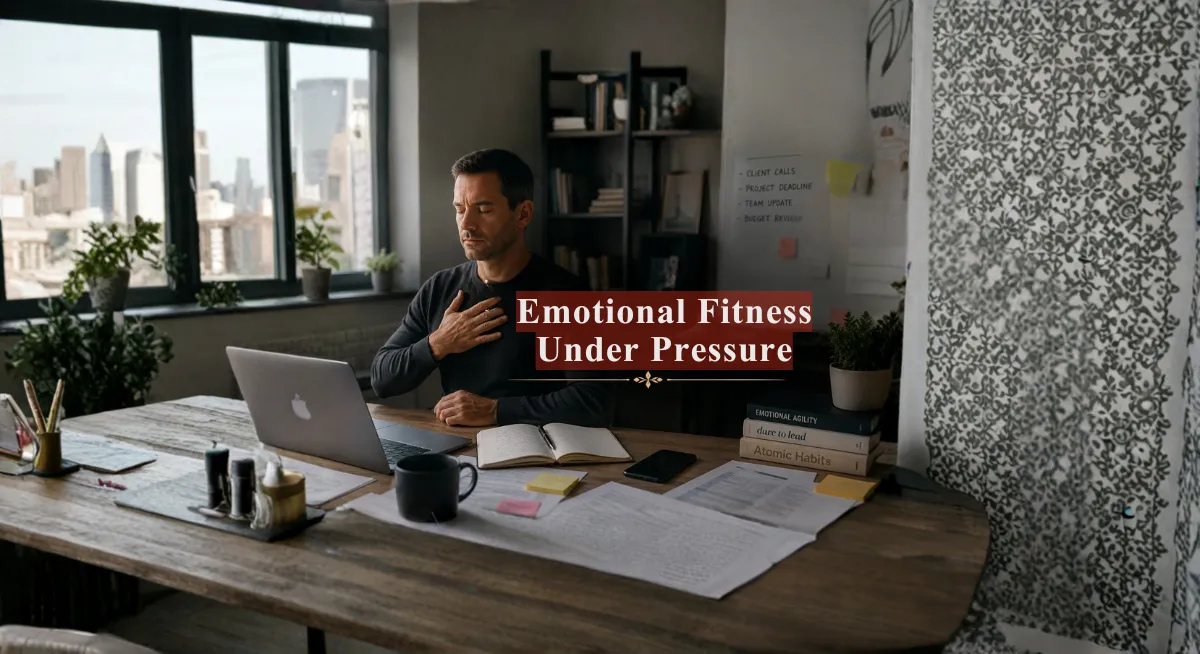
Emotional Fitness Under Pressure
Why Pressure Reveals Your Patterns, and the Capacity That Keeps You Present When Life Gets Heavy
Quick Answer: Emotional Fitness is the capacity to feel your feelings without being controlled by them and without bypassing them. Pressure doesn't create your emotional patterns; it reveals them. The capacity grows through small, repeatable practices over seasons that train you to stay present to your interior while the Spirit forms you through what pressure exposes.
The boardroom call goes sideways, and your shoulders tighten before you register what you're hearing. A text from your spouse lands during a meeting, and something in your chest drops half an inch. Your kid walks in the door after a hard day, and within two minutes you've said something sharper than you meant.
None of these reactions are moral failures. They're data. They're information about a specific kind of conditioning most Christians have quietly neglected for decades, while tending to the spiritual and physical domains of their lives. In the P2-Driven Framework, the missing piece is called Emotional Fitness.
If you've searched "Emotional Fitness under pressure," "Christian emotional resilience," or "how to stay calm when life gets heavy," this post walks through why pressure reveals your patterns rather than creates them, and the practices that build the capacity to stay present when everything around you is trying to run your nervous system.
Get the Gist Quick
The short version, because if you're reading an article on Emotional Fitness, something heavy has likely been pressing on you recently.
Emotional Fitness is the capacity to feel what you feel without being controlled by it and without bypassing it. Most of us fall into one of two ditches under pressure. Some get run by feelings, reactive, short-tempered, snapping at the people closest to us. Others suppress or spiritualize the feelings, performing calm while something is churning underneath that we haven't let ourselves notice. Both ditches are low Emotional Fitness. Tue Fitness means neither.
Pressure doesn't create your emotional patterns. It reveals them. The patterns that run you when life gets heavy have been running you all along, quietly enough that you didn't have to see them. Pressure turns up the volume. The signal has been there.
The good news is that Emotional Fitness can be built. Not quickly. Not through a weekend intensive. Through small, consistent practices that expand your capacity to stay present to your own interior over time. Scripture doesn't ask you to transcend your feelings. It asks you to bring them honestly to the Lord who can meet them. That's the whole training regimen, sustained across years.
Keep reading for the full picture.
And now… the rest of the story.
What Is Emotional Fitness?
A clear definition matters, because the phrase gets used loosely.
Emotional Fitness is the capacity to feel your feelings, name them honestly, bring them to God, and respond to your circumstances with intentional action rather than automatic reaction. That capacity has multiple dimensions: the ability to notice what you're feeling in real time, the vocabulary to name it accurately, the willingness to bring the feeling to God without cleaning it up first, the discipline to pause before reacting, and the integration to let the feeling inform your response without running it.
Notice what Emotional Fitness is. Presence, not absence of feeling. Honesty, not constant calm. Capacity to hold the feeling and the Faith together, rather than performance of serenity while your body carries twenty years of unprocessed grief.
In Rhythms of Fitness That Support Your Calling, we walked through five domains of Fitness: spiritual, emotional, relational, physical, and financial. Emotional is the domain most Christians underestimate until something breaks. Spiritual disciplines are honored. Physical care is honored. Emotional conditioning gets treated as an optional add-on, which leaves a load-bearing beam thin. The beam holds, until the pressure is heavy enough to expose the thinness.
Why Does Pressure Reveal Rather Than Create?
One of the most useful reframes available to a Christian is this one.
Pressure doesn't create your emotional patterns. It reveals them. The patterns that run you under pressure are the patterns that have been running you all along, just quietly enough that you didn't have to see them.
The colleague who sends the passive-aggressive email isn't the reason you reacted the way you did. They turned up the volume on a pattern that was already running. The hard conversation with your spouse isn't creating your shutdown response. It's surfacing a reflex that's been part of you for years. The bad doctor's appointment isn't producing your anxiety. It's revealing an anxiety that's been sitting in your body while you were too busy to feel it.
This reframe is good news. If pressure created the patterns, you'd need to avoid pressure to avoid the patterns, which means avoiding life. Pressure reveals the patterns, which means the work is noticing what pressure shows you and letting the Spirit form you through the noticing, over time, into a different default.
What Are the Four Signals of Low Emotional Fitness Under Pressure?
A few recognizable signs mark low Emotional Fitness. Noticing them without shame is the first step toward building capacity.
Signal 1: Disproportionate Reactivity
A small comment produces a large reaction. A minor disruption triggers a full-body stress response. Your ten-year-old leaves a glass on the counter, and you react as if they've committed a crime. The intensity of the reaction has no relationship to the size of the trigger.
When the reaction is out of proportion, the reaction is about something older that's been waiting for a match. The fitness work is noticing the gap between the size of the trigger and the size of the response, and bringing the gap to God with curiosity rather than shame.
Signal 2: Numbing and Shutdown
The opposite pattern. When pressure spikes, something goes still. You check out mentally. You scroll. You pour a drink. You watch something that doesn't require you to feel anything. Your body is technically present; your interior has gone offline.
Numbing is a form of emotional self-protection that often served you as a kid. It stops serving you in adulthood. The fitness work is gently re-engaging presence, starting with five minutes of noticing what's happening in your body, without needing to fix it yet.
Signal 3: Spiritualizing Before Feeling
A distinctly Christian version of bypassing. You feel something hard. You immediately quote a verse at yourself, or declare that God is in control, or remind yourself that this is for His glory, before you've let yourself actually feel what you were feeling. The Scripture is true. The timing is off.
The Psalms model a different pattern. "How long, O Lord? Will you forget me forever? How long will you hide your face from me?" (Psalm 13:1, ESV). The psalmist doesn't skip to the resolution. He sits in the question. The resolution comes later in the same Psalm, and it lands with weight because the feeling was honored first. As we walked through in Renewing the Mind God's Way, Scripture doesn't ask us to transcend our emotional reality. It invites us to bring it honestly to the Lord.
Signal 4: Displacement Onto Safer Targets
Someone you work for disappoints you, and the person who pays the cost is your spouse. A conversation at church leaves you unsettled, and your kids feel the edge in your voice all afternoon. The pressure came from one place. The pressure came out on someone else, usually someone safer. The pattern isn't malicious. It's what happens when emotional pressure has no honest outlet.
Displacement is one of the most common forms of low Emotional Fitness in Christian families, and it's often invisible to the person doing the displacing. The people absorbing it know it's happening. Building capacity means learning to process the pressure at its source instead of redirecting it toward softer landings.
What Did Jesus Model in Gethsemane?
The most honest picture of Emotional Fitness under pressure is Jesus in the garden on the night before He died.
"He took Peter and the two sons of Zebedee along with him, and he began to be sorrowful and troubled. Then he said to them, 'My soul is overwhelmed with sorrow to the point of death. Stay here and keep watch with me'" (Matthew 26:37-38, NIV).
Notice what He did and what He didn't do.
He felt the weight. He named it out loud. He brought companions. He Prayed honestly. He asked the Father for an alternative. He stayed in the Prayer long enough for resolution to come. When the resolution came, He stood up and walked into the exact suffering He had asked to avoid.
That's Emotional Fitness under the heaviest pressure any human has ever faced. Feeling the full weight. Naming it precisely. Bringing it into honest Prayer. Staying in community. Processing toward Surrender rather than bypassing toward numbness. Moving into action when action became clear. No performance of calm. No suppression of the agony. And no reaction that damaged the people around Him.
That's the goal. Not the absence of pressure. The capacity to meet the pressure as He did.
What Practices Build Emotional Capacity?
Capacity grows through practices repeated over time. A few that produce reliable change when held for seasons.
Daily emotional check-in. Once a day, at the same time, name what you're feeling. Not what you think about what you're feeling. The feeling itself. Angry. Sad. Anxious. Disappointed. Grateful. Hopeful. The vocabulary matters. Keep a small list on your phone if the words are hard to find. Over time, the naming becomes automatic.
The pause before reaction. When something triggers you, practice a five-second pause before responding. Breath. Feet on the floor. A silent Prayer. Anything that interrupts the automatic. The gap between trigger and response is where Emotional Fitness lives. That gap can be expanded with practice.
Prayer that names the feeling. Most Christians Pray about their circumstances. Balance that with Prayer that names what you feel about the circumstances, honestly, without editing. "God, I'm angry. God, I'm afraid. God, I feel abandoned by you right now." The Psalms modeled this. God can handle the raw version better than you can handle the performance.
Honest conversation with a trusted person. Pick one person, your spouse, a friend, a coach, a pastor, who knows you well enough that you don't have to clean up the feelings before you share them. Meet regularly. Feelings processed in relationship integrate faster than feelings processed alone.
Body-first practices when words won't come. Walk. Run. Lift. Garden. Physical movement often accesses emotional material that stays locked when you try to think your way in. Your body holds what your mind is too tired to name.
These practices are repeatable rather than dramatic. Capacity grows through consistency, not through intensity.
Live Your Legacy Today
On any given Tuesday morning, the honesty looks like this.
The pressure you're carrying is real. The patterns it's revealing are real. Both deserve a response more thoughtful than pushing through or pretending away.
As we explored in Burnout Recovery for High-Functioning Christians, capable Christians often suffer alone because everyone assumes they're handling it. Handling it is not the same as being well, and the gap between the two is where Emotional Fitness work has the most to offer.
Pick one practice this week. Start small enough that you'll actually do it. Repeat it long enough for the pattern to shift. Bring someone else into the process if you can. Trust that the Spirit is forming you through the noticing, over time, into a different default than the one pressure has been exposing.
Capacity is the gift you give to everyone who will share a room with you for the rest of your life. It's worth every minute of the small, repeatable practices that build it.
Key Takeaways
Emotional Fitness is the capacity to feel your feelings without being controlled by them and without bypassing them.
Pressure doesn't create your emotional patterns; it reveals them. The patterns under pressure have been running quietly all along.
Four signals of low Emotional Fitness under pressure: disproportionate reactivity, numbing and shutdown, spiritualizing before feeling, and displacement onto safer targets.
Jesus modeled Emotional Fitness in Gethsemane: felt the weight, named it precisely, brought companions, Prayed honestly, stayed in Prayer until resolution came, and moved into action.
Capacity-building practices: daily emotional check-in, the pause before reaction, Prayer that names the feeling, honest conversation with a trusted person, and body-first practices when words won't come.
Emotional Fitness builds over months and years, not days. Direction matters more than pace. Consistency outperforms intensity.
Going Deeper
In my upcoming book, Your Purpose & Principle Driven Life 2.0, we walk through the Get Fit phase of the P2-Driven Framework in depth, including Emotional Fitness alongside spiritual, relational, physical, and financial fitness. The book unpacks the specific practices that build emotional capacity across seasons, the signals that indicate which domain needs attention most, and the integrated rhythms that sustain a Christian across decades of real life.
What Coaching From AI Bots Misses
An AI bot can produce a list of emotional regulation techniques in ninety seconds. Breathing exercises, grounding practices, journaling prompts, Scripture suggestions for specific emotions, even a custom weekly plan with calendar blocks. A capable Christian will read the plan, recognize most of it, and remain exactly where they started, because information was never the thing missing.
What was missing is another person in the room when your pattern shows up. A coach notices when your face changes in response to a specific topic, while you're still denying that it affected you. A coach asks the question that interrupts your spiritualization before the bypass completes. A coach stays in the work across months while you build capacity one small repetition at a time. Capacity grows in relationship, not in isolation, and the relationship has to be with a person who can see what you can't see yet.
A bot produces plans. Emotional Fitness requires presence, and presence requires a person.
→ If you're ready to build emotional capacity for the pressure your life is already carrying, book a discovery call: https://p2driven.com/discovery-call
FAQ: Emotional Fitness Under Pressure
Is Emotional Fitness the same as emotional intelligence?
They overlap. Emotional intelligence (EQ) is the broader category, awareness of your emotions, awareness of others' emotions, and the ability to navigate both. Emotional Fitness is more specific, focused on the capacity to feel your own feelings and respond with intention rather than reaction. You can have high EQ and low Emotional Fitness if you understand emotions well but still get run by yours under pressure. Fitness is the ongoing practice that makes EQ livable.
Does Emotional Fitness require therapy?
Often, no. Emotional Fitness is about building capacity through practices, which most people can develop with coaching, accountability, community, and disciplined self-work. Therapy is valuable and sometimes essential, especially when trauma is in play, clinical issues are present, or patterns have roots that need clinical expertise to address. Many Christians benefit from both coaching and therapy at different seasons.
What's the difference between Emotional Fitness and spiritualizing my feelings?
Spiritualizing is the tendency to skip to the spiritual conclusion before you've felt the honest emotion. Emotional Fitness holds the feeling and the Faith at the same time. A Christian with Emotional Fitness can say, "I'm afraid, and I trust God in this," where spiritualizing would have said only, "I trust God," while leaving the fear unacknowledged. The Psalms model the fuller version.
Why do I react so strongly to small things?
Usually because the small thing is triggering a larger pattern that's been running quietly in the background. The reaction isn't about the small thing. It's about what the small thing touched. Building Emotional Fitness includes noticing the gap between the size of the trigger and the size of the response, bringing the gap to God and trusted community, and letting the Spirit show you what the small trigger has been pointing at all along.
How long does it take to build Emotional Fitness?
Like any kind of fitness, it builds over months and years rather than days or weeks. Small changes come faster: noticing your patterns, pausing before reacting, naming feelings with more precision. Deeper changes like integration of old wounds, lasting shifts in default patterns come through sustained practice over longer stretches. The direction matters more than the pace.
Can I build Emotional Fitness without involving anyone else?
Some growth is possible alone, especially the noticing and naming work. Deeper capacity almost always requires another person like a coach, counselor, trusted friend, spouse who can see patterns you can't see yet. Solo work hits a ceiling. Relational work tends to clear it.
What's one place to start this week?
The daily emotional check-in. Once a day, at the same time, name what you're feeling in one or two words. No fixing. Just naming. The simplest practice has the most reliable cumulative return.
