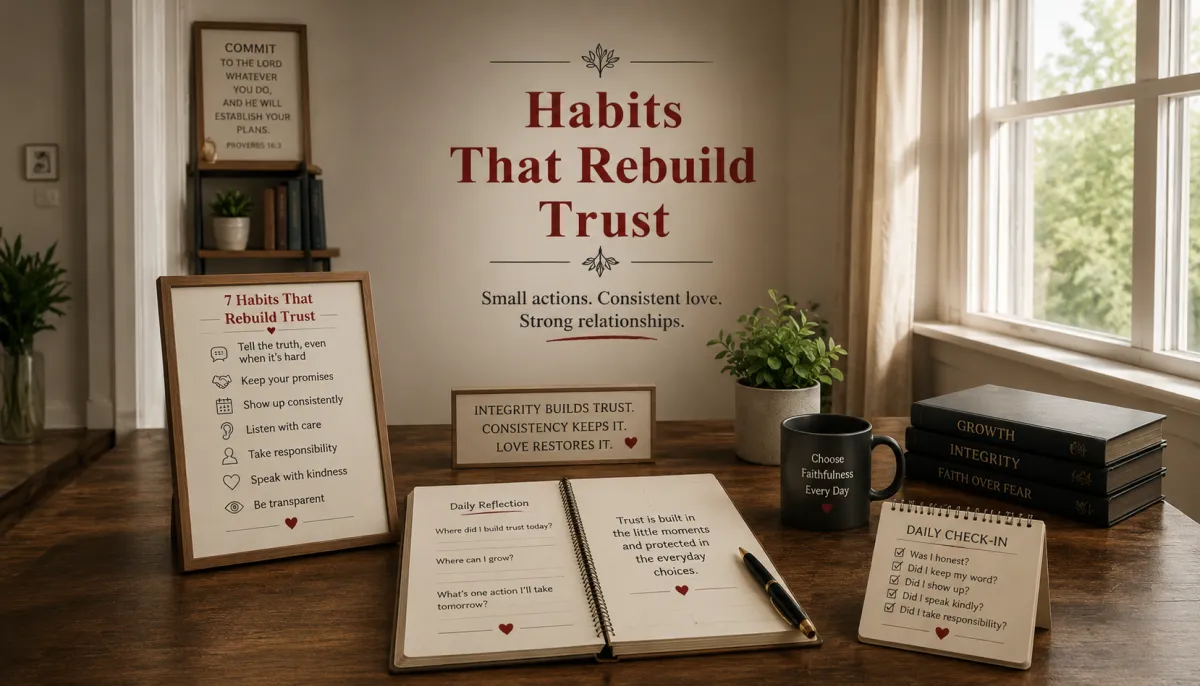
Habits That Rebuild Trust
Why Apologies Don't Rebuild a Marriage, And the Small Rhythms That Actually Do
If you've searched phrases like “habits that rebuild trust in marriage,” “how to rebuild trust after hurt,” or “why my apology isn't enough,” you're already closer to the answer than most people get. Trust doesn't rebuild through apologies. It doesn't rebuild through grand gestures, tearful promises, or one dramatic conversation that finally breaks the stalemate. Trust rebuilds the same way it was built in the first place, through small, repeated actions that add up over time to a pattern your spouse can actually count on. The work is slower than most couples want and more practical than most marriage advice suggests. This post walks through the specific habits that do the rebuilding, and why they matter whether the breach was a betrayal, a drift, or a thousand small disappointments nobody flagged until the whole thing went quiet.
Get the Gist Quick
Short version, because if you're reading this, you're probably tired of explanations and looking for traction.
Trust is a pattern your brain tracks, not a feeling your heart produces. It gets built when someone's actions consistently match their words over enough time that the brain stops flinching. It gets broken when the pattern ruptures, whether through a single betrayal or a thousand small disconnects. And it rebuilds the only way it ever got built, through consistent small actions that prove the pattern is changing.
That's why apologies alone don't rebuild trust. An apology is a word. Trust responds to patterns. The spouse you hurt isn't withholding forgiveness out of cruelty. They're watching, consciously or not, to see whether the next hundred Tuesdays look different from the last hundred. That's the data their trust is being rebuilt on.
The habits that matter aren't complicated. They're just relentless. Consistency over grand gestures. Transparency without having to be asked. Fast repair when ruptures happen. Protected rhythms that demonstrate priority. Follow-through on the small promises, because small promises are where big trust lives.
Keep reading for the full breakdown.
And now… the rest of the story.
What Trust Actually Is
Let's start with a definition most marriage advice skips.
Trust isn't an emotion. It's not a decision. It's not even, strictly speaking, a choice. Trust is what your brain produces when it's watched someone's behavior match their stated intentions often enough that it stops bracing for impact. When the pattern is reliable, trust is the output. When the pattern ruptures, your brain updates the pattern, usually faster than you'd like.
That's why “just trust me” almost never works. The spouse you hurt can't will their trust back into existence. Their brain is doing pattern recognition whether they're conscious of it or not. The data it's gathering is your behavior across time. You can't shortcut that process. You can only feed it new data, consistently, until the pattern updates.
This reframe changes how you approach rebuilding. Instead of asking your spouse to feel different, you give them new information to feel with. Instead of demanding faster forgiveness, you demonstrate sustained change. Instead of grand gestures that spike once, you build small rhythms that accumulate quietly.
Trust was earned the first time through a pattern. It's earned back the same way.
Why Apologies Alone Don't Rebuild Trust
Apologies matter. They just aren't the rebuild.
A real apology is essential. It names the specific wrong, takes full ownership without minimizing or deflecting, acknowledges the impact on the other person, asks what's needed for repair, and does so without expecting immediate forgiveness. An apology that does all of that is a doorway. It's not the house.
Problems start when the apologizing spouse mistakes the doorway for the structure. They apologize once, sometimes beautifully, and then wait for trust to be restored. When it isn't, they either push harder for forgiveness (which regresses progress) or conclude their spouse is unreasonable (which compounds the injury). Both responses misunderstand what trust requires.
As we walked through in Christian Marriage Coaching vs. Counseling: Which Do You Actually Need?, certain kinds of breaches need clinical support, infidelity, addiction, abuse. In those cases, apologies are the starting point for a much longer process that requires professional help. For most marriages, though, the breach is something smaller and more cumulative, a drift, a slow erosion of presence, a pattern of small broken promises. In those cases, the work is less dramatic and more habitual. Repeated. Over time.
Apologies open the door. Habits build the house.
The Habits That Actually Do the Work
Here are the habits that rebuild trust in a marriage, whether the breach was big or small. Pick the ones that apply. Build them slowly. Stay with them longer than feels comfortable.
Habit 1: Consistency Over Grand Gestures
Most spouses trying to rebuild trust overshoot. They plan the surprise weekend, book the expensive dinner, write the long letter, and expect the grand gesture to bridge the gap. Their spouse receives it politely and remains guarded. The grand-gesture spouse feels baffled and wounded. Why isn't this working?
Because grand gestures don't rebuild trust. They spike emotional intensity, which is something different. Trust is built by the Tuesday version of you, the one nobody writes songs about. The consistent text at lunch. The phone call on the drive home. The household task done without being asked. The evening presence that's actually present.
Grand gestures aren't wrong, they're just incomplete. The ratio that matters is a hundred small moves for every one big one. Most spouses get that ratio backwards.
Habit 2: Transparency Without Being Asked
When trust has been broken, the damaged spouse is often doing detective work they wish they didn't have to do. Checking. Watching. Wondering. That surveillance is exhausting for them and resenting it won't help. The way to lighten their load is to make detective work unnecessary.
Transparency that rebuilds trust isn't interrogation-compliance. It's voluntary. You share the schedule before they ask. You offer the phone access before they request it. You tell them about the conversation at work before they hear about it from someone else. You narrate your life to them in real time, not because they demanded it, but because you want them to stop having to investigate their own marriage.
Over time, as transparency becomes the habit rather than the test, their vigilance can relax. Not because they've decided to trust you, but because their brain has enough new data to update the pattern.
Habit 3: Fast Repair When Ruptures Happen
Ruptures will happen. You'll snap. You'll miss something. You'll disappoint them in small ways you didn't intend. The question isn't whether ruptures happen. The question is how fast the repair follows.
Healthy marriages aren't the ones without conflict. They're the ones that repair quickly. A three-minute repair prevents a three-day cold war. A same-day repair prevents a three-week pattern. As we walked through in Drift in Marriage, most marriages don't collapse in a single moment. They erode through a thousand unrepaired ruptures that nobody flagged as dangerous. The repair itself is the habit.
Fast repair sounds like, “That came out sharp. I'm sorry. Can I try that again?” It sounds like, “I noticed I pulled away during dinner. That wasn't about you. I got in my own head. Can we reconnect?” It sounds like, “I was wrong an hour ago. I shouldn't have said it that way.” The shorter the gap between rupture and repair, the less damage the rupture leaves.
Habit 4: Follow-Through on Small Promises
Trust lives in small promises more than big ones.
When you say you'll call at six, call at six. When you say you'll take out the trash, take out the trash without being reminded. When you say you'll be home by seven, be home by seven or text before you're late. These aren't minor administrative matters. They're the granular data your spouse's brain is using to update the trust pattern.
Most spouses who've broken trust focus on the big promises and fumble the small ones. They promise to change their whole life and forget the grocery run. They commit to a new season of the marriage and ignore the small commitment from this morning. The damaged spouse notices. The pattern isn't updating, because the data isn't consistent.
Small promises, kept relentlessly, rebuild trust faster than big promises kept occasionally.
Habit 5: Protected Rhythms That Demonstrate Priority
In Faith-Based Marriage & Family Alignment, we named that the calendar is the most honest theological document in the house. The same applies to rebuilding trust. Your spouse doesn't ultimately believe your words about priority. They believe your calendar.
Rhythms that rebuild trust include protected time that nothing displaces. A standing weekly check-in. A date that doesn't get rescheduled for work. A morning coffee together before the day starts. A Sabbath where the marriage gets the attention it usually loses to logistics.
These rhythms aren't dramatic. They're deliberate. They say, through actual behavior over weeks and months, that the spouse is a priority you're willing to structure your life around. Words about priority mean little in the face of a calendar that says otherwise. A calendar that says yes to the marriage, week after week, says everything.
Habit 6: Patience With the Pattern
Here's the habit nobody wants to practice.
Trust rebuilds on the damaged spouse's timeline, not yours. You cannot speed it up by wanting it faster. You cannot resent them into trusting you again. You cannot exhaust your way to restoration. The brain updates patterns at its own pace, and impatience slows the process rather than accelerating it.
The spouse doing the rebuilding has to accept that their part is the habits and the waiting, not the timeline. Six months becomes a year. A year becomes two. And somewhere in the slow accumulation of reliable behavior, the brain updates, and trust returns quietly, without announcement, because trust doesn't arrive the way it broke. It returns the way it built, gradually, almost invisibly, until one day it's just there.
That's the long game. Most couples quit before it pays off. The ones who don't usually have a marriage on the other side that's sturdier than what they had before.
When You Need Professional Help
A caveat that matters.
If the breach is clinical, an affair, addiction, abuse, untreated mental health, or trauma affecting the relationship, habits alone won't do it. You need a licensed counselor alongside the habit work. The habits support healing. They don't replace clinical care. A couple rebuilding after infidelity, for example, often needs both: a counselor helping them process the trauma and a coach helping them build the rhythms that hold the marriage together through the process.
There's no shame in needing both. The shame is refusing help that would have worked.
Live Your Legacy Today
Here's the Tuesday morning version.
You can't make your spouse trust you. You can only give them new data to trust you with. The habits above are that data, delivered over time, until the pattern updates.
Pick one habit this week. Just one. Make it small enough that you'll actually do it every day. Let it compound. Add a second habit when the first is automatic. Over six months, you'll have built something small and steady that your spouse can count on. Over two years, you'll have rebuilt a pattern that the brain can finally trust.
Trust isn't a feeling you argue back into existence. It's a pattern you rebuild, one small reliable Tuesday at a time, for longer than you'd like. That's the whole secret.
Going Deeper
In my upcoming book, Your Purpose & Principle Driven Life 2.0, we unpack the Get Fit phase of the P2-Driven Framework as it applies to marriage specifically. The book walks through the rhythms that rebuild trust, protect Alignment, and sustain covenant over decades, including the specific practices for different seasons of marriage and the work required when trust has been damaged. It's not available yet, but this series is the conversation it's designed to extend.
What Coaching From AI Bots Misses
An AI bot can generate you a comprehensive list of trust-building habits in under two minutes. It can draft a script for the apology you haven't given yet, produce a weekly check-in template, and build you a rebuild plan with weekly milestones. Your spouse will read none of it and care about none of it, because trust isn't rebuilt by a plan. It's rebuilt by a person.
That's where the real work happens. A coach notices when you're performing the habits rather than living them. A coach watches your spouse's face during the session and catches the tell you missed. A coach stays in the process with both of you during the long, slow middle where nothing obvious is changing but the pattern is quietly updating underneath. A coach asks the question that helps you see what you still can't quite see about your own patterns.
An AI bot can generate habits. Rebuilding a marriage requires someone who can see through the habits to the people living them out, and help you stay in the work long enough for trust to return.
→ If you're in the work of rebuilding trust in your marriage, book a discovery call: https://p2driven.com/discovery-call
FAQ: Habits That Rebuild Trust in Marriage
How long does it take to rebuild trust in marriage?
Longer than most spouses want and faster than some fear. For smaller breaches and ongoing drift, meaningful rebuild usually takes six to eighteen months of consistent habit work. For larger breaches like infidelity or sustained deception, the process is often two to five years and typically requires professional counseling alongside the habit work. The timeline is set by the damaged spouse's brain updating the pattern, not by anyone's preferred schedule. Patience with the process is itself a trust-building habit.
What if my spouse won't tell me what they need?
Many damaged spouses can't articulate what they need, because they've been operating in self-protection mode for so long that they've lost contact with their own requests. Start with the universal habits, consistency, transparency, fast repair, follow-through on small promises, protected rhythms, and patience. These habits are helpful in every marriage, even without a specific request. A good coach or counselor can help surface more specific needs as trust begins to rebuild.
Isn't forgiveness the answer? Why all the habits?
Forgiveness and trust aren't the same thing. Forgiveness is a gift the damaged spouse gives, often repeatedly, usually before they feel ready. Trust is a pattern their brain rebuilds as new data accumulates. A spouse can forgive while still not trusting. That's not hypocrisy, it's how human brains work. Habits give their brain the data it needs to eventually rebuild what was broken, even after forgiveness has already been offered.
What if I keep messing up the habits?
Name it quickly, repair fast, and stay in the process. Perfection isn't the goal. Consistency over time is. The rupture itself isn't what damages trust further, the unrepaired or minimized rupture is. A same-day repair after a slip actually strengthens trust more than a slip that never happened, because it demonstrates that repair is now part of your pattern. Falling and getting up becomes the new pattern, and that pattern is more trustworthy than pretending you'll never fall.
Can trust fully return, or is it always damaged after a breach?
Trust can fully return. It usually doesn't look identical to what it was before, it's often more realistic and more earned, and in many marriages, that's actually healthier. The idealized trust of early marriage is often partly fantasy. Trust rebuilt after a breach is tested, seasoned, and anchored in the reality of who both spouses actually are. That's not less valuable. In some ways, it's more.
