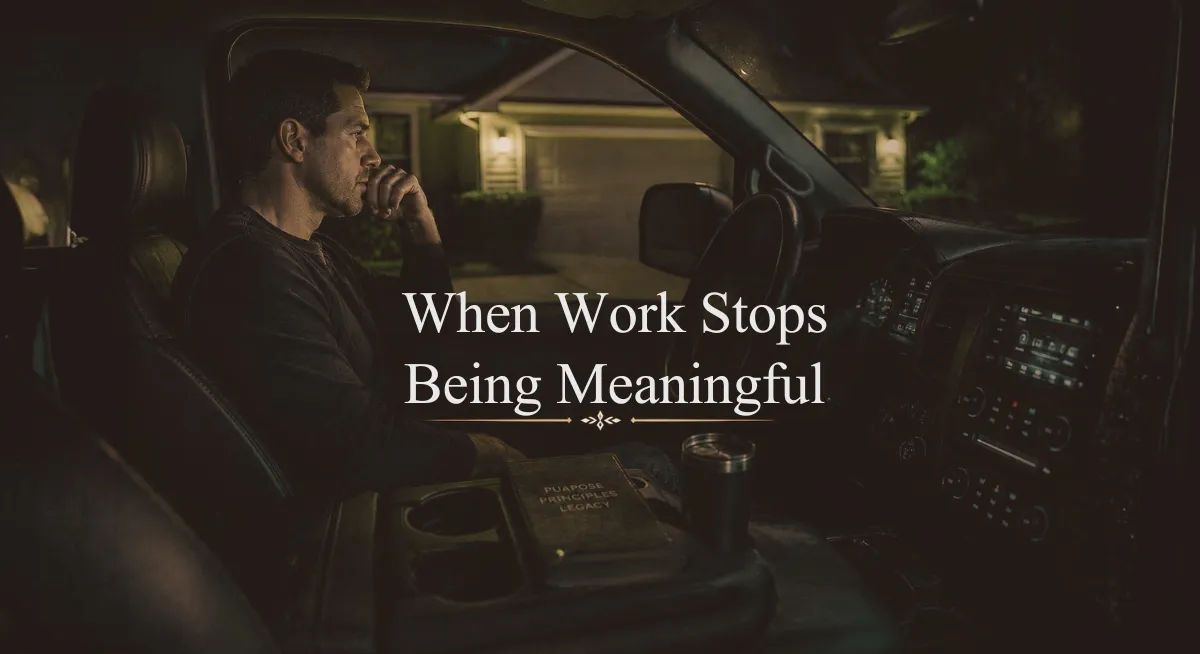
When Work Stops Being Meaningful
You’re Still Winning at Work You No Longer Care About. The Job Didn’t Change. The Questions You’re Carrying Into It Did.
Fall of 2022. Sunday night, 9:40. A man sits in a parked truck in a driveway in Dripping Springs, Texas, engine off, garage door down, the house dark except for the porch light his wife leaves on. Tomorrow is already running in his head. The 7:30 leadership huddle. The board deck that needs one more pass. The two people he has to disappoint before Friday. He is good at every bit of it, and he will walk in tomorrow and win, the way he has been winning for the better part of a decade.
Sitting in that truck, he can’t give a single reason why any of it matters. It isn’t exhaustion. It’s something more subtle. The work hasn’t changed. The title is the one he spent twenty years chasing. The paycheck clears. Somewhere along the line the Meaning drained out of the whole operation, and he never saw it leave.
If you’ve searched “when work stops being meaningful,” “lost passion for my job,” or “should I quit my job,” this post is the one I’d hand you across a table. Before you draft the resignation letter, I want to show you what the man in that truck figured out, because there’s a good chance your problem isn’t the one you think it is.
Quick Answer: When work stops being meaningful, the job is rarely what changed. Meaninglessness at work is usually a Clarity problem before it is a job problem: the questions you’re carrying into the building have outgrown the answers you’ve been living on. Solomon ran the experiment 3,000 years ago and published the results in Ecclesiastes, hatred of his labor and all (Ecclesiastes 2:17-26). Work regains its Meaning when it gets re-anchored in Calling and Stewardship, and that re-anchoring rarely requires a resignation letter. Diagnose before you resign.
Get the Gist Quick
Short version, because if you’re reading this late on a Sunday night, you shouldn’t have to wait 2,000 words for the point.
When work goes hollow, the first instinct is to blame the work. A stale role, a hard boss, an industry that lost its shine. Sometimes that diagnosis is right. More often, for the competent Believer in the middle decades, the job is the same job it was five years ago. You’re the one who changed. The questions you carry into the building got bigger. What is all this for? Who is it serving? What will be left of it? A title and a paycheck were never built to answer questions that size.
Solomon proved it from the top. He built houses, vineyards, and reservoirs, stacked up a fortune no rival could touch, and then wrote, “So I came to hate life because everything done here under the sun is so troubling. Everything is meaningless—like chasing the wind” (Ecclesiastes 2:17). Seven verses later, the same man receives the same work back as a gift from God’s hand. The work never changed. The anchor did.
That’s the hope of this post. If meaninglessness at work is a Clarity problem, the fix starts with diagnosis, and diagnosis is work you can begin this week without touching your resume. Re-anchor the work in Calling and Stewardship, and the same office, the same inbox, and the same Monday meetings can carry Meaning again. Keep reading for the full breakdown.
And now… the rest of the story.
Why Does Work Stop Being Meaningful?
Meaningful work is load-bearing. A 2019 meta-analysis in the Journal of Management Studies pulled together the research and found that people who experience their work as meaningful are more engaged, more committed, in better health, and far less likely to be planning an exit.1 The reverse reads like the man in the truck. Disengaged. Detached. Healthy on paper, hollow in person, polishing a resume he doesn’t even want to send.
Notice what the research measures. Not salary or seniority, but the experienced sense that the work means something. Which raises the question this whole post turns on: where does that sense come from, and what happens when the source runs dry?
For the first stretch of a career, work borrows its Meaning from momentum. Proving yourself supplies it. Feeding young kids supplies it. The next promotion supplies it. Between twenty-five and forty, borrowed Meaning holds, because the questions you’re asking are momentum-sized. Can I do this? Will this provide? How far can I go?
Then the questions change size. As we walked through in Identity and Midlife Re-Direction, midlife trades your old questions for heavier ones. What is all this for? Who am I when the title comes off? What outlasts me? The job didn’t change. The questions you’re carrying into it did. And the weight you feel is measurable. A meta-analysis of 147 studies covering more than 92,000 people found the presence of Meaning in a life to be among the strongest predictors of well-being on record, while searching for it without an anchor predicts the opposite.2 You’re not weak for feeling the drain. You’re feeling what a human being feels when momentum-sized answers meet Eternity-sized questions.
Solomon Ran the Experiment First
Ecclesiastes reads like a lab report from the corner office. The writer held the resume nobody could match. Building projects, vineyards, orchards, herds, silver, gold, and a staff that ran to the hundreds. Then he tallied the results. “I came to hate all my hard work here under the sun, for I must leave to others everything I have earned” (Ecclesiastes 2:18). Not a man who failed at work. A man who won at all of it and hated the whole pile.
His phrase for work anchored to itself is “under the sun.” Work under the sun has to be its own justification. The output is the point, the accumulation is the scoreboard, and death gets the last word on everything you build. Run the experiment long enough on those terms and hating your labor is the honest result. Solomon got there faster than most because he had the resources to finish the experiment.
Then the anchor moves. “So I decided there is nothing better than to enjoy food and drink and to find satisfaction in work. Then I realized that these pleasures are from the hand of God” (Ecclesiastes 2:24). Same fields. Same projects. Same king. The work moved from Under the Sun to Under the Son (Jesus), from self-justifying grind to received gift, and satisfaction showed up on the same job site where hatred had been the week before. The oldest re-anchoring story in print, and it didn’t involve a resignation.
The Man in the Truck
I should tell you about the truck.
I can still hear that Sunday night. The tick of the engine cooling. The porch light Heidi leaves on. A Monday I could run in my sleep sitting on my chest like a stranger. I had spent a decade climbing from director to the C-suite, at the end of a road that started when I enlisted in the Marines at seventeen and ran through oil and gas field construction projects before it ever saw a corner office. The man in that truck was me.
I didn’t resign that night. I spent the better part of a year diagnosing before I changed anything, with Heidi, with Scripture open, with men who knew me well enough to ask rude questions. The diagnosis eventually pointed me out of the C-suite and into coaching, and I walked away in 2023. Hear the order, though. Diagnosis first, decision second. Most of the men I coach who sit in that same truck never write the letter at all. They re-anchor the job they already have.
Diagnose Before You Resign
Resigning from a Clarity problem is like moving houses to cure insomnia. New address, same 3 a.m. The men I’ve watched quit hollow jobs without a diagnosis report the same arc: eighteen months of new-job adrenaline, then the same drain in a different parking lot. As we covered in Talent Without Clarity Creates Frustration, talent without a target doesn’t rest. It rattles.
So run the diagnosis. Three questions do most of the work.
When this work still meant something, what was it anchored to? Proving yourself, providing, climbing, building, serving? Name the old anchor honestly. Most Meaning that drains away was borrowed from an anchor that expired.
Which question got louder? What is this for. Who is it serving. What will be left. The loudest one is a map to where the Clarity work starts.
If Meaning returned to this exact job, would you stay? Most men answer yes before I finish the sentence. That yes is diagnostic gold. It means the job is a candidate for re-anchoring, not replacement.
A few answer no, mean it, and the no survives months of Prayer and wise counsel. That’s a different letter and a different post, and God is fully in that story too. Either way, let the resignation be a conclusion, not an anesthetic.
Re-Anchoring Work Through the P2-Driven Framework
The P2-Driven Framework gives the re-anchoring a repeatable architecture.
In Get Clear, you name what the work has been anchored to and what it should be anchored to. This post lives in that pillar. Write down the old anchor, the loudest question, and your honest answer to whether you’d stay if Meaning returned. Clarity is specific or it is decoration.
In Align with God’s Heart, you hand the work back. “Work willingly at whatever you do, as though you were working for the Lord rather than for people” (Colossians 3:23). Alignment moves your Mondays from Under the Sun to Under the Son. As we walked through in How to Find Your Calling as a Christian, Calling is less about locating a perfect role and more about Stewardship of the assignment already in front of you.
In Get Fit, you build the rhythms that keep the new anchor set, because anchors drift. The rhythms in the next section are the ones I use and coach.
In Live Your Legacy Today, you let re-anchored work pay Eternal dividends now. The patience you show an analyst this afternoon. The integrity in this quarter’s numbers. The vendor treated like a human being on Thursday. Work Under the Son turns ordinary weeks into Legacy, starting well before your next performance review.
Rhythms That Put Meaning Back Into Monday
Re-anchoring holds when a handful of rhythms hold.
A commissioning Prayer in the parking lot. Thirty seconds before you walk in. “Father, this work is Yours today. Show me who it serves.” The shortest rhythm on this list moves the anchor the most.
A Friday two-name review. Write down two people your work touched that week. Names, not metrics. Meaning lives in faces, and this rhythm trains your eyes to find them.
Sabbath that lets the work belong to God for a day. Twenty-four hours where the inbox survives without you preaches a weekly sermon to your own soul about who holds the outcomes.
A quarterly Clarity audit. One hour, the three diagnostic questions, one honest person across the table. Anchors drift quietly. Quarterly beats catastrophically.
Heidi can tell when I skip the Friday review. She says I start describing my week like a deposition.
None of these rhythms takes twenty minutes. Every one of them moves the anchor.
Live Your Legacy Today
On any given Monday morning, the honesty looks like this.
The job you’re walking into today is the same one that felt hollow last night, and it is a candidate for Meaning again. The anchor can move today. God isn’t waiting for you at some future job with better lighting. He’s at this one, ready to hand the work back as a gift the way He handed it back to Solomon, ready to be asked, “Show me who this serves.”
So run the diagnosis before you write the letter. Name the old anchor. Listen for the loudest question. Answer the would-you-stay question honestly. Then hand the work back, one commissioning Prayer at a time, and pay attention to what a Tuesday afternoon feels like when it’s anchored to Someone who outlasts the org chart.
Solomon hated his work on the same acreage where he later received it as a gift. Same fields. New anchor. Yours can move too.
Going Deeper
In my upcoming book, Your Purpose & Principle Driven Life 2.0, the Get Clear section walks through the full work diagnostic, the anchor audit, and the Scripture-anchored exercises for rebuilding Meaning in a career mid-stream. I wrote it for competent adults who are winning at work they no longer care about and suspect the problem runs deeper than the job description.
→ If you want help running the diagnosis before you write the letter, book a discovery call: https://p2driven.com/discovery-call
FAQ: When Work Stops Being Meaningful
Is it a sin for a Christian to feel like work is meaningless?
No. Solomon wrote an entire book of the Bible from inside that feeling, and the Holy Spirit preserved it for you. The feeling is a diagnostic, not a verdict. It usually signals that the anchor under your work has expired, and it is an invitation to re-anchor rather than a mark against your Faith.
How do I know if the problem is the job or me?
Ask whether Meaning returning to your exact job would make you stay. If yes, the problem is the anchor, and the job is a candidate for re-anchoring. If a different job would go hollow within eighteen months for the same reasons, the problem travels with you. Honest counsel from a spouse, friend, or coach makes this call much clearer.
Should I quit a job that feels meaningless?
Diagnose first. Most meaninglessness at work is a Clarity problem, and Clarity problems follow you to the next employer. Quit when the diagnosis is finished, the counsel is consistent, and the decision survives months of Prayer. Resignation should be a conclusion, not an anesthetic.
What does the Bible say about meaningless work?
Ecclesiastes 2:17-26 is the definitive passage. Solomon hated his labor when it was anchored to itself, then received the same work back as a gift from God’s hand. Colossians 3:23 gives the re-anchor: work willingly, as though working for the Lord rather than for people. Scripture treats work as a gift that goes hollow when it becomes a god.
How long does re-anchoring take?
The first differences usually show up within a few weeks of starting the rhythms, especially the commissioning Prayer and the Friday review. A settled sense of Meaning typically rebuilds over six to twelve months of honest practice. The timeline shortens considerably with a coach or trusted friend keeping the diagnosis honest.
What if I’m too far into my career to start over?
Re-anchoring is not starting over. The whole point is that the same job, the same field, and the same decades of skill can carry new Meaning when the anchor moves. Solomon made this discovery late, on the far side of every achievement, and the work he had already built came back to life. Your experience is an asset here, not a sunk cost.
