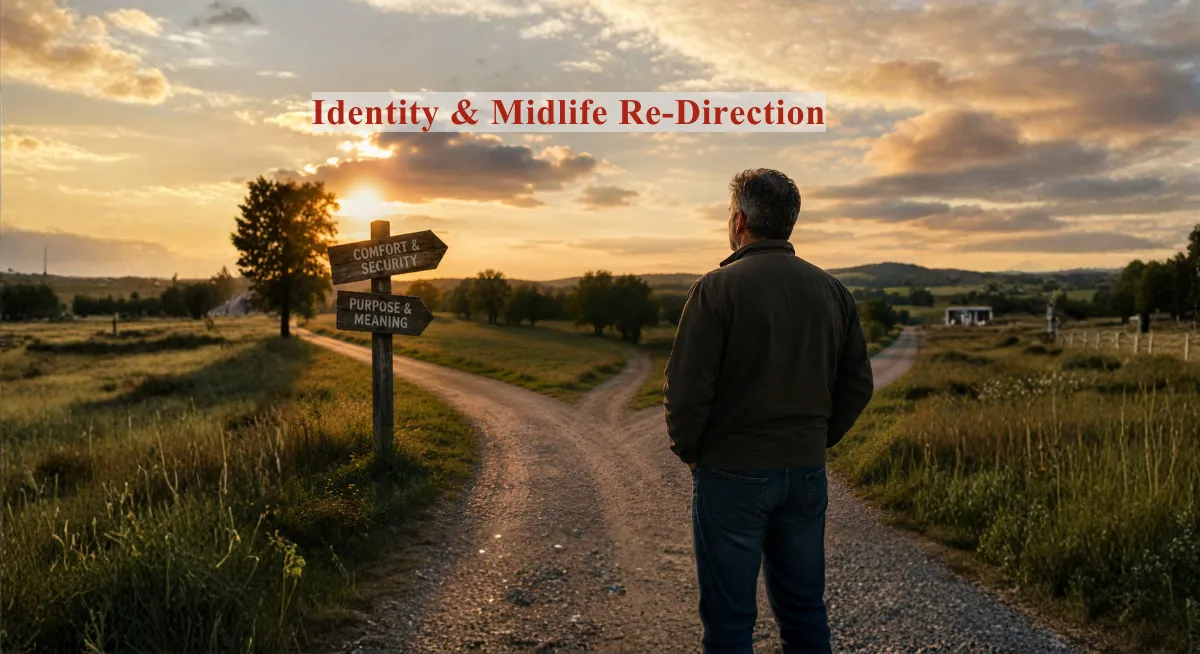
Identity & Midlife Re-Direction
Why Midlife Isn't a Crisis God Gave You, And How Scripture Points You Toward the Second Half That Compounds the First
You've watched it happen. Someone you respected was one person at 35 and a different person at 52. Not different in a "they grew" sort of way. Different in a "what happened to them" way. The colleague who traded a two-decade career for something that looked less like a Calling and more like a panic attack. The friend whose marriage held for twenty-five years and cracked in the fifth year of the empty nest. The executive whose successful career started feeling like a stranger's job halfway through her fifties. The pastor who spent the summer before his sabbatical drinking more than he admitted to his wife. The woman who walked out of her ministry role at 49 without a plan and only told two people why. Midlife took them. Or more accurately, midlife came calling with a question most Christians never prepared to answer, and the answer they improvised in the moment turned out to be expensive. If you've searched "Christian midlife crisis," "midlife identity re-direction Christian," or "why do I feel lost in my forties and fifties," this post is the one I'd hand you across a table. Midlife isn't a crisis God imposed on you. It's a re-direction Scripture has always known was coming, and how you navigate it determines whether the second half of your life compounds the first or compensates for it.
Quick Answer: Short version, because if you're reading this, there's a good chance something in your life has started feeling misaligned and you don't yet have the language for what changed. The midlife crisis most Christians have heard about isn't inevitable. It's what happens when someone has built identity on something that was always going to run out, career trajectory, parenting role, physical youth, applause, and panics when the thing starts receding. The crisis is the panic. The re-direction is a different path, available to anyone willing to let midlife do what God designed it to do. Scripture is fu...
The path is diagnostic before it is prescriptive. Name what identity has been anchored to. Notice what's receding. Let midlife surface the question you've been postponing. Let Scripture give you a different answer than the one your culture pressures you to improvise. The P2-Driven Framework walks you through exactly that, and what it produces is a second half of life that makes the first half make sense, rather than apologize for it.
Keep reading for the full breakdown.
And now… the rest of the story.
Why Midlife Hits Christians Especially Hard
Christians often assume that Faith insulates them from midlife disruption. It does the opposite. Christians who have been faithfully serving, parenting, leading, and achieving often arrive at midlife with a specific version of the problem nobody warned them about. They thought the Calling they picked up at twenty-five would carry them for a lifetime. Midlife is when the Calling reveals whether it was the whole Calling or just the first chapter.
The quiet truth is this. Many Christians built a faithful life around roles rather than identity, and the roles were always going to change. The young dad identity doesn't survive the kids leaving for college intact. The fast-rising executive identity runs into a ceiling somewhere in the fifties that the thirties didn't prepare anyone for. The ministry leader who poured decades into building something watches the thing evolve past them. The high-achieving spouse whose partner suddenly needs a different kind of relationship can't locate themselves inside the shift. None of this is Faithlessness. It is the structure of a life built on roles meeting the season when roles change.
Add the body into the equation. Sleep doesn't work the way it used to. Energy doesn't recover the way it used to. Hormones shift, sometimes dramatically. Old injuries start speaking. The face in the mirror stops matching the identity running the show. None of this is a spiritual problem, and all of it is interpreted spiritually if you have no other language for it.
The confusion compounds because Christian culture has been more comfortable warning against midlife crisis than preparing people for midlife re-direction. The prevention language has been clearer than the formation language. As a result, many Christians arrive at the re-direction with nothing but crisis-prevention vocabulary, and crisis-prevention isn't the same as path-finding. You can successfully avoid the red sports car and still end up with a life you don't recognize.
The Difference Between Crisis and Re-Direction
The crisis version of midlife and the re-direction version look similar from the outside. Both involve big changes. Both feel disorienting. Both often include some form of grief. The difference isn't the intensity. It's the posture toward what midlife is surfacing.
Crisis says the receding thing needs to be replaced fast, before the loss becomes unbearable. The career plateau needs a pivot nobody has thought through. The empty nest needs a distraction. The aging body needs a workaround. The cooling marriage needs a spark imported from somewhere else. Crisis is reactive. It treats midlife as an emergency, and the decisions made under emergency logic tend to be expensive ones.
Re-direction says the receding thing was always going to recede, and the season is asking a deeper question than what to replace it with. Re-direction is reflective. It sits with the loss without panicking. It lets grief speak. It allows Scripture to ask what identity has been anchored to, and it lets the Spirit reframe the second half as an invitation rather than an accident. Re-direction produces decisions that compound the first half, because the decisions are being made from a place of anchored identity rather than scrambling self-preservation.
As we walked through in Calling Without Burnout, most of what Christian leaders confuse with Calling fatigue is actually engine fatigue, and fixing the engine changes the pace without abandoning the Calling. The same principle applies to midlife identity. Most of what feels like a Calling problem at forty-nine is actually an identity-and-engine problem that the Calling has quietly been exposing for years. Midlife is when the exposure becomes impossible to ignore.
What Midlife Is Actually Surfacing
If you sit with midlife long enough to let it speak, it usually surfaces a short list of specific questions. These are the ones worth hearing.
1. Who am I when the role I built my life around is over?
If identity was anchored to being the provider, the mom of young kids, the senior leader, the athlete, the pastor with the growing church, midlife will eventually hand every one of those identities a set of changes they can't fully control. The question isn't whether the role ends. It's whether there is a self underneath the role when it does.
2. Did I build the life I thought I wanted, or the life other people approved of?
This is the question a lot of Christians refuse to ask until midlife forces it. The faithful, responsible, culturally commended life that seemed obviously right at twenty-five starts looking less obvious at forty-eight, and the gap is often the gap between what God was Calling and what everyone around you approved of. Those two paths often run parallel for years. Midlife is when they usually part.
3. What have I been postponing that I can no longer postpone?
Most adults carry a small list of things they always thought they'd get to. The conversation with the father. The written thing. The adopted child. The surrendered grudge. The career the voice inside them has been naming since their twenties. Midlife tightens the runway. The postponed things start pressing harder, because the arithmetic finally feels real.
4. What have I been pretending to believe that I don't actually believe anymore?
For many Christians, midlife surfaces a quiet review of inherited Faith. The beliefs absorbed from parents, culture, denomination, or ministry tribe get tested by decades of real life. Some of those beliefs strengthen. Some of them collapse. Some are clarified. This isn't a Faith crisis. It is a Faith maturation, and refusing to let the review happen is how Christians drift into quietly-held cynicism that nobody diagnoses until much later.
5. What do I want the second half of my life to make of the first?
This is the question the Gospel most wants to ask a Christian in midlife. The first half of life was preparation in ways you couldn't see while you were living it. Midlife is the turning point where the preparation starts looking for its use. Scripture is full of this. Moses's left the Egyptian Kingdom to become a shepherd at forty, leading Israel out of Egypt at eighty. Abraham had seventy-five years just being Abram before the Calling. Then there was Paul's life of zealous legalism and persecuting Christians before his Damascus transition. The Father wastes very little, and the second half of a surrendered life routinely compounds the first half in ways nobody at twenty-five could have predicted.
The Gospel Foundation: Identity Is Given, Not Earned
The deepest word Scripture has for a midlife Christian is about where identity actually comes from. Paul wrote to the Colossians, "You have died, and your life is hidden with Christ in God" (Colossians 3:3, ESV). That one sentence dismantles half the midlife crisis industry. If your life is hidden with Christ in God, it isn't stored in your career, your parenting role, your body, or your reputation. None of those can be taken from you at fifty-three, because none of those were holding the real thing in the first place.
John wrote, "See what kind of Love the Father has given to us, that we should be called children of God; and so we are" (1 John 3:1, ESV). Identity as a child of God isn't earned by output, preserved by youth, or validated by applause. It's given. It precedes everything the first half of your life built, and it survives everything midlife recedes from under you. As we walked through in Calling Is Formed Through Love, the Calling that actually holds is the one formed in the Love of the Father rather than the approval of the audience, and midlife is where the difference between those two foundations usually becomes obvious.
What Christians who let midlife do its work usually discover is that the Gospel was more real than they'd been living it. They had been operating on a functional identity of faithful achiever or good spouse or responsible leader, and the Gospel had been underneath it all along, waiting for one of those functional identities to crack open enough for the Cross-shaped one to become load-bearing. Midlife crack-open is a gift, even when it doesn't feel like one.
Midlife Through the P2-Driven Framework
The Framework gives midlife re-direction an architecture.
In Get Clear, you honestly name what identity has been anchored to. Not the version you'd give at a dinner party. The real version. If the role I've built my life around ended tomorrow, who would I be? If no one noticed anything I accomplished this year, would I still know I was Loved by the Father? Clarity for midlife is always harder than it sounds, because the answers Christians want to give aren't always the answers their lives have been producing.
In Align with God's Heart, you surrender the functional identities to the Gospel one. You let hidden with Christ in God become the actual foundation, not just the memory verse. Alignment in midlife is the willingness to have your life reorganized around a Love that was already there, rather than defended around a role that was always going to change. It often looks like Prayer that says, Lord, pry my fingers off what I've been holding, and hold me with what I should have been holding all along.
In Get Fit, you build the rhythms that let the re-direction take root. Silence. Solitude. Sustained Prayer. Honest community. Physical rhythms suited to the body you actually have now, not the one you had at twenty-eight. Sleep treated as a spiritual discipline. These rhythms aren't self-care. They are the scaffolding on which the second half gets built, and most midlife re-directions collapse back into crisis because the rhythms weren't in place to hold the work.
In Live Your Legacy Today, you reframe the second half as the Legacy chapter, not the decline chapter. As we walked through in Calling as Stewardship, the Calling Christians are given isn't a career. It's a stewardship. Midlife is when stewardship language finally makes sense, because the first half of life taught you what you have to steward, and the second half is where the stewarding gets done. Legacy in midlife isn't the eulogy. It's the next twenty-five years.
Rhythms for a Re-Directed Midlife
If you sense midlife stirring, a few rhythms do most of the work.
Regular extended silence. A half-day or full day, monthly, with no input. No phone. No podcast. No agenda. Let the questions midlife is surfacing rise and speak. Most Christians can't hear what midlife is actually saying because they haven't turned the noise off long enough to listen.
A spiritual director or coach who won't flinch. Someone outside the hierarchy who can hold the questions you can't yet answer without needing to solve them for you. Many midlife crises happen because the person had no one safe enough to sit with them through the slow version.
A ninety-day audit of functional identity. Quarterly, ask what identities you are still operating from. Name which of them are Gospel-founded and which are role-founded. Notice which ones have been quietly receding. The audit is the honesty that prevents the slow drift from becoming a sudden crash.
Scripture that specifically names midlife saints. Read Moses's story in Exodus. Abraham's in Genesis. Paul's in Acts 9. Let the Biblical record of older Calling soak in. Most Christians have been fed a disproportionate diet of youth-focused Faith narrative. Midlife needs a different shelf of the Bible.
Physical rhythms suited to this season. The body you have now is the vessel the second half will be lived in. Sleep, strength training, walking, sunlight, and sustainable nutrition are not vanity projects. They are the infrastructure for the Legacy work. Ignore them and the re-direction stalls for reasons you'll be tempted to interpret spiritually.
A surrender Prayer said daily. Something simple enough to repeat. Father, my life is hidden with Christ in You. Reorganize me around what's actually true. Said once a day, with a little belief behind it, this kind of Prayer does more work than it looks like it does.
These rhythms feel slow before they feel transformative. That's the signal you're doing them correctly.
Live Your Legacy Today
The honest word for midlife Christians on Monday morning is this.
Midlife isn't a crisis God gave you. It's a re-direction God has always known was coming, and He has been preparing you for it longer than you realize. The career, the kids, the body, the reputation, the ministry, the marriage, none of those were the point. They were the preparation. The point is the second half, and the second half is available to anyone willing to let the first half be exactly what it was and nothing more.
The Gospel is enough to hold you while the roles change. The Father is not embarrassed by what midlife is surfacing. He has been waiting to meet you on the other side of the image you built, and the meeting He has prepared is more real than the identity you've been operating from. Let midlife do its work. The second half is worth the surrender.
Midlife isn't the end of who you thought you were. It's the invitation to finally meet who God has been calling you toward the whole time.
Going Deeper
In my upcoming book, Your Purpose & Principle Driven Life 2.0, a full section is given to midlife re-direction as a central Christian experience, including the specific diagnostics, Scriptures, and rhythms that have helped leaders and spouses navigate this season without losing themselves in it. The book was written for Christians who suspect there is more to the second half than the first half has hinted at, and who want a framework that is honest about what midlife costs and what it can produce.
What Coaching From AI Bots Misses
A Christian in midlife can ask an AI bot for wisdom about this season and receive a thoughtful, well-sourced summary of the usual advice. The leader will read it at 6:14 a.m. over coffee and feel briefly seen. Nothing will change. The advice will live in a tab somewhere, while the actual midlife work goes undone for another year.
The bot can't sit with you. The bot doesn't know that your father died three years ago and you haven't cried yet. The bot doesn't see that your career pivot idea is a panic reaction to a conversation you had with your board two weeks ago. The bot gives you information. Midlife doesn't get re-directed by information. It gets re-directed in the presence of someone who can hold the questions long enough for the Spirit to answer them.
A coach does what the bot can't. A coach sits in the slow work. A coach notices the panic disguised as clarity and asks what it's protecting. A coach stays in the room when you don't yet have the language for what's receding. That kind of companionship is what turns midlife from a crisis into a re-direction, and it is the kind of work no automated tool will ever substitute for.
→ If you're in the middle of midlife and you want a coach who will walk with you toward a re-directed second half instead of a scrambled one, book a discovery call: https://p2driven.com/discovery-call
FAQ: Christian Midlife Re-Direction
How do I know if I'm in a midlife re-direction vs. a midlife crisis?
The crisis version is reactive, fast, and often aimed at replacing the receding thing with something that restores the previous identity. The re-direction version is reflective, slower, and willing to sit with the loss before deciding what to do. Crisis decisions are usually made inside a three-month panic window. Re-direction decisions are usually made inside a two-year discernment window. The tempo is a reliable diagnostic.
Is it too late if I'm already well past fifty?
No. Moses was eighty when the burning bush found him. Abraham was seventy-five when God called him to leave Ur. The Christian tradition is full of second-half Callings that emerge long after the culture's timeline would have written someone off. What matters isn't the number. It's the willingness to let the re-direction do its work whenever it arrives.
What if my marriage is also strained during this season?
Midlife often stresses marriages because both spouses are frequently navigating their own re-directions at the same time, sometimes in different directions. The strain is common, and it is usually workable with honest, patient work. What matters most is not treating the marriage as a role to escape. Treating it as a covenant worth rebuilding with two re-directed adults is often the path forward. Coaching or counseling helps significantly.
How long does midlife re-direction take?
Most of the deep work happens across eighteen to thirty-six months, sometimes longer. The acute disorientation usually settles within six to twelve months. The rebuilding of a second-half identity and rhythm pattern takes longer. The slow timeline is part of the design. Trying to speed it up tends to produce the crisis version rather than the re-direction version.
Is it wrong to make changes during midlife, or should I just stay put?
Some real changes are part of a genuine re-direction. The question isn't whether to change. The question is whether the change is anchored in Gospel identity or in panic. A change made from an anchored place tends to compound the first half. A change made from a panicked place tends to compensate for it. The test is whether you could explain the decision honestly to a wise friend and have the explanation survive scrutiny. If not, the decision probably needs more time.
