Enneagram: The Fight You Keep Having – And What Your Type Has to Do With It
And What Your Type Has to Do With It
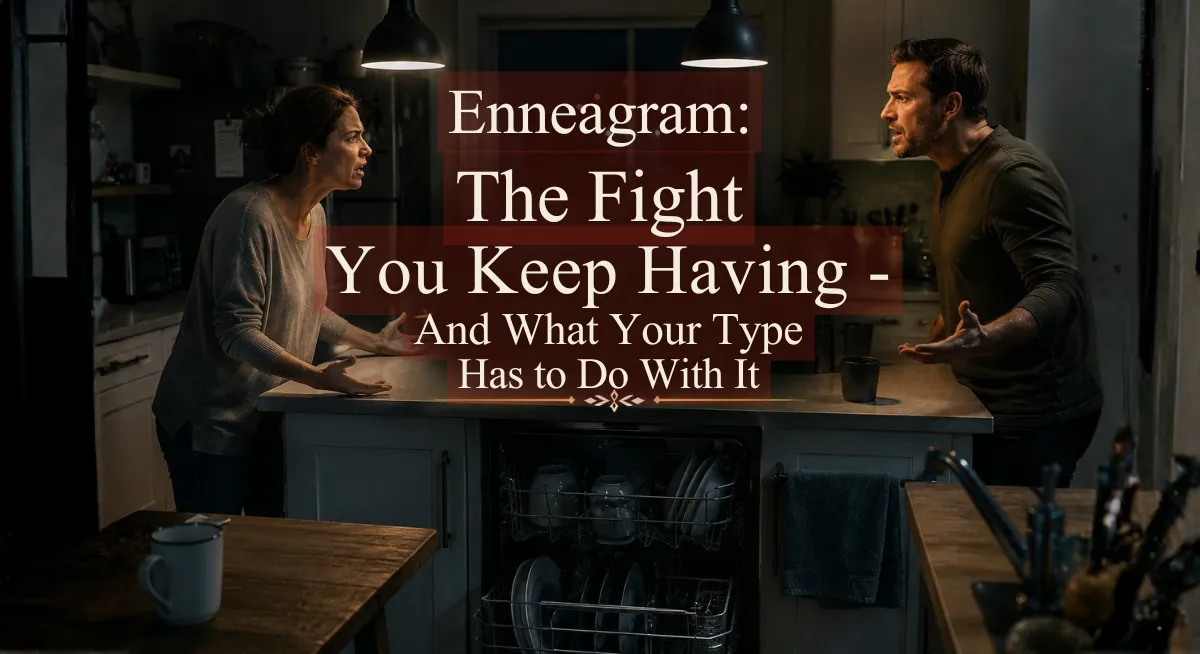
The fight starts at 7:40 on a Tuesday night, over the dishwasher. Not the dishes themselves. The way the dishes were loaded, which is somehow about respect, which is somehow about the weekend calendar, which is somehow about a sentence one of you said in the car in 2021. By 9:55 you are both running lines from a script you could recite in your sleep, because you have. This is the fifth year of this fight.
Most couples know some version of it. The topic rotates. The dishes, the calendar, the in-laws, the money, the phone. The structure never rotates. One of you moves toward the problem and gets louder. One of you moves away and gets quieter. Both of you leave the room certain the other one started it, and both of you are wrong, because the fight didn’t start in the kitchen. It started in two nervous systems that learned two different survival strategies decades before you met.
If you’ve searched “why do we keep having the same fight,” “enneagram conflict patterns in marriage,” or “how to stop repeating arguments with my spouse,” this post is the one I’d hand you across a table. The recurring fight is the most practical place your Enneagram type shows up in your marriage. It is also one of the most hopeful, because a loop that runs on autopilot is a loop that awareness can interrupt.
Quick Answer: The fight you keep having is rarely about its subject. It is two Enneagram autopilots colliding on schedule. Under conflict stress, every type falls back on the survival strategy it has practiced since childhood, and when two of those strategies interlock, one pursuing while the other retreats, the couple gets a recurring fight with interchangeable topics. Scripture diagnosed the mechanism long before personality science did: “What is causing the quarrels and fights among you? Don’t they come from the evil desires at war within you?” (James 4:1). The loop breaks when one person sees their half of it clearly, and naming your side of the loop is the first act of Love that changes it.
Get the Gist Quick
Short version, because some of you had this fight last night.
Every Enneagram type has a conflict autopilot, the move it makes when a disagreement starts to feel threatening. Body Center types (8, 9, 1) fight with the will. Control, compliance, correction. Heart Center types (2, 3, 4) fight with the relationship’s story. Score-keeping, performance, feeling unseen. Head Center types (5, 6, 7) fight from a distance. Analysis, cross-examination, escape.
When your autopilot interlocks with your spouse’s, the fight becomes structural. It repeats because the pattern repeats, not because the topic never got resolved. Topics are interchangeable. The loop is not.
James 4:1 locates the quarrel between you inside the war within you, and that is good news wearing work clothes. It means the fight can change without your spouse changing first, because half of the loop lives in you.
Keep reading for the full breakdown.
And now… the rest of the story.
The Fight Is Never About the Dishes
James asked the diagnostic question two thousand years before marriage researchers got funding for it.
“What is causing the quarrels and fights among you? Don’t they come from the evil desires at war within you? You want what you don’t have, so you scheme and kill to get it. You are jealous of what others have, but you can’t get it, so you fight and wage war to take it away from them.” (James 4:1-2)
The order matters. James doesn’t start with the quarrel. He starts with the desire underneath it, the thing you want and are not getting. To be respected. To be safe. To be chosen. To be right. To be left in Peace. The dishwasher is a delivery mechanism. The desire is the cargo.
Couples who fight about topics stay in the loop for decades, because topics are infinite. Couples who learn to name the desire underneath their own half watch the loop lose power in months. Your Enneagram type is the map to that desire.
Two Autopilots on a Collision Schedule
Every type carries a core fear, and under conflict stress the type does what it learned to do about that fear before you were old enough to name it. The Active Controller feels the threat of being controlled and pushes harder. The Adaptive Peacemaker feels the threat of the conflict itself, goes along in the moment, and goes away afterward. Autopilots, engaging in about a quarter of a second, before anyone in the kitchen has decided a single thing.
James calls it desires at war within you. Communication researchers call it demand/withdraw. A meta-analysis of 74 studies covering more than 14,000 people found the interlock of one partner pursuing (demanding, criticizing, escalating) while the other retreats (defending, going quiet, leaving) to be among the most corrosive patterns a relationship can run, reliably tied to lower satisfaction for both people.1 That study is older than most I cite, and it has held up as the foundational benchmark because the finding repeats everywhere researchers look. A 2022 meta-analysis of 64 couple studies added the long view: negative communication patterns predict where a relationship’s quality is headed years out, and whether it survives at all.2
Now put two autopilots in one kitchen. The pursuer’s escalation confirms the withdrawer’s instinct to retreat. The retreat confirms the pursuer’s conviction that nothing gets addressed unless they push. Each strategy feeds the exact fear driving the other one, which is why the fight arrives on schedule and why it has never once cared what the topic was.
You’re not incompatible. You’re interlocked.
What Your Center Does When the Fight Starts
Nine exhaustive profiles would bury the point. You are looking for your own move, and the three Centers narrow the search. (Most of us read our spouse’s line first and nod. Read your own line twice.)
Body Center types fight with the will. The Active Controller (Type 8) escalates. Volume rises, the point sharpens, and for about ninety seconds winning matters more than the marriage. The Adaptive Peacemaker (Type 9) agrees in the room and then disappears from it, sometimes for two days, present at dinner and gone behind the eyes. The Strict Perfectionist (Type 1) argues the principle. The correct way to load the racks, the correct tone, and eventually the correct wording of your apology.
Heart Center types fight with the relationship’s story. The Considerate Helper (Type 2) produces the ledger, every unthanked gift and unnoticed sacrifice, with dates. The Competitive Achiever (Type 3) turns the conflict into a project and would rather solve it than feel it, ideally in under four minutes. The Intense Creative (Type 4) reads the fight as evidence of being fundamentally unseen, and the withdrawal that follows has weather to it.
Head Center types fight from a distance. The Quiet Specialist (Type 5) goes silent mid-sentence and finishes the argument alone, hours later, in an inner courtroom where they win. The Loyal Sceptic (Type 6) cross-examines. What did you mean, what are you not saying, what happens if this is worse than it looks. The Enthusiastic Visionary (Type 7) reframes, jokes, and suddenly has somewhere to be, because staying inside the discomfort is the one move that type refuses to make.
Somewhere in those nine sentences, you flinched. The flinch is the map talking. That move is your half of the loop, and as we walked through in You Know Your Type – Now What?, seeing your pattern clearly is Step One.
The Loop Breaks When One Person Sees Their Half
A kitchen in Texas. It’s 2019, 7:40 on a Tuesday night, and a man is re-loading a dishwasher his wife already loaded, jaw tight, saying nothing loudly. She asks a question about the weekend. He answers with a plan, a defense of the plan, and a volume the plan didn’t need. She goes quiet. He takes the quiet as agreement and finds out on Friday it wasn’t. The two of them had been running that exact exchange since their daughters were in car seats.
You’ve already guessed the man. The wife was Heidi. The fight had followed us from a teacher’s paycheck to an oil-patch pickup to a corner office without once changing its structure, and what finally interrupted it wasn’t a better argument. It was an iEQ9 report and one uncomfortable hour of seeing my half in print. The escalation. The plan delivered as an answer to a question nobody asked. The way my certainty made quiet the only room left in the house. I couldn’t unsee it, and the next time the loop started, I watched my own hand reach for my usual line, and I put it down.
That is the mechanics of hope in a recurring fight, and it is smaller than you feared. Nobody has to fix the whole marriage tonight. One person sees their half, hands it to God, and declines to feed the loop one time. The loop stumbles. Decline again next week and the loop starts starving, because a script only survives while everyone keeps reading from it. David gave this work its Prayer three thousand years ago: “Search me, O God, and know my heart; test me and know my anxious thoughts. Point out anything in me that offends you, and lead me along the path of everlasting life” (Psalm 139:23-24). Prayed before 9:40, that request has saved more marriages than eloquence ever will.
The P2-Driven Framework for the Fight You Keep Having
The Framework gives this work a repeatable shape.
In Get Clear, you name your conflict autopilot with the precision the iEQ9 makes possible. “We fight too much” names a weather pattern. “When Heidi questions my plan, I escalate, and my escalation triggers her retreat” names a loop with your fingerprints on half of it. Clarity that specific is uncomfortable, and it is the doorway.
In Align with God’s Heart, you take James 4 at its word and bring the desire under your half to the Father by name, the respect or safety or Peace your strategy has been trying to secure by force. As we covered in Marriage as Spiritual Alignment, a marriage strengthens fastest when each person aligns with God first and finds the other closer for it. Surrender your strategy in Prayer before the next fight, and you will have somewhere to stand during it.
In Get Fit, you train in peacetime. Conflict fitness is built the same way trust is rebuilt. The rhythms in Habits That Rebuild Trust are the same muscles. Small repetitions, scheduled, kept, long before the stakes rise.
In Live Your Legacy Today, you remember who else lives in the house. Your kids never hear your intentions. They memorize your loop, and they will run it in kitchens you’ll never stand in. Break your half and you are doing more than changing a marriage. You are editing the conflict script your grandchildren inherit.
Three Rhythms for the Next Fight
Start with three practices. They are small on purpose, and none of them require your spouse to have read a single word about the Enneagram.
The pause word. Pick it together in peacetime. Either of you can call it when the loop engages, and it buys a fifteen-minute recess with a guaranteed return time. The withdrawer gets room to think. The pursuer gets a promise the issue will not disappear.
The replay. Within a day of any fight, each of you names your own move first, in one sentence, out loud. “I escalated.” “I left.” No commentary on the other person’s sentence. Going first on yourself is the whole exercise.
The fifteen-minute Tuesday. One scheduled check-in a week where the desires underneath get to speak in daylight. Desires with a standing appointment will stop booking the 7:40 slot.
Run them for a season, imperfectly. Rhythms outlast motivation, which is why they beat resolutions here the same as everywhere else.
Live Your Legacy Today
On any given Thursday morning, the honesty looks like this.
The fight will probably try to happen again this week. The trigger is already scheduled, somewhere between the dishwasher and the calendar, and your line in the script is already memorized. The difference is that now you know it’s a script. Ask God to search your half before the loop starts. Call the pause word when it does. Put your line down once, and watch what one dropped line does to a scene that needs two actors.
The couples who get free of the recurring fight never found a marriage without conflict. They found the loop, owned their halves, and let God re-pattern what white-knuckle politeness never could. Their kitchens still have dishwashers and calendars and7:40 on Tuesdays. The war inside stopped supplying ammunition, and the quarrels outside quietly ran out of it. That Peace is available to any two people willing to start with one.
Going Deeper
My upcoming book, Your Purpose & Principle Driven Life 2.0, walks the four phases through your closest relationships in full, with Scripture anchors, type-aware applications, and practice plans for couples doing this work side by side. If this post named your kitchen, the book is the longer conversation it came from.
→ If you want a coach who will help you find your half of the loop and walk with you while God re-patterns it, book a discovery call: https://p2driven.com/discovery-call
FAQ: Enneagram Conflict Patterns in Marriage
Do my spouse and I both need to know our Enneagram types for this to work?
No. The loop weakens when either person stops feeding their half. Knowing both types adds Grace and shared language, and it is worth doing together when your spouse is willing. Your own pattern remains the only one you can change, and changing it is enough to change the fight.
Which Enneagram types clash the most in marriage?
No pairing is doomed and no pairing is safe. Conflict frequency has less to do with which types marry than with how aware each person is of their own stress strategy. Two aware people with clashing autopilots will fight better than two unaware people with compatible ones.
Isn’t calling the fight an autopilot a way of avoiding responsibility for sin?
It works in the opposite direction. James 4 locates the quarrel in desires at war within you, which makes the recurring fight a discipleship issue rather than a personality quirk. The Enneagram names your pattern so you can repent of it specifically instead of vaguely. Precision increases responsibility; it tells you exactly what to bring to God.
What is the demand/withdraw pattern?
It is the interlock where one partner pursues an issue while the other retreats from it, and a meta-analysis of 74 studies found it among the most damaging patterns a couple can run. The roles are not fixed; the person who pursues about money may withdraw about intimacy. Watch for the structure rather than for a villain.
How long before the recurring fight changes?
Most couples notice the loop losing force within a few months of one person consistently naming and dropping their half. The topics still come up; the escalation stops arriving with them. Deeper re-patterning takes a season of rhythms rather than a single insight, and the early wins usually show up fast enough to keep you going.
When is this a counseling issue instead of a coaching one?
If abuse, betrayal, addiction, or a mental health crisis is in the mix, start with a licensed counselor, because those wounds need clinical care. Coaching serves couples whose recurring fight is a pattern problem inside an otherwise safe marriage. Many couples use both, and a good coach will tell you when you need the other room.
