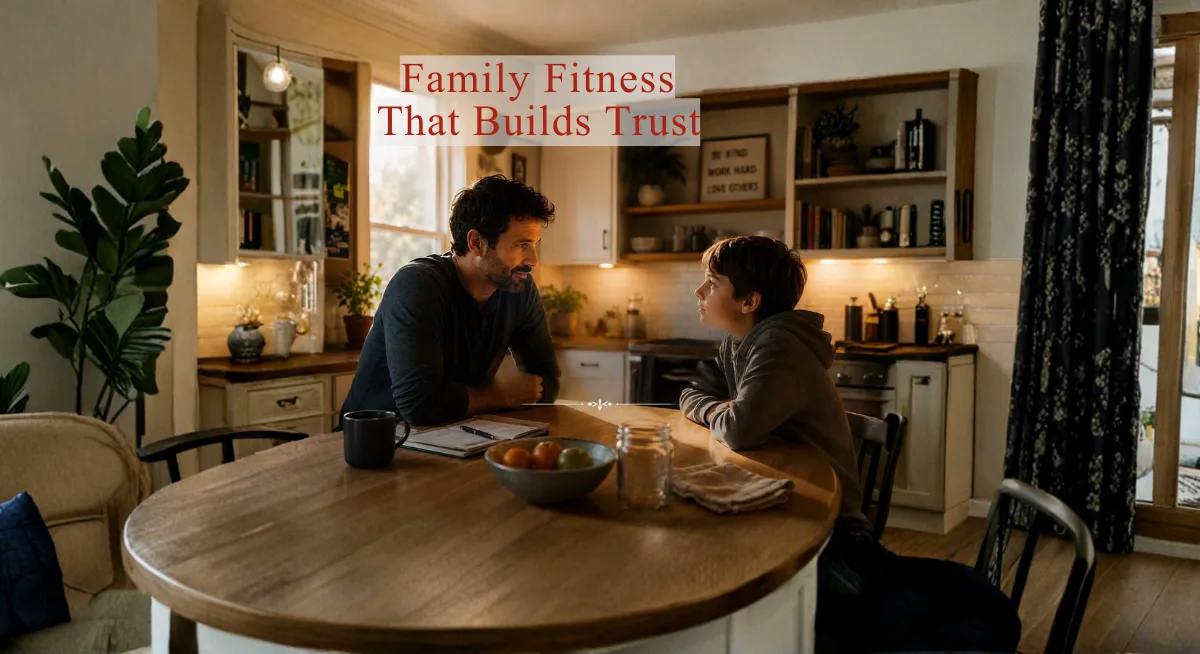
Family Fitness That Builds Trust
The Ordinary Rhythms That Quietly Form a Home Where Kids Know They Can Count on the Adults
Quick Answer: Family Trust is built through small, repeatable Fitness-pillar rhythms, not through lectures or dramatic conversations. Eight rhythms do most of the work: predictable presence, follow-through on small promises, fast repair, honest apology, protected weekly anchors, one-on-one time, visible Prayer, and non-performative affection. Trust compounds across weeks, months, and years, and the rhythms become the home that becomes the Legacy.
Ask a teenager to describe their family and listen past the first sentence. The first sentence is for you. The second sentence is honest. "We're close," is often followed by "but I don't really tell my parents much." "My dad's great," is often followed by "I just don't know what mood he's going to be in." The gap between those two sentences is where Family Trust lives or quietly dies.
If you've searched "how to build trust with my kids," "Christian family rhythms," or "why won't my teenager open up," this post walks through what Family Trust actually is, why most Christian families run a quiet deficit, and the eight Fitness-pillar rhythms that build a home kids can count on.
What Is Family Trust, Actually?
Family Trust isn't a feeling kids produce. It isn't a decision they make. It is what their nervous systems produce when the adults in their home have been predictable, safe, and honest long enough that the kid's inner watchman can finally sit down.
Children are wired for pattern recognition. Before they can name what's happening, they are tracking. They know which parent handles a spilled drink calmly and which one doesn't. They know the mood in the car ten seconds after the door closes. They know which stories to tell at dinner and which to save for a friend's car ride home. They know whether "I'm sorry" actually lands or arrives wrapped in a defense of the original action.
When the adults are trustworthy, the scan eventually relaxes. The kid's body stops bracing. Conversations get longer and more honest. The kid brings the hard story home instead of to a friend's car. The Trust was produced by the pattern, not by the lecture. Kids trust what they can predict and what they have experienced as safe across time.
Why Do Most Christian Families Run on a Trust Deficit?
Most Christian families aren't neglectful. They're busy. Stretched. Running on depleted tanks, navigating school schedules, work pressures, church commitments, and the quiet assumption that the family will be fine because the parents are Faithful. That assumption is where the deficit starts. Faithfulness in service of others doesn't automatically produce Trust at home.
A Faithful parent with no rhythms is a parent whose kids feel Loved in theory and unsure in practice. The kids see you serving the neighborhood and wonder when you'll have an afternoon for them. They hear you Pray at dinner and wonder why the tone at breakfast was so sharp. They watch you apologize publicly and wonder why apologies in the kitchen carry an excuse attached.
As we walked through in What Your Marriage Is Modeling, the marriage itself is part of the family's Trust curriculum. The way the adults treat each other teaches the kids whether adult Love is safe. Family Trust and marriage Trust are not separate subjects. They are the same subject seen from two angles, and a rebuild in one rebuilds the other across time.
What Does the Gospel Say About Family Trust?
Scripture gives parents a model that most of us under-use. God introduces Himself again and again as the Faithful Father. "Know therefore that the Lord your God is God; he is the Faithful God, keeping his covenant of Love to a thousand generations" (Deuteronomy 7:9, NIV). The Faithfulness runs across generations because the rhythms run across generations.
Jesus described the Father in the parable of The Prodigal Son (Luke 15:11-32) as the one who runs to meet the returning kid. The son rehearsed a speech of shame. The father interrupted it with a robe, a ring, and a feast. Notice what that kind of predictable Love does to a returning kid. It tells him that the safest place to come home to was always going to be home.
That Father is the model. He's predictable without being rigid, warm without being flighty, Loving without being naive, and Faithful across time in a way that makes every other family Trust a smaller version of the same architecture. A Christian home built on those rhythms isn't copying a technique. It's reflecting a character.
Eight Rhythms That Build Family Trust
Family Trust is built with Fitness-pillar rhythms, the small practiced behaviors that add up over years. These eight do most of the work.
Predictable presence. Your kids don't need you around every hour. They need to be able to predict when you will be. The dad who leaves work on time three nights a week and the mom who protects Saturday mornings are writing a Trust pattern nobody's going to thank them for out loud. The predictability is the gift.
Follow-through on small promises. Big promises feel impressive. Small promises kept are what kids measure you by. "I'll take a look at that homework tonight" is a Trust transaction. If you forget three of those in a row, your credibility on the bigger promises is already gone. Kids don't announce the lost Trust. They quietly stop bringing requests.
Fast repair after a rupture. You will lose your temper. You will speak sharply. You will misread a situation and come down too hard. As we covered in Habits That Rebuild Trust, the rupture itself isn't the Trust problem. The unrepaired rupture is. A parent who names a wrong, apologizes specifically, and reconnects within twenty-four hours rebuilds Trust faster than a parent who avoids the topic and hopes time will heal it.
Honest apology without excuses. Apologies that include "but you…" aren't apologies. They are re-litigations of the original conflict. A real apology names the specific wrong, takes full ownership, acknowledges the impact, and asks what's needed. Kids can smell the difference between the two kinds of apology by the time they're six.
Protected weekly anchors. Family dinner most nights. Saturday morning breakfast. Sunday together. Sabbath that actually slows down. These rhythms become the skeleton of the kids' sense of home. When the anchors hold, the kids' inner watchman takes the night off. When the anchors drift, the watchman comes back online.
One-on-one time that isn't optional. Group family time is important. One-on-one time is where real Trust gets transferred. A walk with one kid. A coffee with another. A drive with the third. Fifteen minutes of undivided attention builds more Trust than two hours in a crowded room with everyone looking at screens.
Visible Prayer and Faith in the ordinary. Pray for your kids out loud. Pray with them when they're scared. Pray over the car before a long trip. Pray over the dinner without making it theater. The kids don't remember the content of family devotion as vividly as they remember that Mom Prayed for them by name on a hard Tuesday.
Non-performative affection. Hugs in the kitchen. A hand on a shoulder when the kid walks in discouraged. A kiss on the head before bed, even when the kid is thirteen and rolls their eyes. Affection that isn't staged and isn't hidden teaches a kid that their body is safe in this house and their proximity is welcome.
Family Trust Through the P2-Driven Framework
The Framework gives the rhythms a sustainable architecture.
In Get Clear, you audit the Trust account in your home honestly. Not the highlight reel. Which of the eight rhythms are running well? Which ones have drifted? Which kid in your house has the lowest-balance account, and when did that start? Clarity for a family's Trust isn't a nice thought. It's an inventory.
In Align with God's Heart, you run what you found against the Faithful Father in Scripture. Your rhythms aren't trying to copy a technique. They are reflecting a character. Alignment means asking the Father to re-pattern your Love after His, and letting the Spirit shape the specific places your Faithfulness has been thin.
In Get Fit, you build the rhythms on purpose. Not all eight at once. Pick two or three you've been drifting in and put them back on the calendar. Rhythms don't require dramatic overhaul. They require repetition. The kid who watches you start showing up to breakfast for three straight weeks has already updated their Trust file.
In Live Your Legacy Today, you recognize that the Trust in your home today is the Legacy in their homes tomorrow. Kids who grew up in a Faithful rhythm carry a template into their own marriages and parenting. Kids who grew up in Trust deficit carry a different template. The rhythm is the Legacy. The Legacy is the rhythm.
Live Your Legacy Today
On any given Tuesday morning, the honesty looks like this.
Your kids are already writing their family file on you. Every showed-up dinner is a deposit. Every broken small promise is a withdrawal. Every honest apology is interest. Every unrepaired rupture is a fee. The account has been building since the day they were born, and most parents don't check the balance until a teenager goes quiet.
The good news is the rhythms compound. You don't need a dramatic turnaround to rebuild Trust in your home. You need three weeks of predictable presence, followed by three months, followed by three years. Kids track the pattern. The pattern becomes the home. The home becomes the Legacy, and the Legacy travels into their marriages and their parenting whether you ever talk about it again or not.
Family Trust isn't what you teach. It's what you repeat. The ordinary Tuesday is the curriculum, and the Faithful Father is the pattern the whole thing was built to point to.
Key Takeaways
Family Trust is a nervous-system outcome kids produce when the adults in the home have been predictable, safe, and honest long enough that the inner watchman can stand down.
Most Christian families run a quiet Trust deficit because Faithfulness in outward service does not automatically produce Faithfulness in the kitchen.
Scripture's model is the Faithful Father, Deuteronomy 7:9. Christian parenting reflects His character through rhythms, not techniques.
Eight rhythms do most of the work: predictable presence, follow-through on small promises, fast repair, honest apology, protected weekly anchors, one-on-one time, visible Prayer, non-performative affection.
Rhythms compound. Three weeks, three months, three years. The home that emerges becomes the Legacy your kids carry into their own marriages and parenting.
Going Deeper
In my upcoming book, Your Purpose & Principle Driven Life 2.0, I walk through the specific rhythms, Scriptures, and diagnostics that families use to rebuild Trust accounts and reshape the home their kids actually live in. A full section is given to the Fitness pillar as it applies inside the home, because the Faithfulness that builds Family Trust is the same Faithfulness that shapes everything else the family touches.
What Coaching From AI Bots Misses
A Christian parent can ask an AI bot for the best family rhythms to build Trust with their kids. The bot will return a tidy list of Bible verses, parenting principles, and bullet-pointed practices. The parent will read the list at 11:14 p.m. on a Wednesday, feel a small surge of conviction, and go to bed unchanged.
The bot can't see which of your kids is pulling back. The bot doesn't notice that your middle child has stopped volunteering information at dinner, or that your oldest has been eating in their room three nights a week, or that your youngest flinches when you raise your voice about a lost shoe. The bot produces a list. The list is not the same as the work.
A coach does the one thing the bot can't. A coach helps you see the pattern you've been inside of for too long to notice. A coach names the rhythm that broke down during a specific stressful season and never got put back. A coach walks alongside you as you rebuild, without shaming the drift and without sugaring the rebuild.
→ If you want a coach who will help you rebuild the rhythms your family has been missing, book a discovery call: https://p2driven.com/discovery-call
FAQ: Family Fitness and Trust
How do I know if my family has a Trust deficit?
The signs are quiet. Kids who used to share now share less. Bedtime goes faster. Dinner conversation thins. A kid eats in their room more often. The fourteen-year-old answers "fine" to every question. Each of these can have other causes, and none of them in isolation prove a deficit. A cluster of them across months is a signal worth taking honestly.
Can you rebuild Trust with a teenager who has stopped trusting you?
Yes, and it takes longer than rebuilding with a younger kid. Teenagers are tracking the pattern you've been running for years, and they won't update their file on three good days. Sustained, consistent rhythms over months, combined with honest repair of specific past wrongs when possible, does rebuild Trust. Time matters, and so does humility.
What if only one parent is committed to the rhythms?
One parent can start, and usually does. Kids distinguish between parents in their Trust accounts. A Faithful pattern from one parent builds Trust with that parent even when the other parent is still drifting. Over time, a Faithful parent's example often influences the other, though that isn't guaranteed and isn't the reason to do the work.
How many rhythms should we start with?
Two or three. Families that try to install all eight at once usually collapse within a month. Pick the two rhythms where you've drifted the furthest, and the one your spouse and kids would most notice. Put those on the calendar. Run them for ninety days. Then add one more. Rhythms compound. Dramatic overhauls do not.
Is Prayer part of Fitness?
Visible Prayer inside the home is part of the Fitness pillar, yes. Prayer itself is spiritual, and Prayer practiced as a rhythm is part of how a family builds the scaffolding of Trust the Gospel points to. Praying with your kids, over your kids, and in front of your kids forms a pattern no other practice replaces.
