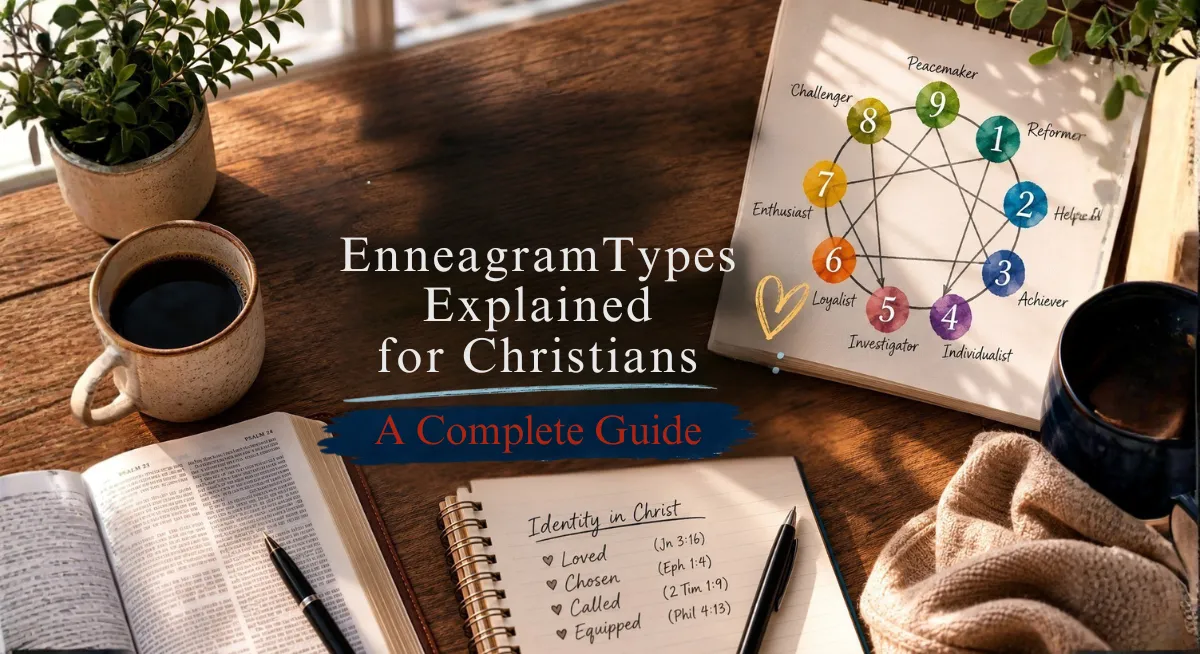
Enneagram Types Explained for Christians: A Complete Guide
The Nine Integrative Enneagram Types, Their Faith Patterns, and How Each One Meets the Gospel
The Enneagram has spread across Christian circles faster than most Christians are comfortable admitting, and the reason is simple. It names patterns every thoughtful believer already suspected were running underneath their behavior. If you've searched "Enneagram types explained for Christians," "9 Enneagram types Christian," or "which Enneagram type am I from a Christian perspective," this guide is the one-page reference. It walks through the nine Integrative Enneagram (iEQ9) types, names the core gift and shadow of each, and links to a full Gospel-centered breakdown for every type. Your type is diagnostic, not identity. The Spirit does the work the mirror can't do. Let's look at all nine.
Quick Answer: The Enneagram is a typology of nine patterns, each rooted in a core fear and protected by a core strategy. The Integrative Enneagram (iEQ9), the clinical version we use inside the P2-Driven Framework, names those nine with specific precision. Type 1 protects against being bad by being right. Type 2 protects against being unloved by being needed. Type 3 protects against being unworthy by achieving. Type 4 protects against being insignificant by being unique. Type 5 protects against being depleted by understanding. Type 6 protects against being unsupported by being vigilant. Type 7 protects agai...
And now… the rest of the story.
What the Enneagram Is (and Isn't)
Before the types, a clarifying word. As we walked through in What Is the Enneagram? A Christian Coach's Guide, the Enneagram isn't a personality test, an astrology system, or a replacement for Scripture. It's a diagnostic tool that names the motivational patterns underneath behavior. It doesn't predict your future. It doesn't condemn your type. It doesn't baptize your weaknesses either. Used well, it gives you language for the autopilot you've been running and shows you where the Spirit is inviting you to grow.
The Three Centers of Intelligence
The nine types are grouped into three Centers of Intelligence, each governed by a core emotion. As we covered in The Three Centers of Intelligence: Head, Heart, and Body, the Centers organize the types into families of three with a shared underlying emotion.
Body Center (8, 9, 1) is the anger center. These types process the world through instinct and will, and they struggle with how to direct anger. Type 8 expresses it outwardly, Type 1 internalizes it as self-critique, and Type 9 numbs it underneath a desire for peace.
Heart Center (2, 3, 4) is the shame center. These types process the world through image and relationship, and they struggle with feeling of worth. Type 2 earns worth through being needed, Type 3 through achieving, and Type 4 through uniqueness.
Head Center (5, 6, 7) is the fear center. These types process the world through analysis and pattern, and they struggle with trust. Type 5 manages fear by withdrawing into understanding, Type 6 by scanning for danger, and Type 7 by fleeing into possibility.
The Nine Types: Quick Reference
A one-glance overview. Click any type for the full Gospel-centered breakdown.
The Nine Types: Full Breakdowns
Type 1 – The Strict Perfectionist
The one in the room who sees what's wrong with the plan before everyone else has finished celebrating it. Core gift: integrity. Core shadow: a relentless inner critic that calls perfectionism holiness and burns out the carrier along with the people around them. The Gospel's word to Type 1 is that righteousness is imputed before it is practiced, and the Father doesn't grade a child He already Loves. Read the full Type 1 breakdown →
Type 2 – The Considerate Helper
The one who remembers your birthday, notices you're tired before you do, and has been giving out of an empty tank for years. Core gift: warmth. Core shadow: earning Love through being needed, until the need becomes the identity and the self disappears into the helping. The Gospel's word to Type 2 is that God doesn't need what they're offering to justify loving them, and receiving Love they didn't earn is the beginning of freedom. Read the full Type 2 breakdown →
Type 3 – The Competitive Achiever
The one running the company, winning the awards, and privately terrified that the achievement is what's keeping them loved. Core gift: drive. Core shadow: using the image for approval until the real person goes missing behind the performance. The Gospel's word to Type 3 is that worth is declared at baptism, not earned at results, and the image can finally be set down. Read the full Type 3 breakdown →
Type 4 – The Intense Creative
The one who feels everything at volume, makes beauty out of grief, and has quietly believed their whole life that they are both too much and not enough. Core gift: depth. Core shadow: building identity around what's missing until longing becomes the home. The Gospel's word to Type 4 is that the Father has already chosen them specifically, and the longing they thought was a deficiency was an instinct for the Joy He intends to give. Read the full Type 4 breakdown →
Type 5 – The Quiet Specialist
The one with the deepest knowledge in the room and the smallest footprint in the relationships. Core gift: wisdom. Core shadow: hiding inside understanding until the library replaces the life. The Gospel's word to Type 5 is that they were Loved before they understood anything, and the invitation is to live an embodied life, not merely study one. Read the full Type 5 breakdown →
Type 6 – The Loyal Sceptic
The one running the worst-case scan for you before you've named the concern. Core gift: vigilance. Core shadow: anxiety dressed up as responsibility until the engine starts chewing on the people they love. The Gospel's word to Type 6 is that God is the Authority who doesn't betray, and courage is faithful action in the presence of fear, not the absence of it. Read the full Type 6 breakdown →
Type 7 – The Enthusiastic Visionary
The one whose vision is contagious and whose attention has left four conversations early this week. Core gift: possibility. Core shadow: staying ahead of pain by chasing the next thing until nothing holds. The Gospel's word to Type 7 is that the deepest Joy is on the other side of the grief they've been outrunning, and Jesus met His Joy by staying present to the Cross, not avoiding it. Read the full Type 7 breakdown →
Type 8 – The Active Controller
The one who takes the hill, protects the vulnerable, and has been running a fortress for so long that nobody, including themselves, gets inside. Core gift: strength. Core shadow: armor so thick that Love can't reach the heart behind it. The Gospel's word to Type 8 is that the strongest Person in history was also the most vulnerable, and tenderness in the Kingdom is not weakness but Christlikeness. Read the full Type 8 breakdown →
Type 9 – The Adaptive Peacemaker
The one who harmonizes the room by quietly disappearing from it. Core gift: peace. Core shadow: merging with everyone else's preferences until the self goes missing and the family wonders where the leader went. The Gospel's word to Type 9 is that the Shepherd calls each sheep by name, and real Peace is the presence of Truth held in Love, not the managed absence of friction. Read the full Type 9 breakdown →
The P2-Driven Approach to the Enneagram
The Enneagram isn't the point. As we walked through in The Enneagram Isn't the Answer, It's the Mirror, the types are a diagnostic tool that shows the pattern. The Spirit is the one who does the Transformation work the mirror can't do. Inside the P2-Driven Framework, each type moves through four phases: Get Clear (name the pattern), Align with God's Heart (surrender the strategy), Get Fit (build rhythms that resist the autopilot), and Live Your Legacy Today (become the version of yourself God had in mind the whole time).
How to Find Your Type
Free online quizzes are a starting point, and often mis-typed, because the types are motivational rather than behavioral and quizzes tend to measure behavior. The Integrative Enneagram (iEQ9) is the clinical-grade assessment we use for accuracy. If you're trying to locate yourself honestly, take a proper iEQ9, read the two or three types that resonate, and ask yourself which one names a fear you rarely say out loud. The type that names the fear is usually yours.
Going Deeper
In my upcoming book, Your Purpose & Principle Driven Life 2.0, each type moves through a full chapter of the P2-Driven Framework, including the specific rhythms, Scriptures, and practices that free that type from its default autopilot. The book isn't a repeat of this series. It's the extended conversation this series has been setting up, and Series 3 was written with the book in mind.
What Coaching From AI Bots Misses
A Christian curious about the Enneagram can ask an AI bot for a tour of the types, and the bot will return accurate, readable summaries. What the bot can't do is help you locate yourself honestly, because the bot has no way of watching your actual Tuesday patterns and calling out the places your description of yourself doesn't match what your life has been producing.
A coach does what the bot can't. A coach reflects the pattern back, names the specific shadow the pattern keeps producing, and walks with you as the Spirit does the re-patterning work. The Enneagram in the hands of a coach is a tool for freedom. The Enneagram in the hands of a bot is a description. The first changes you. The second doesn't.
→ If you want a coach who uses the Integrative Enneagram inside the P2-Driven Framework to help you stop running your autopilot, book a discovery call: https://p2driven.com/discovery-call
FAQ: Enneagram for Christians
Is the Enneagram compatible with Christian faith?
The Enneagram is a diagnostic tool, not a belief system. Used as a tool, it's compatible with Christian Faith, in the same way any well-made map is compatible with any destination. The caution comes when the Enneagram is treated as the answer rather than the mirror. Inside the P2-Driven Framework, Scripture and the Spirit are primary. The Enneagram supports self-awareness that makes Scripture's call to Transformation more specific.
Which Enneagram type is the most Christian?
None of them. Every type has gifts that reflect something real about God, and every type has a shadow that needs the Gospel. Christlikeness in a Type 1 looks different from Christlikeness in a Type 7, and both are being formed into the same Christ. The types aren't ranked. They're named.
Can my Enneagram type change?
Your core type doesn't change, though health levels within a type shift significantly over time. A healthy Type 4 and a shadow Type 4 can look very different on the outside while running the same motivational pattern underneath. Growth means becoming a freer, more integrated version of your type, not becoming a different type.
What's the difference between the Enneagram and other personality tools?
Tools like Myers-Briggs or DISC name behavior and cognitive style. The Enneagram names the motivational engine underneath the behavior, which is why it tends to hit closer to home and to be more useful in pastoral and coaching contexts. It asks why you do what you do, not simply what you tend to do.
Where should I start if I've never looked at the Enneagram before?
Start with What Is the Enneagram? A Christian Coach's Guide, then read the quick reference above and pick the two or three types that seem to describe you. Read the full breakdown of each candidate type, and see which names a fear you rarely say out loud. Then take a proper iEQ9 assessment to confirm. Avoid free quizzes that ask mostly behavioral questions, because they frequently mis-type.
