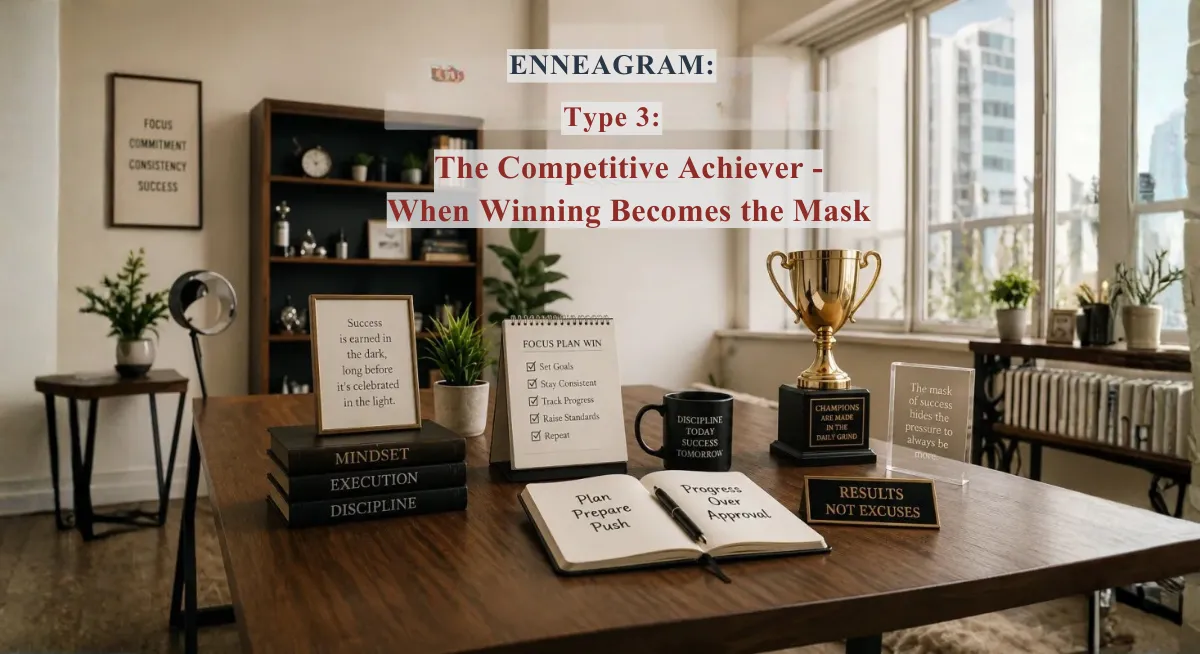
Enneagram: Type 3: The Competitive Achiever – When Winning Becomes the Mask
How the Gift of Excellence Becomes a Disguise, And How the Gospel Sets Type 3s Free
If you've searched phrases like “Enneagram Type 3 Christian,” “Competitive Achiever,” or “why do my wins feel empty,” you may be a Type 3. Also called The Competitive Achiever in the Integrative Enneagram (iEQ9), Type 3s are the engine of most organizations, the driving force behind most successful careers, and often the quiet backbone of growing ministries. They know how to win. They know how to read a room. They know how to produce results at a pace most people can't sustain. The gift is real, and the shadow is just as real. Because when winning starts to do the work the Gospel was meant to do, the Type 3 builds a disguise so convincing that they lose track of the person underneath it. This post walks through how Type 3s thrive and how they get stuck, what the Gospel says specifically to a Type 3, and how the P2-Driven Framework becomes the path to a self they can actually live inside.
Where We Are in Series 3: The Nine Types
We've walked through the body center with Type 1: The Strict Perfectionist and now we're two steps into the heart center. Last week, Type 2: The Considerate Helper named the trap of giving-as-getting. This week, we sit with Type 3, whose version of the heart center wound shows up differently. Same shame underneath. Different strategy on top.
Same posture throughout the series. Your type is diagnostic, not identity. The Enneagram Isn't the Answer, It's the Mirror, and the Spirit does the Transformation work the mirror can't do.
With that in place, let's look at Type 3.
And now… the rest of the story.
The Heart of Type 3: The Gift of Excellence
Type 3s are the people who get it done. They see the goal, build the plan, marshal the resources, motivate the team, and move the whole operation forward while everyone else is still drafting the email. They're the ones who can read a room in three seconds and adjust accordingly. They have a gift for finding the next step when the path goes dark. They know how to turn vision into execution, and they make it look effortless even when it isn't.
The gift of Type 3 is excellence in motion. Not excellence as perfectionism, but excellence as a natural habit of shipping good work, hitting the marker, and moving on to the next challenge. Type 3s make companies grow, ministries scale, and organizations professionalize. They're often the highest-functioning person in the room, and they carry that weight without visible strain.
At their best, Type 3s reflect something real about the way God made humans to work and to create. A God who designed labor as part of the goodness of the world. A God who invested us with capacity, with vision, with the ability to bring order out of chaos and fruit from the ground. Type 3s live into that vocation naturally, without having to be convinced that what they do matters.
That gift is worth celebrating. And the shadow underneath it is the thing that eventually drives Type 3s to burnout, hollowness, or a quiet identity crisis they don't know how to name.
Why the Shame Runs Underneath
As we covered in The Three Centers of Intelligence: Head, Heart, and Body, Type 3 sits in the Heart Center, alongside Types 2 and 4. The core emotion driving the Heart Center is shame, a deep, usually unconscious sense that the self underneath the performance might not be enough.
Type 3s almost never call it shame. They call it drive, or ambition, or not wanting to settle. What they often don't see is the learning that happened early. That love came when they performed. That applause meant safety. That being impressive was the price of admission to rooms where being ordinary wouldn't have been enough.
That wound shapes the entire system. It's what makes Type 3s naturally chameleonic, able to adapt their presentation to whatever room they're in, not out of manipulation but out of instinct. It's what makes them good at reading what success looks like in a new environment and then embodying it faster than anyone else. It's what makes them allergic to failure, not because they can't handle setbacks, but because failure threatens the engine that's been doing the work of keeping them loved.
The shame is quiet, and quiet shame doesn't disappear. It leaks. It leaks into a performance of self that the Type 3 no longer recognizes as performance. It leaks into a pace that doesn't let them stop long enough to feel anything deeply. And it leaks into the slow emergence of a mask that's so good, even the Type 3 forgets who's underneath it.
When Winning Becomes the Mask
Here's the turn. Type 3 excellence is designed to serve Love and vocation. But when it starts doing the work of identity, it becomes a disguise the Type 3 eventually can't take off.
A Type 3 executive builds a career most people would envy. He's the face of his industry. He's the guy everyone wants at the table. He's won awards, closed deals, scaled companies. Then one morning, alone in a hotel room on a business trip, he realizes he doesn't know what he actually likes anymore, outside of winning. He can't tell you his favorite book. He can't name a hobby he's done in five years. He doesn't know who his friends are, outside of business contacts. The man in the mirror is a polished stranger.
A Type 3 ministry leader builds a church most pastors would envy. Growing. Vibrant. Influential. She's on podcasts, on panels, on the conference circuit. Then her marriage starts quietly unraveling, her kids start pulling away, and she realizes she's been preaching about intimacy with God while running a ministry that leaves no time to experience it. The public ministry has eclipsed the private formation. The brand has eaten the soul.
A Type 3 spouse is the one everyone admires. Accomplished. Attractive. Competent. Behind closed doors, their partner has slowly realized they're married to a performance, not a person. The Type 3 won't fight because fighting looks bad. Won't cry because crying looks weak. Won't admit confusion because confusion looks incompetent. The spouse feels alone in a marriage with someone who looks perfect.
That's the trap. The mask gets more impressive, and the self gets more buried. The Type 3 wins more and feels less. They get more successful and less recognizable to the people closest to them.
When winning becomes the mask, the Type 3 stops being able to tell the difference between being valued and being seen. They're surrounded by applause and starving for recognition of a self nobody, including them, can locate anymore.
What the Gospel Says to a Type 3
If you're a Type 3 reading this, here's the Truth underneath the mirror.
You were Loved before you were impressive. Before you achieved a single thing, hit a single milestone, or earned a single accolade, the Father looked at you and called you His. “See what kind of Love the Father has given to us, that we should be called children of God; and so we are” (1 John 3:1, ESV). The and so we are is not conditional on your performance. It's not revoked when you fail. It's not earned when you win.
That changes everything, because the engine driving so much Type 3 winning is the buried belief that if you stop producing, the Love will dry up with you. The Gospel says the opposite. The Love was there before you started producing. The Love will be there if you fail. The Love isn't contingent on your output. It never was.
The Gospel tells a Type 3 three things that have to land in that order. First, you are Loved apart from what you produce. Your worth isn't attached to your results. Second, the self you've been hiding behind the mask is the self God actually wants to meet. “Man looks on the outward appearance, but the Lord looks on the heart” (1 Samuel 16:7, ESV). He's been looking at the heart the whole time. The performance wasn't fooling Him, only you. Third, your gifts are real, your excellence is good, your impact is a blessing, and none of it is who you are. It's what God has given you to do, not what makes you Him.
The goal isn't to stop winning. The goal is to let the winning be what it was designed to be, an expression of a beloved self, not a replacement for one.
Type 3 Through the P2-Driven Framework
Here's how the mirror gets used inside the Framework for a Type 3.
In Get Clear, Type 3s name the mask. They stop pretending the performance is them. They get honest about the gap between who they appear to be and who they actually are, and they stop calling that gap a strength. Clarity for a Type 3 is the painful but freeing admission that they've been running an image instead of a life.
In Align with God's Heart, Type 3s let themselves be seen without the accomplishments. This is the hardest work, harder than any project they've ever shipped. They sit in Prayer without being productive. They let God Love them when they haven't earned anything yet that day. They let their spouse and closest friends see the version that isn't polished. Alignment for a Type 3 means letting the Father meet the self they've been hiding from Him and from everyone else.
In Get Fit, Type 3s build rhythms that the mask hates. Rest that doesn't produce. Hobbies that don't generate content. Time with people who don't further any agenda. Slow meals. Unstructured play. Solitude without headphones. These rhythms aren't extra. They're the way the buried self gets uncovered slowly enough to stay alive.
In Live Your Legacy Today, Type 3s become what they were designed to be, people whose excellence flows from a real self instead of protecting a hidden one. A Type 3 at their best shows the world that high performance and authentic identity aren't enemies. That's a Legacy worth leaving, and it's a rare one, because most Type 3s never arrive there.
Rhythms Type 3s Actually Need
If you're a Type 3, here's where the work meets the week.
Unproductive Sabbath. One day a week where nothing gets optimized, monetized, or leveraged. No reading business books. No catching up. No “light” work. If a real Sabbath feels impossible, that's the clearest signal you need one. The rest is where the buried self starts to speak.
Feelings-first Prayer. Most Type 3s pray strategically. Practice praying emotionally instead. Name what you actually feel, not what you should feel. Confusion. Fatigue. Loneliness. Pride. Fear. The Psalms did this all the time, and God wasn't scandalized. Start there.
A no-brand friendship. Cultivate at least one relationship with someone who gives you nothing strategically and has no idea what you do for a living. Let them know you. Let yourself be bored with them. Let the friendship have no ROI. This is the muscle of being Loved apart from performance, and you have to build it deliberately.
The failure practice. Once a month, on purpose, do something you're bad at. Not to become good at it. Just to remember that you're still you when you fail. Take a class outside your field. Pick up an instrument. Try a sport you'll embarrass yourself in. The self that survives the embarrassment is the self the Gospel has been trying to reach.
Telling the truth about the cost. Once a week, with your spouse or a trusted friend, name what winning cost you this week. Not to indulge in self-pity. To stay connected to the Truth that every victory has a bill, and ignoring the bill is how Type 3s go bankrupt invisibly.
These rhythms will feel counterproductive before they feel freeing. That's the signal you're in the right territory.
Live Your Legacy Today
Here's the Tuesday morning version for Type 3s.
Your excellence isn't the problem. The way it's eaten your identity is the problem. The world doesn't need you to stop producing. It needs you to find out what you actually like, who you actually are, and whom you actually love, apart from the applause that's been filling in for all three for years.
If you're a Type 3, the people closest to you are lonely. Not because you're absent, but because the version of you they get is the public version, and they've sensed for a long time that there's someone underneath it they haven't met in years. The gift you can give them, and yourself, is to start uncovering that person, slowly and honestly, and let them love the real one.
You were Loved before you were impressive. The sooner you believe it, the sooner the person under the mask can finally come out, and the sooner the life you've been performing can become the life you actually live.
Going Deeper
In my upcoming book, Your Purpose & Principle Driven Life 2.0, we unpack how each Enneagram type moves through the four phases of the P2-Driven Framework, including the specific rhythms, Scriptures, and practices that free each type from its default autopilot. Type 3s get a full chapter, because the trap of winning-as-identity is one of the most common and least recognized crises in Christian leadership. The book isn't available yet, but this series is the conversation it's designed to extend.
What Coaching From AI Bots Misses
An AI bot can type a Type 3 accurately. It can describe the image management, map the stress patterns, quote the relevant Scriptures, and draft an elegant growth plan with phases, checkpoints, and measurable outcomes. A Type 3 will love the plan. The Type 3 will also probably optimize the plan into another performance within three weeks, because the plan itself can become part of the mask.
That's where the real work happens. A coach notices when the Type 3 is performing the coaching session. A coach asks the question that interrupts the performance mid-sentence. A coach watches what happens in the Type 3's face when they actually feel something, and doesn't let them skip over it to the next strategic insight.
An AI bot can generate you a growth plan. A Type 3 doesn't need a plan. They need somebody who knows them well enough to see through the plan and keep asking the question underneath it.
→ If you're a Type 3 ready to stop winning at the cost of a self you can't locate anymore, book a discovery call: https://p2driven.com/discovery-call
FAQ: Enneagram Type 3 and Faith
How do I know if I'm a Type 3?
Type 3s usually recognize themselves by the pattern of productivity. If you naturally move toward goals, set the pace for the teams you're on, adapt your presentation to match what success looks like in each environment, and feel a quiet panic when you fail or look foolish, you may be a Type 3. If the idea of a full day with nothing to accomplish feels anxious rather than restful, that's also a signal. A proper assessment like the iEQ9 confirms it.
Is it wrong for a Christian to be a Type 3?
No. Type is a description of default patterns, not a moral category. Type 3 at its best reflects God's design for humans to create, build, and produce. Type 3 at its shadow turns work into worship and success into salvation. The goal isn't to stop being a Type 3. The goal is to grow in Grace as a Type 3, letting your excellence flow from a beloved self rather than building the mask of one.
What's the difference between healthy ambition and Type 3 image management?
Healthy ambition flows from identity and serves Love. Image management protects identity by building it out of accomplishments. The first one can fail without losing the self. The second can't. A useful question: if your career, your ministry, and your public platform all vanished tomorrow, would you still know who you are? If the answer is no or you're not sure, image management has replaced identity, and the Gospel has some work to do.
Why do my wins feel hollow?
Because the wins aren't supposed to do the work you've been asking them to do. Wins are good. They're also finite. They can't give you a stable sense of self, a feeling of being loved, or a secure identity. Those are Gospel jobs. When winning is filling in for the Gospel, every victory feels great for about four hours and then empty, because it was never designed to feed the part of you you've been feeding with it.
How does a Type 3 let themselves be seen by God?
Slowly, and usually through practices that don't feel spiritually productive. Silent Prayer without an agenda. Journaling feelings rather than strategy. Receiving Love in worship without analyzing it. Confession that names the real failures, not the polished ones. The muscle grows with practice, and the whole engine of the spiritual life changes as the hidden self comes into view. Most Type 3s need help from a coach, counselor, or spiritual director to stay in the practice long enough for the mask to come off.
