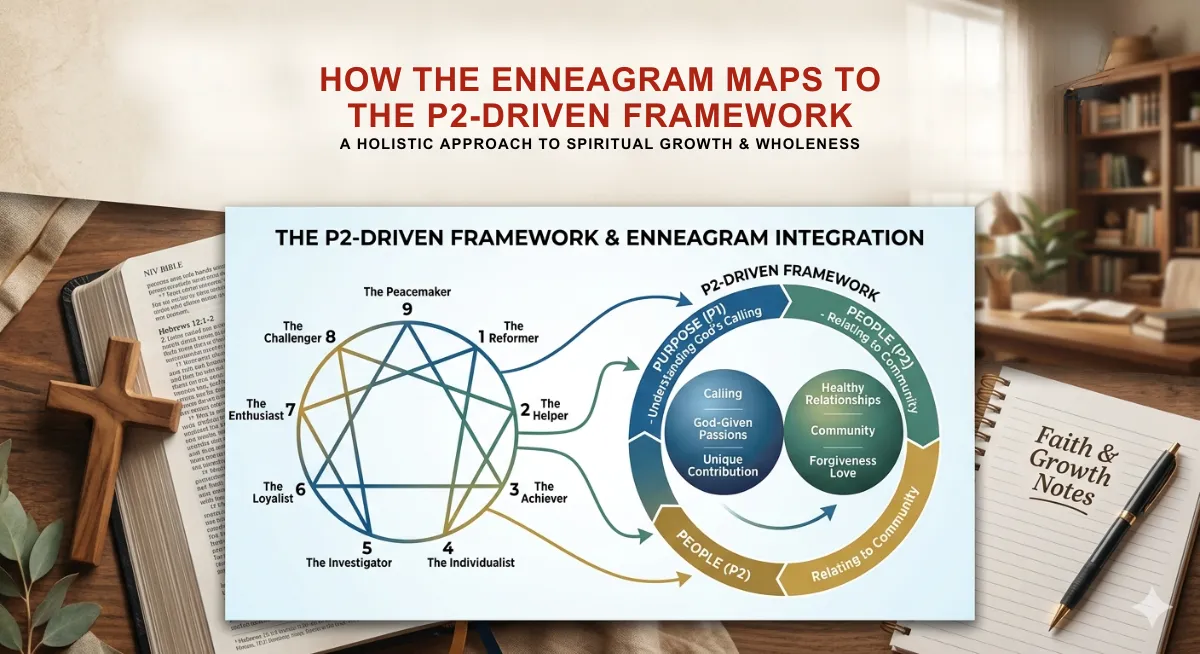
How the Enneagram Maps to the P2-Driven Framework
The Phase-by-Phase Guide to What Your Type Actually Needs at Each Stage of Growth
If you’ve searched phrases like “Enneagram and coaching framework,” “Enneagram faith-based coaching process,” or “how to use the Enneagram for real growth,” you’ve probably already figured out that knowing your type isn’t enough. You took the assessment. You read the description. You nodded at the parts that felt uncomfortably accurate, and then nothing changed. This is because the Enneagram is a diagnostic tool, not a treatment plan. It can show you what’s running underneath your decisions, your relationships, and your walk with God. What it can’t do, by itself, is tell you where to go next. That’s what a framework does. And this post shows you exactly how the Enneagram fits inside the P2-Driven Framework, phase by phase, with your type’s specific journey in mind.
Get the Gist Quick
Here’s the short version, because you probably already know your number and you’re wondering what to do with it.
Last week, we made the case that The Enneagram and Faith: Why Self-Awareness Is a Spiritual Discipline. Self-awareness without a framework is just navel-gazing with better vocabulary. This week, we get specific, because it’s one thing to say the Enneagram fits inside the P2-Driven Framework. It’s another thing to show you how.
The P2-Driven Framework has four phases: Get Clear, Align with God’s Heart, Get Fit, and Live Your Legacy Today. Your Enneagram type moves through each phase differently, not because the framework changes, but because the patterns you’re bringing to it are type-specific. The Strict Perfectionist doesn’t Get Clear the same way the Enthusiastic Visionary does. The Active Controller doesn’t Align the same way the Adaptive Peacemaker does. It’s the same destination with a different path through the woods.
That’s what makes the Enneagram useful inside this framework, not as the map itself, but as the GPS that tells you where you’re starting from, because you can’t plot a course if you don’t know your current location, and most people have been guessing at that location for decades.
If you want the phase-by-phase breakdown, keep reading.
And now… the rest of the story.
Phase 1: Get Clear – The Enneagram Shows You the Autopilot
In The Enneagram and Spiritual Autopilot, we walked through how every type has a default operating system, a pattern that kicks in before you’re conscious of it. That pattern shapes how you make decisions, how you handle conflict, how you relate to God, and how you show up in every room you enter. Getting Clear means seeing that pattern without flinching.
Here’s what the Get Clear phase looks like for different types:
The Strict Perfectionist (Type 1) needs to see that their inner critic isn't the voice of God. It's the voice of their core fear. They've spent years confusing moral rigidity with Faithfulness, and clarity means learning to tell the difference.
The Considerate Helper (Type 2) needs to see that their compulsive generosity isn't selflessness – it's a strategy for earning love. They've been so busy meeting everyone else's needs that they've never sat still long enough to admit they have needs of their own. Clarity for a Two means asking, "Am I giving because I love – or because I need to be needed?"
The Competitive Achiever (Type 3) needs to see that their identity has been built on performance, not on who God says they are. Clarity for a Three often feels like a crisis, because stripping away the achievements leaves a question they've been avoiding: Who am I when I'm not winning?
The Intense Creative (Type 4) needs to see that their emotional depth, the thing they value most about themselves, has become a hiding place. They've turned their longing and uniqueness into an identity, and clarity means confronting the possibility that they're not as different as they need to believe they are and that ordinary Faithfulness is just as Holy as the extraordinary life they're waiting for.
The Quiet Specialist (Type 5) needs to see that retreating into analysis isn't wisdom. It's avoidance with a library card. Clarity for a Five means admitting that understanding something is not the same as living it.
The Loyal Sceptic (Type 6) needs to see that their vigilance isn't discernment. It's anxiety dressed in responsible clothing. They've built entire systems around worst-case scenarios and called it preparedness. Clarity for a Six means recognizing that their need for certainty has been running their Faith instead of the other way around.
The Enthusiastic Visionary (Type 7) needs to see that their relentless optimism isn't joy. It's an escape hatch. They've been reframing pain, skipping grief, and chasing the next experience to avoid sitting with anything uncomfortable. Clarity for a Seven means staying in the room when the room isn't fun.
The Active Controller (Type 8) needs to see that their need for control isn't strength. It's a defense against vulnerability. Getting clear for an Eight is one of the hardest things in coaching, because the pattern has been protecting them since childhood and it doesn't want to be seen.
The Adaptive Peacemaker (Type 9) needs to see that their easygoing nature isn't peace – it's self-erasure. They've been merging with other people's agendas for so long they can't name their own. Clarity for a Nine means answering a question they've been dodging their entire life: "What do I actually want?"
On the Monday track, we explored how Talent Without Clarity Creates Frustration. The Enneagram adds a layer to that: it’s not just talent that’s unclear. It’s the reason you’ve been deploying your talent the way you have. Your type has been choosing your direction for you. Get Clear is where you take that choice back.
Phase 2: Align with God’s Heart – The Enneagram Shows You Where You’ve Drifted
Once you’ve seen the pattern, the next question is: what does God want instead? Alignment isn’t self-improvement. It’s surrender. It’s bringing the pattern you’ve been running to the God who made you and asking, “Is this what You had in mind?”
The answer, for every type, is some version of: “Partly. But not like this.”
God gave the Considerate Helper (Type 2) a genuine capacity for Love and service. The drift is that the Helper started serving to be needed rather than serving out of overflow. Alignment means learning to receive love without earning it first, which feels, to a Two, like the most unnatural thing in the world.
God gave the Intense Creative (Type 4) a depth of emotional awareness most people can’t access. The drift is that the Four started using that depth as identity, defining themselves by their pain, their longing, their sense of being different. Alignment means finding their significance in Christ, not in their emotional landscape.
God gave the Loyal Sceptic (Type 6) a gift for discernment and preparedness. The drift is that the Six started trusting their anxiety more than they trust God. Alignment means choosing Faith over fear, not once, but daily, in the specific situations where their type defaults to worst-case-scenario thinking.
God gave the Enthusiastic Visionary (Type 7) an infectious capacity for joy and possibility. The drift is that the Seven started using joy as an escape hatch, chasing the next experience to avoid sitting with pain, loss, or limitation. Alignment means learning that God is present in the valley, not just on the mountaintop.
Notice the pattern: every type’s drift is a God-given strength that got hijacked by their core fear. Alignment isn’t about eliminating the strength. It’s about returning it to its original purpose – under God’s authority, aimed at God’s heart. “Trust in the LORD with all your heart and lean not on your own understanding” (Proverbs 3:5, NIV) is a verse that hits every type differently, because every type leans on a different understanding.
Phase 3: Build Rhythms of Fitness – The Enneagram Shows You What Sustains You
Here’s where most growth plans fail: they prescribe the same rhythms for everyone. Wake up at 5 a.m. Journal for twenty minutes. Read three chapters. Pray for thirty minutes. And if that rhythm doesn’t fit the way you’re wired, you’re told the problem is discipline.
It’s not a discipline problem. It’s a design problem. God didn’t wire every type to sustain growth the same way.
The Adaptive Peacemaker (Type 9) needs rhythms that include intentional disruption, practices that challenge their tendency to merge with whatever’s comfortable. A Nine who builds rhythms around comfort will stay comfortable and call it peace. Real rhythms for a Nine include honest conversations, accountability partnerships, and spiritual practices that require them to name what they actually want instead of defaulting to “I’m fine with whatever.”
The Strict Perfectionist (Type 1) needs rhythms that include intentional rest and Grace, practices that interrupt their inner critic’s running commentary. A One who builds rhythms around more discipline will just tighten the screws on an already rigid system. Real rhythms for a One include Sabbath, play, and spiritual practices that remind them they’re loved for who they are, not how well they perform.
The Competitive Achiever (Type 3) needs rhythms that include stillness and being known, not just being admired. A Three who builds rhythms around productivity metrics will optimize their way into deeper disconnection from God and the people who love them. Real rhythms for a Three include silence, unhurried Prayer, and relationships where they’re valued without performing.
The Enneagram doesn’t prescribe the rhythms. It tells you which rhythms your type will resist and those are usually the ones you need most. The rhythm that feels most unnatural to your type is almost always the rhythm that produces the most growth.
Phase 4: Live Your Legacy Today – The Enneagram Shows You What You’re Building
Every type, left on autopilot, builds a default Legacy. And it’s almost never the Legacy they actually want.
The Active Controller’s default Legacy is a family that respects them but doesn’t feel safe with them. The Considerate Helper’s default Legacy is a community that depends on them but never truly knows them. The Quiet Specialist’s default Legacy is a body of knowledge that nobody could access because the Five never let anyone close enough to learn it.
When you move through the framework to Get Clear on the pattern, Align it with God’s Heart, build Rhythms of Fitness that sustain the change, the Legacy naturally transforms. The Controller becomes a leader people actually want to follow, not just obey. The Helper becomes someone who loves freely instead of strategically. The Specialist becomes a mentor who shares wisdom generously instead of hoarding it behind a wall of competence.
That’s the whole point. The Enneagram shows you the pattern. The P2-Driven Framework gives you a structure for transforming it. Faith provides the power source. And coaching provides the relationship where all three come together in real time, with real accountability, aimed at the real Legacy God designed you to leave.
Your type isn’t your destiny. It’s your starting point. The framework shows you the path from where you are to where God is taking you. And that path runs through every phase – clarity, Alignment, rhythms, Legacy in the specific way your type needs to walk it.
Going Deeper
In my upcoming book, Your Purpose & Principle Driven Life 2.0, the full integration of Enneagram type and the P2-Driven Framework is mapped out for all nine types, including the specific Get Clear breakthroughs, Alignment shifts, Fitness designs, and Legacy recalibrations each type needs. The book positions the Enneagram where it belongs: one instrument on the dashboard, serving a framework built on Scripture, guided by the Spirit, and aimed at a life that outlasts your personality patterns. It’s not available yet, but this series is the conversation it’s designed to deepen.
What Coaching From AI Bots Misses
An AI can generate a phase-by-phase growth plan for your Enneagram type in seconds. It can cross-reference your stress patterns with suggested rhythms, map your core fear to Biblical themes, and produce a personalized framework walkthrough faster than you can finish reading this sentence. What it can’t do is notice that you flinched when it named the pattern. It can’t ask why you teared up at Phase 2 and went quiet at Phase 3. It can’t tell the difference between intellectual agreement and the kind of honest surrender that actually changes a life.
Frameworks don’t transform people, relationships do. The framework gives you structure. The Enneagram gives you awareness, but transformation happens in the space between someone who sees you clearly and a God who Loves you anyway. AI can map the journey. It can’t walk it with you.
→ If you’re ready for someone to walk it with you, book a discovery call: P2Driven.com/discovery-call
FAQ: The Enneagram and the P2-Driven Framework
Do I need to know my Enneagram type before starting coaching?
No. The iEQ9 assessment is part of the coaching process. You don’t need to arrive with your type already identified. In fact, many people who’ve self-typed from online quizzes discover through the iEQ9 that their actual type is different from what they assumed. The assessment is a starting point, not a prerequisite.
Does the framework work the same for every type?
The structure is the same: Clarity, Alingment, Fitness, and Legacy, but what each phase looks like is type-specific. A Type 1 getting clear looks different from a Type 7 getting clear. A Type 8’s alignment struggle is different from a Type 2’s. The framework adapts to the person, not the other way around.
What if I don’t agree with my Enneagram results?
That’s actually useful data. Resistance to a type description sometimes indicates you’re seeing a pattern you’d rather not see. Other times it means the result genuinely doesn’t fit. Either way, a coaching conversation about the resistance is often more productive than the type description itself.
Can I go through the framework without the Enneagram?
Yes. The P2-Driven Framework stands on its own. It’s built on Scripture, not the Enneagram. The Enneagram is one tool that accelerates the Get Clear phase, but it’s not the only path in. What matters is honest self-awareness before God, and there are multiple ways to get there.
How long does it take to move through all four phases?
It depends on the person and the depth of the work. Some clients move through the framework in a few months. Others spend significant time in one phase because the patterns run deep. Coaching isn’t a program with a graduation date. It’s a guided process aimed at lasting transformation, and lasting takes as long as it takes.
