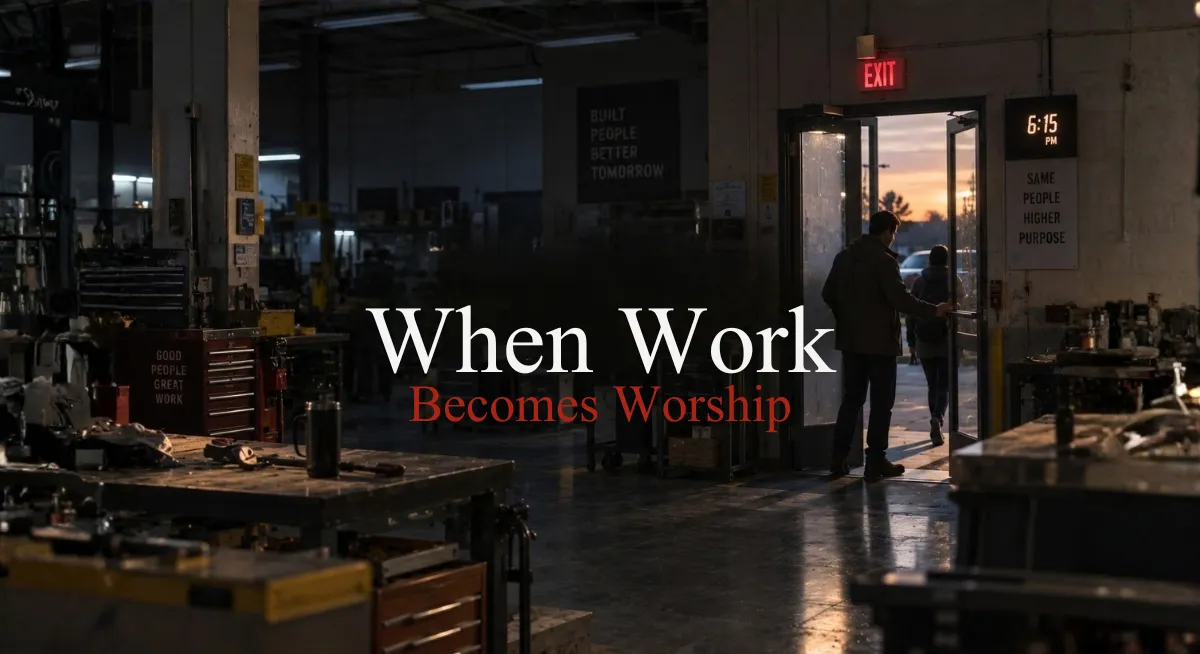
When Work Becomes Worship
Six shifts that change how you lead. You keep the job. The work gets a new owner.
Walk your building at 6:15 on a Tuesday night.
Half the lights are still on. Somebody's coffee has gone cold next to a keyboard that's still warm. A guy on your ops team is packing up slowly, glancing at your office to see if you're still in it. He isn't waiting on work. He's waiting on permission. And the way he leaves tonight is something he learned from watching how you leave.
That's what you want to fix, and you've wanted it for a while. You want the work to be worth it. Not just for you, but for the people who do it with you. You want a company where the work means something on an ordinary Tuesday, where your people go home believing it mattered because it did, and where what you built keeps mattering after your name comes off the door.
If you've searched "work as Worship," "Faith and work integration," or "is my job a Calling," this post is the one I'd hand you across a table. The fact that you're asking is the whole starting point. Most leaders never get around to the question.
Get the Gist Quick
Short version, because you may be reading this between a P&L and a people problem.
Work becomes Worship through a change of ownership, not a change of occupation. Chapter three of Your Purpose & Principle Driven Life 2.0 names six shifts that turn a life Under The Sun into a life Under The Son (Jesus), and all six apply to running a business. A meta-analysis 240 studies and 185,857 working people, those who experienced their work as a Calling found it more Meaningful, were more engaged, and were more satisfied with their jobs than those who didn't.1 The one honest limit is that Calling is a weak shield against overload, so the structure you build around your people has to do that job. Four moves carry the shifts into a company: name the shift you haven't made yet, change who the work is for, protect the people who do it, and build the version that outlasts you.
The whole post, in three bullets:
Work gets exhausting when you ask it to tell you whether you matter. Under The Sun, the job grades you. Under The Son, the same job becomes an offering. Six shifts make that turn, and none of them asks you to build less.
One guardrail comes first. In a lab, leaders excused unpaid hours and demeaning work when they believed the worker loved his job. So, pay people properly and protect their hours before you ever talk to them about work as Worship.
Four moves make the turn in your company this quarter. Name the shift you haven't made yet, hand that part of the work to God, build the structure that protects your people, and let the version you build outlast you.
And now... the rest of the story.
Start With Monday
On Monday I wrote about a king who had everything and called it Meaningless. That post is The Man Who Had Everything and Called It Meaningless, and it covers chapter three of the book, The King's Story. Start there if you haven't.
This one picks up Monday's six transformations and carries them into a room with a P&L in it. Monday walked the two ways the King of Futility, Solomon, found to live. Under The Sun, where work and wealth and the rest get asked to deliver what only God can. And Under The Son, Jesus, where every one of them gets a new owner. Monday answered what changes when that happens. This one answers what you do about it Thursday morning.
The Job That Grades You
Under The Sun, the book says, work becomes exhausting. That happens when it's the thing that decides whether you matter. Every quarter becomes a report card. Every win is provisional, because the next quarter can take it back. You can't finish a job like that, so you don't leave at 6:15, and neither does the guy on your ops team.
That shows up all over a company, and it wears a good disguise. It looks like diligence. It's the pace nobody decided to set, the stopping time that slid a half hour a year until it was gone, and the mission statement doing the job a raise should have done.
The good news is that none of the six shifts asks you to change jobs. They change who the work is for, and that changes almost every decision downstream of it.
What Calling Actually Buys
Researchers pooled 201 studies, 240 separate samples, and 185,857 working people to find out what feeling Called to your work goes with.1 Strongest by a distance: whether the work feels Meaningful. Close behind: how engaged people are and how satisfied they are with the job. Solidly there: their general well-being. The people who see their work as a Calling are the ones who find it worth doing, and that's exactly what you want for the people in your building.
One honest limit, and then we move on. The weakest link in the whole set was relief from strain. Feeling called went with Meaning at real strength and with relief from overload only faintly. So Calling isn’t a shield. A man can believe deeply in the work and still be running on empty, which is why the structure around your people has to do the protecting. That's Step 3 below, and it's the part most faith-and-work talks skip.
Almost all of this research is a snapshot rather than film, so it shows what travels together and not what causes what. The point holds either way.
The Name for It
The enemy here has a name, and it isn't you. It's Drift.
Nobody decides that the work will be the verdict on whether he matters. He drifts there. A quarter gets tight and the stopping time slides. A good man gets promoted and nobody tells him the new hours. The word calling gets used in an all-hands where the word raise belonged. Each of those is a small move in one direction, and that's all it is. Stack a few years of them and the company is running the Under The Sun version of all six shifts, and everybody in the building can feel it.
Drift is beatable precisely because it has a direction. Anything with a direction can be steered.
The Question You Don't Say Out Loud
Underneath the practical problem sits a quieter one. Most leaders I work with carry some version of it. If I stopped grading myself by this company, would there be anything left to grade?
You’ll be tempted to keep that one to yourself, because saying it in front of people who report to you sounds like weakness. It isn't. It's the most honest question in the building, and it has an answer, which is the part nobody told you.
Why This Was Never Meant to Be the Cost
Building something and being consumed by it were never meant to be a trade. A leader who hits the number while the work slowly eats him, and then starts on the people around him, has borrowed against something he'll pay back later. A leader who hits the same number as an offering, with his people paid and rested and watching him go home, has built something that compounds. Same scoreboard. Very different Legacy.
Working for a Different Boss
Watch how a man leaves the building and you'll know who he thinks he works for. The man working for a verdict can't leave, because the verdict isn't in. The man working as an offering hands in the best work of his life at 6:15 and goes home, because an offering is finished when it's finished.
Paul wrote about that difference two thousand years before anybody measured it. "Work willingly at whatever you do, as though you were working for the Lord rather than for people" (Colossians 3:23).
Willingly. That's the word to slow down on. Not harder. Not longer. Willingly, which is what work looks like once it has stopped being a grade and become a gift. Anyone who has run a crew knows the difference between a man working off a clock and a man working off a conviction, whatever they believe. Paul's point is that the second man has a different boss, and that changes the work without changing the job.
That's the shift underneath all six. Work becomes Worship when it's offered to Someone who isn't grading you. The rest of the list follows from that one.
I've Sat in That Chair
For most of thirty years I'd have told you my work was a calling, and I'd have meant it. What I was actually running was a very disciplined trade. I gave the work everything and expected it to hand back a verdict on whether I mattered. It paid every invoice it ever received. The one I actually cared about was never on the contract.
In 2023 I walked away from the C-Suite, and the honest accounting started after that. I used mission language for years with people whose hours I never audited. Not cynically. It never occurred to me to check, which is exactly how the research says it happens. I'd be more comfortable telling you to pay people first if I had always done it.
So, I know the road from both sides. I know what it's like to work for a verdict, and I know what it took to hand the work to a different owner. The four moves below came from the same chair you're in.
The Plan: Four Moves That Change the Owner
Everything I do with leaders runs on four pillars. In Your Purpose & Principle Driven Life 2.0 they're written for the whole of life. Below, they're written for the company you run.
1. Get Clear
Clarity here means naming which of the six shifts you haven't made yet. Every one of them has a before and an after, and you're living in one or the other. Read the list slowly. Work as exhaustion, or Worship. Wealth as restlessness, or Stewardship. Pleasure as the next win, or Joy rooted in Gratitude. Wisdom as a weight, or Guidance. Justice as policy, or Love in action. Legacy as an afterthought, or Faithfulness that outlives you. Most leaders I work with are running the Under The Sun version of at least one and haven't noticed. Say which one out loud, with the specifics, to one person who won't flinch. You probably already know.
2. Align with Purpose
Alignment is the change of owner. Once you've named the shift, hand that part of the company to God and let Him decide what it's for. The work stays where it is. Who it's for changes.
The research has a finding here that runs against the intuition. In that same pool of 185,857 people, Callings aimed outward, toward service and something beyond the person, went with Meaning more strongly than callings aimed inward at personal fulfillment.1 So, the version of calling that produces Meaning is the one pointed away from you. That isn't sentiment. It's the direction the data ran. I made the fuller case in Why Alignment Matters More Than Effort.
On the Faith side of our work this pillar is called Align with God's Heart. Same move. Same handoff.
3. Build Sustainable Capacity
This is the pillar with the sharpest research behind it. You've heard the sentence. Maybe you've said it. "It isn't really work if you believe in it." Researchers tested what that sentence does to the people it's said about, running the experiment eight different ways. When people were told a worker was passionate about his job, they rated demeaning tasks, unpaid extra hours, and work outside his job description as more legitimate. Two beliefs did the work: that he would have volunteered anyway, and that the work is its own reward. Then they ran it the other way, and it held. People assume a mistreated worker who stays must be passionate.2 That's experimental evidence, not a survey, and both of those beliefs are sentences I've heard in Christian workplaces, said warmly, by people who meant well.
So, the order matters. Pay people properly, staff the work honestly, protect their hours. Then talk about Worship. The wage law sits in the same Scripture as the calling language (Deuteronomy 24:14-15), and that's no accident. A leader who reverses the order has turned a theology into a discount. I wrote about the money side in Calling as Stewardship. In the book this pillar is Establish Rhythms of Fitness, and here the rhythm is structural: a real stopping time, real margin, and a pay band you'd be comfortable reading aloud next to your mission statement.
4. Live Your Legacy Today
Your Legacy in this company is the version of these six that keeps running after you've left the building. It gets built in ordinary decisions, and the research says structure matters as much as conviction. Researchers studied 237 working adults who all described their work as a Calling and sorted them by how they were doing. The ones doing well weren't the ones who believed hardest. They were the ones with support around them and pay that matched the work.3 Conviction plus structure. That's what outlives you.
Your Dash (that tiny line between the two dates on your headstone) gets etched in pay bands and stopping times as surely as in anything you'd call spiritual, and the people who run this place after you will inherit whichever version you built. When Success Pulls You Away from God is the post for the week the scoreboard starts winning again.
Rhythms for the Next Ninety Days
Pick one shift and run it for a quarter. The one you named in Get Clear. Six at once is a resolution. One is a change.
Say the stopping time out loud, then keep it. Your team learns whether an offering can be finished by watching whether yours ever is.
Thank one person for the work itself, specifically, once a week. Not for the result. For the work. Gratitude is the shift you can practice on a Tuesday.
Ninety Days From Now
Picture the building in a quarter.
It's 6:15 and you're walking out with your coat on, and the guy on your ops team doesn't check your office first, because he already knows. The quarter comes in hard and your people read steadiness on your face, because you decided in advance whose work this is. Somebody on your team tells a new hire the work here matters, and you know she's paid like it does. The shift you named in September is running, and nobody had to be told.
Same company. Same number. Different owner. And your people can feel the difference before they can name it.
The Cost of Leaving It Alone
One paragraph on the alternative, because it's real. Drift left alone keeps drifting. The stopping time slides another half hour, the calling language does another year of a raise's work, and the company learns that Worship means working for free. Everything above starts reversing that with one named shift and one honest look at a pay band.
Going Deeper
Monday's post covers The King's Story, chapter three of Your Purpose & Principle Driven Life 2.0, where all six of these shifts come from.
You can read the first three chapters free. The Introduction, Welcome to the Table, and The King's Story. Download them here.
If you're running a company while quietly running the Under The Sun version of one of these six, that's the conversation a Discovery Call is for. Book a Discovery Call.
FAQ: Work as Worship
What does it mean for work to be Worship?
It means the work is an offering rather than a verdict. The occupation doesn't change. The ownership does. In practice, an offering can be excellent and finished at the same time, which is the part most driven people find hardest. A job that's grading you is never finished, because the grade is never final. Colossians 3:23 puts it as working willingly, as though for the Lord rather than for people, and that one word changes the shape of the work without changing the job.
Is my job supposed to be my calling?
Not necessarily, and the research is encouraging either way. Across 240 samples and 185,857 people, those who experienced their work as a calling found it more meaningful, were more engaged, and were more satisfied with their jobs. Callings aimed outward toward service went with Meaning more strongly than callings aimed inward at personal fulfillment. The one limit worth knowing is that calling only faintly relieved strain, so a called person can still burn out, and the structure around them has to carry that weight.
Can calling language be used to take advantage of people?
Yes, and the evidence for that is experimental rather than a survey. Across eight experiments, people rated demeaning tasks and unpaid extra hours as more legitimate when the worker was presumed passionate, and two beliefs did the work: that the worker would have volunteered anyway, and that the work is its own reward. The effect also ran in reverse, with people assuming a mistreated worker must be passionate. If you use calling language as a leader, the guardrail is pay and hours, and sincerity is not a substitute for either.
What are the six shifts?
Work becomes Worship. Wealth becomes Stewardship. Pleasure becomes Joy rooted in Gratitude. Wisdom becomes Guidance. Justice becomes Love in action. Legacy becomes Faithfulness that outlives the grave. They come from chapter three of Your Purpose & Principle Driven Life 2.0 and describe the move from life Under The Sun to life Under The Son. None of them asks you to own less or achieve less. They change who the work is for.
How do I lead as a Christian without preaching at my team?
Run the six shifts before you talk about them. Pay people properly, protect their hours, say the stopping time out loud and keep it, and thank people for the work itself. Your team learns what you Worship by watching your calendar and your pay bands long before they hear a word about it. When the structure matches the language, the language is welcome. When it doesn't, the language does harm.
Is ambition wrong for a Christian leader?
No. Solomon built cities, and the building wasn't the problem. Under The Sun, ambition is a bid for a verdict that work can't issue. Under The Son, the same ambition becomes Stewardship of something entrusted to you. The shift changes the owner rather than the size. You can build big and go home at 6:15.
