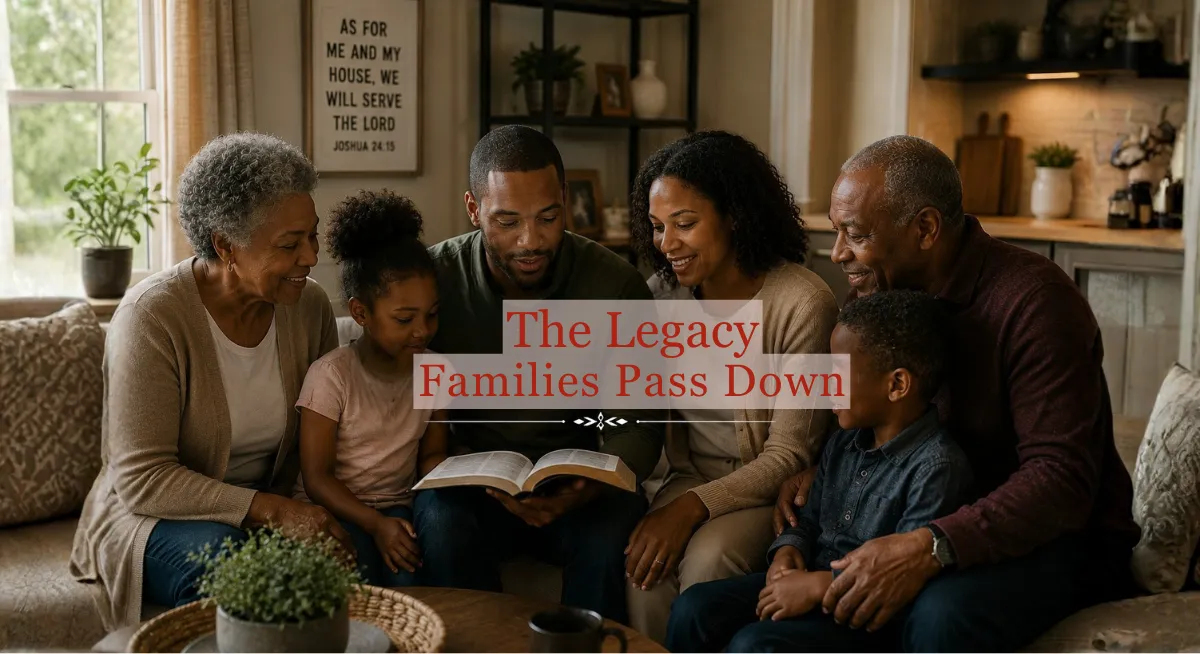
The Legacy Families Pass Down
Every Family Hands Something to the Next Generation, and What Gets Handed Down Is Mostly What Wasn't Chosen on Purpose
You can trace it, if you look honestly. Your grandfather's temper lives in your father's flinch, which lives in your own shoulder tension, which is living in the way your kid goes quiet when you raise your voice. Your grandmother's anxious performance of hospitality lives in your mother's exhausting holidays, which lives in your own inability to let a dinner party go imperfect, which your daughter is already rehearsing. The Faith your family passed down, or didn't. The money language, or the money silence. The way conflict got handled or buried. The tone of voice that filled the kitchen. All of it was a Legacy, whether anyone intended to pass it down or not. If you've searched "the Legacy families pass down," "how to break generational patterns Christian," or "family Legacy Christian," this post is the one I'd hand you across a kitchen table. Most of what your family passed to you wasn't chosen on purpose, and most of what you will pass to the next generation won't be either, unless you do the specific work this post is about.
Quick Answer: Every family hands down a Legacy. What gets handed is a mixed inheritance of Faith, emotional patterns, relational scripts, financial posture, theology, and unspoken rules about what’s allowed and what isn’t. Most of it wasn’t chosen. The previous generation absorbed what the one before it handed them, edited a few things, quietly kept most of the rest, and passed the whole package along. The result is that every family carries forward strengths the grandparents never named and wounds the grandparents never healed, and the descendants spend decades unconsciously reproducing both.
Becoming a transition generation isn't done by willpower. It's done by specific naming, specific Prayer, specific rhythms, and specific Spirit-led Transformation over time. The P2-Driven Framework gives the work a repeatable architecture, and the Legacy that results is what your grandchildren inherit whether or not they ever meet you.
Keep reading for the full breakdown.
And now… the rest of the story.
Every Family Passes Something Down
It's common for Christians to assume that their family doesn't have a generational pattern worth naming. "My family was normal." "Nothing dramatic happened." "My parents were good people." All of those sentences can be true and simultaneously conceal exactly the patterns the family has been quietly handing down for three or four generations. Dramatic trauma is not the only thing that passes. Ordinary patterns pass too, and sometimes more durably, because nobody thought to name them.
The things that pass down automatically are not mostly what a family says out loud. They are what a family did without explaining. The tone of voice at dinner. Who spoke and who didn't. How money was discussed. How disappointment was handled. Whether anyone said the word "I'm sorry" and meant it. Whether the adults in the house regulated their emotions or leaked them. Whether Faith was integrated or performed on Sundays only. These are the deep structures of family life, and they transmit to the next generation with a reliability most parents underestimate.
As we walked through in What Your Marriage Is Modeling, a marriage is curriculum whether the spouses intended it to be or not. The same is true at the family level. The whole family is a curriculum. The students graduate in their early twenties and begin running the curriculum in their own homes, often with almost no conscious awareness that they are doing so.
What Gets Passed Down Automatically
A short inventory of what every family hands down without discussion.
Emotional Regulation Patterns
How the adults in your family of origin handled anger, disappointment, anxiety, and grief is likely the template you are running now. If your father went cold and silent, you probably either do the same thing under pressure or you overcorrect by being too loud. Either way, you are still shaped by his pattern. Emotional patterns transmit through the nervous systems of everyone in the home, and no one escapes the transmission without doing the work to interrupt it.
Relational Scripts
How conflict was handled, how affection was expressed, how difference was tolerated, how Forgiveness was offered (or withheld). These scripts run in the background of your own relationships now, often activating at the exact moments you most wish you could choose differently. The script shows up at a holiday table, in a marriage argument, in a parenting moment, and the adult you is suddenly hearing your mother's voice coming out of your own mouth.
Financial Mindset
Scarcity or abundance. Secrecy or openness. Generosity or hoarding. Anxiety or trust. Your relationship with money was mostly set before you were twelve, and even Christians with strong theology around Stewardship often discover, in coaching or counseling, that their functional relationship with money is the one their parents modeled rather than the one their Faith teaches.
Theological Templates
Your family passed down a functional picture of God whether or not they ever discussed theology. Was God strict and disappointed, or warm and delighted? Was Faith about performance or about Love? Was Church a refuge or an obligation? Your operational theology was partly installed by these patterns, and many adult Christians discover that the God they think they Believe in looks suspiciously like the parent who shaped them.
What Wasn't Allowed to be Said
Every family has topics that couldn't be raised, emotions that weren't allowed, and questions that got deflected. Those silences transmit as strongly as anything that was spoken. The adult child of a family where grief wasn't allowed still has trouble crying. The adult child of a family where disagreement was risky still has trouble naming a difference of opinion. The silences form the self in specific ways, and they pass forward.
Scripture on Generational Transmission
The Bible is clear-eyed about generational patterns. It doesn't romanticize families, and it doesn't pretend Christian families are immune to the transmission.
The Exodus 20 language about iniquity visiting the third and fourth generation isn't a punitive threat. It's a description of how unaddressed sin moves through families. The same verse pairs that description with covenant Love extending to a thousand generations, because the Lord's steadfast Love outlasts any inherited pattern and outweighs any generational curse. Scripture names both transmissions as real. It also names which one is stronger.
Paul's mention of Timothy's grandmother Lois and mother Eunice is a rare positive naming of a specific generational Faith transmission. Three generations, line traced, named by name. Paul doesn't treat this as unusual in the sense of impossible; he treats it as unusual in the sense of beautiful and worth recording. Lois didn't accidentally form Eunice, and Eunice didn't accidentally form Timothy. Something was done on purpose, and the result was three generations of sincere Faith in a culture that wasn't making it easy.
Deuteronomy 6, which we walked through in God's Blueprint for the Family, is the most sustained Biblical teaching on intentional generational formation. Speak the words. Teach them diligently. Talk of them when you sit, when you walk, when you lie down, when you rise. Bind them. Write them. The repetition isn't accidental. Moses understood that what families don't transmit on purpose, they transmit by default, and the default is rarely what the Father had in mind.
Three Common Patterns to Watch For
Most Christian families I've coached carry some version of one or more of these three patterns. Naming yours is usually the beginning of breaking it.
The Anxious Performance Pattern
Families in this pattern have run high-functioning anxiety for multiple generations. The holidays are exhausting, the house is immaculate, the Faith is present but brittle, and the children grow up competent, over-responsible, and quietly worn out. The pattern masquerades as excellence. It is transmitted through a nervous system that has been operating at a nine-out-of-ten for thirty years, and the children absorb the nine-out-of-ten as normal.
The Silent Conflict Pattern
Families in this pattern don't fight out loud and don't repair either. Disagreement goes underground, resentments accumulate, and by the time an adult child is thirty, they carry a bag of unspoken grievances they don't know how to put down. The Faith in these families is often warm on the surface and unavailable for the hard conversations. The children grow up conflict-avoidant and vaguely anxious at every family gathering without being able to name why.
The Performance-Based Love Pattern
Love in these families flowed toward the child who produced. Grades, athletics, ministry success, the right spouse, the right career. The child who fit the mold was celebrated; the child who didn't was gently sidelined. The Faith in these homes is often moralistic, and the children grow up Christian by description and anxious achievers by function. Years later, they realize they've been performing for approval they already had, and the realization is the beginning of a long re-parenting work with the Father.
Becoming a Transition Generation
The phrase comes from family therapy and matches the Biblical instinct. A transition generation is the one that names what came before, ends what needs to end, and begins what needs to begin. They receive the inheritance consciously, and they make deliberate choices about what gets passed on.
Becoming a transition generation is not about rejecting your family of origin. Honor thy father and thy mother remains a commandment, and the command isn't revoked when the parents were imperfect. Honor is compatible with honest naming. You can Love your parents, be grateful for what they gave, and still refuse to transmit what they passed down unexamined. The command is to honor. The command is not to repeat.
The practical work is specific. You name the patterns honestly, usually with the help of a coach, counselor, or trusted friend. You distinguish the patterns that are worth keeping from the patterns that need to end. You Surrender the ending patterns to the Spirit's re-patterning work through Prayer and practice. You begin new patterns on purpose. You stay with the new patterns across years, even when the old ones pull at you in moments of stress. Over time, your family becomes the hinge, and what passes to your grandchildren is shaped by what you did with what you were given.
Legacy Through the P2-Driven Framework
The Framework gives transition-generation work a repeatable architecture.
In Get Clear, you name what your family passed down, honestly and specifically. Not generalities. "My family was pretty normal" is not clarity. "My father went silent when angry, my mother over-functioned in response, the theology of God in our house was disappointed and distant, and money was never discussed out loud" is. Clarity for a Legacy audit is specific.
In Align with God's Heart, you bring the named patterns to the Father. You thank Him for what is worth keeping. You confess what needs to end. You receive His re-parenting of the places your family couldn't reach. Alignment here is deep and slow. It is the place where the Spirit does His most transformative work in a transition generation.
In Get Fit, you build the rhythms that install the new patterns. Honest family conversations. Repair practices. Affection spoken out loud. Financial transparency with your spouse. Visible Prayer. Sabbath. As we covered in Family Fitness That Builds Trust, the rhythms are the load-bearing infrastructure of the Legacy you want to pass down. Without them, intentions collapse under the weight of inherited defaults.
In Live Your Legacy Today, you recognize that the work you are doing in your forties and fifties is not mainly for your peers. It is for the grandchildren you may never meet. A transition generation ends a pattern that had been transmitting for a hundred years and begins one that may transmit for a hundred more. That is the Legacy a Faithful life hands down, and it is more durable than any other gift a Christian can leave.
Rhythms That Shape Intentional Legacy
If you want your Legacy to be chosen rather than inherited, a few rhythms do most of the work.
Audit your inheritance honestly. Once, with a coach or counselor, name the specific patterns your family passed down. Write them. The list will usually have six to ten items. This is the starting map.
Thank God for the good parts by name. Your family didn't pass down only wounds. Name the gifts. Honest Faith. A particular courage. A specific kindness. Thank God for them. Plan to transmit them on purpose.
Confess what needs to end by name. Bring the specific patterns to the Father in Prayer. Confess them even when they weren't your sin, because they became your pattern. Ask the Spirit to re-parent the places your family couldn't reach.
Build new rhythms in the specific rooms where the old patterns ran. Honest money conversations with your spouse if money was a secret. Quick repair if conflict went underground. Speaking affection out loud if the language was missing. Specific new practices installed where specific old ones used to run.
Tell your kids the story truthfully as they get older. Age-appropriate honesty about what you inherited and what you are changing on purpose. Kids who know the story grow up able to continue the intentional work. Kids who never hear it often repeat the patterns without knowing where they came from.
Seek professional help for the deep places. Some generational patterns are too deep for coaching alone. A counselor trained in family systems, trauma, or inter-generational work accelerates the transition generation's job considerably. This is not a failure of Faith. It is the normal shape of serious inheritance work in a broken world.
These rhythms will feel uncomfortable before they feel liberating. That's the signal you're doing them correctly.
Live Your Legacy Today
The honest word for Christians on Monday morning is this.
Your family is handing something down right now, whether you have named it or not. What reaches your grandchildren will either be the patterns you received without examining or the patterns you chose on purpose. Both paths are available. The difference between them is specific, slow, and worth everything. The Christian life has always included transition generations. Timothy had Lois and Eunice. Someone along your family line probably decided, unnamed and often unrecognized, to pass something forward that their generation had not received in full. You have the chance to be that person, deliberately, with the Spirit's help, across the next decade or two. What you hand down is the Legacy, and the Legacy is you.
What your family passes down unexamined becomes what your grandchildren receive. A transition generation ends what needs to end and begins what needs to begin, and the Legacy that results outlasts the person who chose it.
Going Deeper
In my upcoming book, Your Purpose & Principle Driven Life 2.0, a full section is given to generational Legacy work, with specific inheritance audits, Prayers, Scripture anchors, and practice patterns for Christians who want to become the transition generation in their own family line. The book was written for adults who have noticed the pattern and are ready to do the slow, honest, worth-it work of handing something different to the next generation.
What Coaching From AI Bots Misses
A Christian noticing the patterns their family passed down can ask an AI bot for a list of steps to break generational cycles. The bot will produce an organized summary. The person will read the list, understand more about the concept of generational transmission, and probably not act on any of it in a way that changes the pattern in their own home.
The bot can't see your specific family. The bot doesn't know that your father never apologized to you, or that your mother's anxiety about perfection is now your anxiety about perfection, or that your teenager is showing early signs of the exact pattern you inherited. The bot gives general answers. Transition-generation work is specific, embodied, relational, and slow. It happens inside Prayer, community, coaching, and time. No chatbot is positioned to provide any of those.
A coach does what the bot can't. A coach helps you name the specific inheritance. A coach stays with you through the uncomfortable work of confessing patterns that were passed to you without your consent. A coach walks alongside you as the new rhythms take hold in the specific rooms of your family life, and notices when the old patterns try to reassert themselves in moments of stress. That kind of companionship is how transition-generation work has always actually happened, and it is not going to be substituted by software.
→ If you're ready to become the transition generation in your family and want a coach who will walk with you through the specific work, book a discovery call: https://p2driven.com/discovery-call
FAQ: Family Legacy and Generational Patterns
My family seems pretty healthy. Do I still need to do this work?
Yes. Healthy families still pass patterns down that merit examination, and most Christians discover, once they start looking, that their family of origin had more going on than they'd been aware of. The work isn't about finding dysfunction. It's about being intentional about what you transmit. Even the gifts deserve to be transmitted on purpose rather than absorbed by accident.
Isn't examining my parents' patterns dishonoring to them?
No. Honor and honest examination are not in conflict. The command to honor your father and mother does not require you to transmit what they passed down unexamined. You can Love and honor your parents, be grateful for what they gave, and still refuse to repeat the patterns that need to end. Honor looks like doing the hard work well, not pretending the patterns don't exist.
How do I start if I don't know which patterns to name?
Start by noticing the moments in your own life where your reaction seems bigger than the situation warrants. Those moments are usually where an inherited pattern is activating. Ask a trusted friend or your spouse what patterns they notice in you. Walk through the five categories in this post (emotional regulation, relational scripts, financial posture, theological templates, unspoken silences) and name what you received in each. The map emerges over a few conversations, not in a single sitting.
What if my spouse doesn't want to do this work?
Do your own work anyway. One spouse doing transition-generation work usually shifts the family's trajectory significantly, even when the other spouse isn't ready. Over time, the changes become visible in the home, and the other spouse often joins the work eventually. Your Legacy isn't waiting on your spouse's readiness. It's waiting on yours.
How long does it take before the new patterns feel natural?
The conscious work usually takes three to five years to feel deeply established. The old patterns never entirely lose their pull, especially under stress, and part of the transition generation's ongoing work is catching those pulls and returning to the new pattern. What changes over years is that the new rhythm becomes the default, and the old pattern becomes the exception rather than the rule. Your kids will notice the difference before you do.
