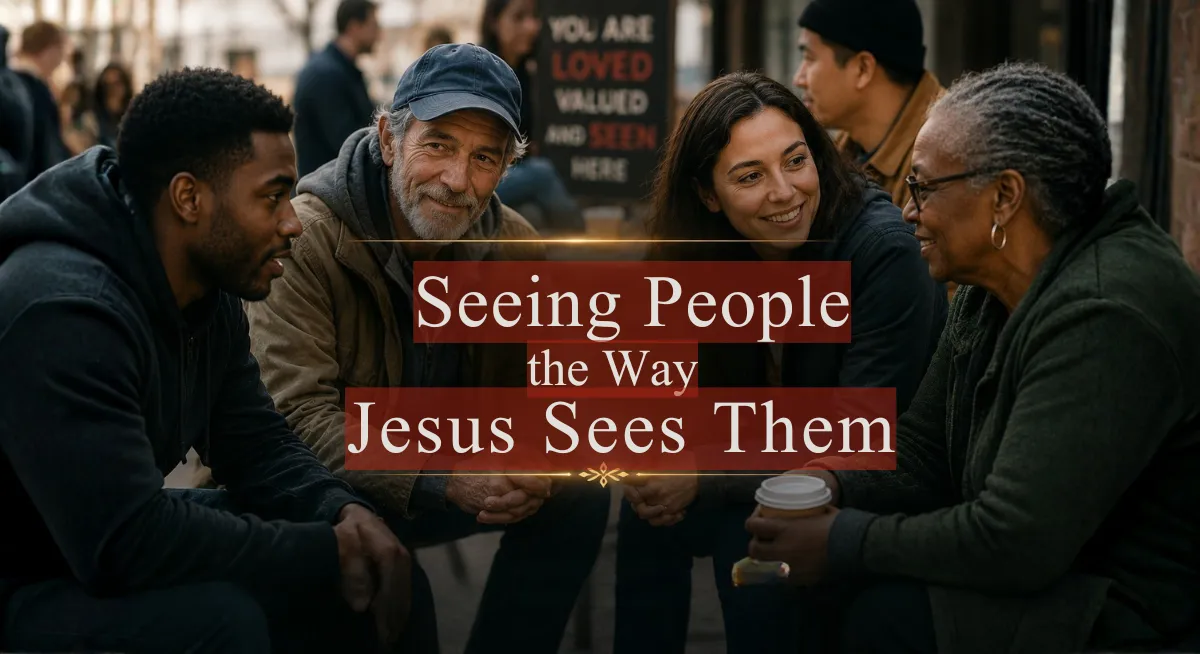
Seeing People the Way Jesus Sees Them
Most of Us Don't Actually See People. We See Compressed Thumbnails. The Gospel Is in the Difference.
You can run a quiet experiment on yourself the next time you walk into the grocery store. Pay attention to what your brain notices in the first three seconds about each person you pass. The cashier who is slow. The mother whose toddler is melting down by the cereal. The man in the produce aisle who keeps clearing his throat. Notice how quickly your mind assigns each one a category, makes a quiet judgment, and moves on. Most of us don't see people. We see compressed thumbnail versions of people, processed through filters of usefulness, threat, irritation, and category, and then we file them away and proceed with our day. Jesus didn't do this. The Gospels record Him seeing people in a way no other human being naturally does, and the difference between His seeing and ours turns out to be one of the most practical things about Christian formation. If you've searched "how Jesus saw people," "seeing people through Christ's eyes," or "Christian perception of others," this post is the one I'd hand you across a table. The Align pillar of the Christian life is, in part, about re-patterning your seeing until it begins to resemble His.
Quick Answer: Your vision is filtered before it ever reaches conscious thought. Your nervous system, your past wounds, your cultural conditioning, your family of origin, and your present mood are all running silently between the person in front of you and your awareness of them. By the time you “see” someone, you have already classified them. The classification often determines the rest of the interaction, and Christians do this no less than anyone else despite knowing better. The seeing is the problem most Christians have never been trained to address.
The P2-Driven Framework holds the work in a repeatable architecture. Get Clear about the filters you carry. Align with God's Heart by surrendering them. Get Fit through specific perception rhythms. Live Your Legacy Today by being someone who actually sees the people in front of you, which is a rarer gift than most Christians realize, and a more transformative one.
Keep reading for the full breakdown.
And now… the rest of the story.
How We Actually See People
Modern neuroscience confirms what the wisdom traditions have always known. Perception is not passive. The brain doesn't receive a person and then evaluate them. The brain anticipates the person, runs predictions about who they are based on prior patterns, and presents you with the version of them that fits the prediction. By the time you are aware of seeing someone, your brain has already done dozens of judgments below the surface, most of them invisible to you.
The filters are predictable. Usefulness (what can this person do for me?), threat (is this person dangerous to my safety, my reputation, my comfort?), category (what type of person is this, and how do I usually treat that type?), irritation (what about this person is keeping me from what I want?), and projection (what about this person reminds me of someone who hurt me, helped me, or shaped me?). Five filters, running in milliseconds, applied to every person you encounter. By the time you smile at the cashier, you have already classified the cashier through some combination of all five.
Christians are subject to the same filters as anyone else, with one addition. Christians often layer a moral filter on top of the others. Is this person's lifestyle approved or disapproved? Are they Christian or not, and if Christian, of the right tribe? Are they on the list of people I think God is pleased with or the list I think God is not? That filter feels spiritual. It is usually doing the same work as the other five, just with theological language draped over it. The result is a Christian who thinks they are seeing as God sees and is mostly seeing as their tribe sees, with God's name attached to the verdict.
How Jesus Saw People
The Gospels give a different pattern. Read with attention to the verbs of seeing, and a portrait emerges that is foreign to ordinary human perception.
Mark 10:21. A man comes to Jesus asking what he must do to inherit Eternal life. He turns out to be wealthy, attached to his wealth, and unwilling to release it. Mark's narration is striking. "And Jesus, looking at him, loved him" (Mark 10:21, ESV). The looking is recorded as a discrete act, before the request to sell his possessions, before the sad walk away. Jesus saw the man, and the seeing produced Love, not judgment. Notice what the looking didn't produce. It didn't produce a quick assessment of the man's sin. It didn't produce a calculation about the man's usefulness to the movement. It produced Love. That is the order Christian seeing is meant to recover.
Luke 19. Zacchaeus, a tax collector, climbs a sycamore tree to see Jesus pass by. Luke records that Jesus "looked up and said to him, 'Zacchaeus, hurry and come down'" (Luke 19:5, ESV). Jesus saw a man the crowd had labeled, called him by name, and went to his house for dinner. The seeing preceded the renaming, the welcome, and the Transformation. By the end of the meal, Zacchaeus was a different man. The Transformation began with being seen.
John 4. The Samaritan woman at the well. Jesus crossed cultural, ethnic, gender, and moral lines just to be there. He saw her thirst before she knew her own. He named her history without shaming her. By the end of the conversation she ran back to her village to tell people, "Come, see a man who told me all that I ever did. Can this be the Christ?" (John 4:29, ESV). The Christological revelation in that story begins with a Christ who sees a woman five husbands deep into her shame and treats her as a person worth a long conversation.
John 8. The woman caught in adultery. The crowd sees a sin. Jesus sees a woman. The phrase "neither do I condemn you" (John 8:11, ESV) doesn't come after a moral lecture. It comes after the crowd has dispersed, the only sinless person in the room remains, and the seeing of the woman precedes any naming of the sin. The pattern repeats: see the person, then attend to the work that needs doing in the person.
Why Christians Often Don't See This Way
If Jesus saw people this way, and Christians are being formed into Christ, why does ordinary Christian seeing so often look like ordinary human seeing with a moral filter added?
Three reasons explain most of it. First, perception runs faster than theology. Your brain has classified a person before your theology gets a vote. Without specific formation work on the perception itself, the classification keeps running and the theology keeps showing up too late. Second, the moral filter feels like spiritual maturity. A Christian who has strong opinions about right and wrong often confuses the strength of the opinion with the rightness of the seeing. The opinion can be technically correct and the seeing can still be uncharitable, transactional, or blind to the person's actual humanity. Third, the church culture you're embedded in trains your seeing in directions you're not aware of. The patterns of your tribe become invisible to you, and the people your tribe doesn't see become invisible too.
As we walked through in Renewing the Mind God's Way, Paul's teaching about Transformation through the renewing of the mind is specifically about this kind of deep re-patterning. "Be transformed by the renewing of your mind" (Romans 12:2, NIV) is not a sentence about cognitive content. It is a sentence about the operating system underneath the content, including the perception that runs in milliseconds. Renewed seeing is part of what Paul is talking about, and it is the part most Christian formation has the least specific tools for.
The Align Work: Re-patterning Perception
Aligning your seeing with Christ's seeing is slow, specific work. It is also one of the most consequential formation tasks a Christian can undertake, because the seeing is upstream of everything else. The way you see your spouse will determine how you treat your spouse. The way you see your team will determine how you lead your team. The way you see the stranger will determine whether the Gospel is alive in your daily life or merely in your theology. As we covered in Emotional Stability as Leadership, what the leader brings into the room becomes the climate of the room, and a leader's seeing is the first thing the room receives.
The Align work begins with honest awareness of how you currently see. Most Christians have never done a careful audit of their own perception. They assume their seeing is mostly accurate, mostly Christian, mostly fair. It is usually less accurate, less Christian, and less fair than they think, and the gap is the formation opportunity. Identity work is a major part of this; as we walked through in Identity & Midlife Re-Direction, how you see yourself shapes how you see others. A Christian who has not received the Father's Love often has trouble seeing it in the people around them, and the gap closes from the inside out.
Renewed Seeing Through the P2-Driven Framework
The Framework gives the perception work an architecture.
In Get Clear, you audit your filters. Honestly. With help. Which categories of people do you classify quickly and uncharitably? Which kinds of people are invisible to you? Which kinds of people activate the moral filter the fastest? Clarity is naming the specific patterns rather than resolving to be more Loving in general.
In Align with God's Heart, you bring those filters to the Father in confession and Surrender. "Father, form Your seeing in me where I have been classifying people through usefulness. Form Your seeing in me where I have been activating the moral filter against people You Love." Specific Surrender produces specific re-patterning. Generic Prayers about Love produce generic results.
In Get Fit, you build the rhythms that train new seeing. Reading the Gospels with attention to how Jesus saw. Practicing slowing down before reactions. Praying the names of specific people the Father is putting in front of you. Asking your spouse and friends to name the patterns they see in your seeing. The rhythms train the perception, and the perception over time becomes the new default.
In Live Your Legacy Today, you recognize that the way you see people is one of the most durable things you transmit. Your kids learn to see by watching how you see. Your team learns to see by watching how you see. The way the people around you have been seen is the way they will see others, and the chain of seeing extends in both directions through the generations. Renewed seeing is one of the most generative Legacies a Christian can leave.
Rhythms That Build New Seeing
A handful of rhythms do most of the work.
Read the Gospels with the verbs of seeing in mind. For one month, every time the text says Jesus "saw," "looked," "noticed," or "turned to," stop and pay attention. Who did He see? What did He see in them? What did the seeing produce? You will start noticing the pattern within a week.
Pause before reaction. When you notice yourself classifying a person quickly, take a breath, Pray "Lord, help me see this person" and look again. Even one pause changes what the next sentence out of your mouth will be.
Pray people by name. Specifically. Daily. The cashier you saw yesterday. The colleague you're struggling with. The neighbor whose name you finally learned. Praying for specific people by name re-patterns your seeing toward them faster than any other practice I know.
Ask trusted people to mirror your seeing back to you. A spouse, friend, or coach can name the categories you're running and the people you're missing. The mirror is uncomfortable. It is also the fastest path to the reformation Paul is describing.
Practice presence in low-stakes encounters. The grocery store, the coffee line, the carpool. Slowing down enough to actually see one person you would normally have processed as background. Over weeks, the practice extends into higher-stakes encounters, and the new seeing starts traveling with you.
These rhythms will feel inefficient before they feel transformative. That's the signal you're doing them correctly.
Live Your Legacy Today
The honest word for Christians on Wednesday morning is this.
The way you see people is shaping every relationship you're currently in, every leadership room you're currently leading, and every encounter you're currently having with strangers. It is also one of the things the Spirit is most willing to re-pattern when a Christian asks Him to. The Gospels are not stories about a man who had ideas about people. They are stories about a man who saw people, the way no other person had ever seen them, and the seeing changed them. He continues to see this way through His Body, when the Body is being formed into the kind of seeing Jesus had. Be one of the people through whom that seeing reaches the rooms you walk into.
Jesus saw the rich young ruler and Loved him. He saw Zacchaeus before the crowd had finished labeling him. He saw the woman at the well before she knew He was looking. The Christian formation called Align is, in part, the long work of letting Him form that kind of seeing in you.
Going Deeper
In my upcoming book, Your Purpose & Principle Driven Life 2.0, a full section is given to the Align pillar work, including specific perception practices, Scripture-anchored exercises, and walk-through audits for Christians who want their seeing to be re-patterned. The book was written for adults who have noticed the gap between how they were taught to think about people and how they actually see them, and who are ready for slow formation rather than another inspirational reframe.
What Coaching From AI Bots Misses
A Christian who has noticed their default seeing is harsher than the Gospel asks for can ask an AI bot for advice on how to see people more compassionately. The bot will produce a clean list of techniques, mindset shifts, and a few Scripture references. The Christian will feel briefly inspired and continue seeing people the same way by Tuesday afternoon.
The bot can't see your specific filters. The bot doesn't know that you classify people by competence first because of how you grew up, or that the moral filter activates fastest with the kinds of people your home church taught you to disapprove of, or that your projection patterns light up around people who remind you of a specific former boss. Perception work is specific to your perception. Generic perception advice produces generic results, and Christians have been receiving generic advice on this topic for decades without much actually changing in their seeing.
A coach does what the bot can't. A coach helps you name your specific filters honestly. A coach notices when your seeing collapses back into a pattern you thought you'd worked through. A coach walks with you across the months and years it takes for new seeing to become a default. That kind of accompaniment is how this formation has always actually happened, and no automated tool will substitute for it.
→ If you want a coach who will help you do the slow Align work of re-patterning how you see people, book a discovery call: https://p2driven.com/discovery-call
FAQ: Seeing People the Way Jesus Sees Them
Doesn't this approach risk softening Scripture's teaching about sin?
No. Jesus saw the woman caught in adultery and said "go and sin no more" (John 8:11, ESV). The seeing didn't skip the sin. It put the sin in its proper place, second to the person. Christians who jump to the sin first usually never get to the person, and the result is a moralism that doesn't produce Transformation in anyone. Jesus's order matters. See the person, then attend to what needs attending.
How long before my seeing actually changes?
Visible change usually appears within three to six months of committed practice, with deeper formation across years. The first changes are often noticed by your spouse or close friends before you notice them yourself. Over time, the seeing becomes the new default, and the old filters become exceptions rather than the rule.
What if I don't even know what my filters are?
Start by writing a list of the kinds of people who irritate you, the kinds you avoid, and the kinds you classify quickly. The list is your starting map. A trusted friend or coach can help you see the patterns you can't see on your own. Most filters are visible to others before they're visible to you.
Is this practice the same as being non-judgmental?
No. Christ wasn't non-judgmental. He had clear views about sin, hypocrisy, and injustice. The practice is about seeing the person before classifying them, not about pretending classification is wrong. Discernment remains. Discernment that begins with seeing produces fundamentally different fruit than discernment that begins with classification.
Where does this practice fit in the larger Christian life?
It is part of Align, in the language of the P2-Driven Framework. Aligning your seeing with Christ's is one of the slowest and most consequential alignment works available, and it serves every other relational and spiritual practice you take on. Renewed seeing makes Prayer more honest, marriage more present, leadership more trustworthy, and witness more compelling. It is foundational rather than peripheral.
