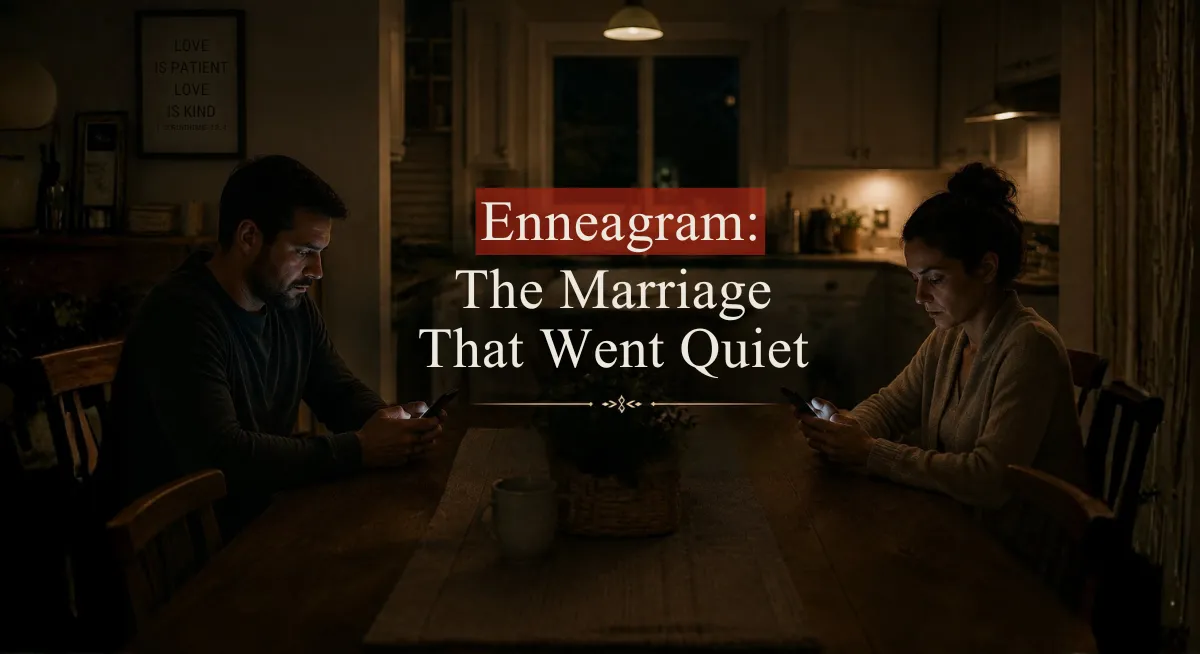
The Marriage That Went Quiet
How Your Type Builds Walls, and How the First Brick Comes Down
There’s a couple in the corner booth of a Tex-Mex place off Highway 290. The chips come, the fajitas come, the check comes, and across forty-five minutes they trade maybe ten sentences, most of them about the check. They aren’t angry. Watch as long as you like. There’s no anger to find. They’re quiet.
Two weeks ago, in The Fight You Keep Having, we looked at the fight that recurs on schedule. This post is for the marriages past that stage. The fighting stopped a while back. So did most of the talking. Of the two, the quiet worries me more.
I can describe that corner booth because I’ve eaten in it. Around 2016, mid-climb from director to the C-Suite, I looked up from my phone on a Friday-night date and noticed my wife’s thumb scrolling too. Neither of us had said a word since the food arrived. Nobody had done anything wrong. That was the unsettling part. We had drifted into that booth, efficiently, one quiet evening at a time. (Heidi read this paragraph before you did. She remembers the fajitas.)
If you’ve searched “enneagram marriage distance,” “why does my marriage feel distant,” or “my marriage went quiet,” this post is the one I’d hand you across a table. Marriages rarely go quiet all at once. Each Enneagram type lays its own kind of brick. And the wall comes down the same way it went up, one type-aware choice at a time.
Quick Answer: A quiet marriage is usually a built thing, not a broken one. Each spouse’s Enneagram autopilot lays its signature brick under stress: Body types wall off with control and busyness, Heart types with image management and collected hurts, Head types with analysis and self-protection. The couples who divorce late are rarely the loud ones; they’re the disengaged ones. The hopeful part: walls come down the way they went up, one brick at a time, and the side you can start on tonight is your own.
Get the Gist Quick
Short version, because if the quiet is sitting in the next room while you read this, you don’t need a lecture. You need a map.
Nobody decides to build a wall in a marriage. Walls get built one brick at a time, and no single brick feels like a decision. A swallowed sentence. A skipped conversation. A night of parallel phones. Your Enneagram type determines which brick your hand reaches for, and the three centers build three different walls: Body types with control and doing, Heart types with image and collected hurts, Head types with analysis and retreat.
The hope is structural. What small choices built, small choices can unbuild, and the unbuilding starts with one. Keep reading for the full breakdown.
And now… the rest of the story.
How a Marriage Goes Quiet
No one plans the quiet. It arrives on the far side of a thousand reasonable decisions. He’s tired, so the thing she said at dinner goes unanswered. She’s hurt, so the hurt goes in a drawer instead of a sentence. The promotion lands, the third kid lands, and the conversation contracts to logistics: who’s driving, who’s paying, who forgot the permission slip. None of it is malicious. All of it is masonry.
John Gottman and Robert Levenson followed the same couples for fourteen years, in research still foundational to the field. Two patterns predicted divorce, on two different clocks. Criticism and contempt running loud predicted the early divorces, inside roughly the first seven years.1 The second clock surprised people. The couples who divorced late, an average of 16.2 years in, weren’t fighters. They were disengaged, their conversations gone flat, almost no warmth left in the room.2
The marriages that end late don’t end in an explosion. They end in a hush.
Solomon saw it three thousand years earlier, in a poem between newlyweds.
“Catch all the foxes, those little foxes, before they ruin the vineyard of love, for the grapevines are blossoming!” (Song of Solomon 2:15)
Notice the size of the threat. Foxes, not wolves. The vineyard of Love gets nibbled, low to the ground, while everything above the fence line still looks green. And notice the timing. The grapevines are blossoming. The foxes do their worst damage in a marriage with plenty left worth protecting.
Why Generic Marriage Advice Doesn’t Reach the Wall
Communicate more. Schedule date nights. The advice isn’t wrong. It’s unaddressed mail. It treats every wall as the same wall, and walls are type-specific. As we walked through in Drift in Marriage, drift is the current that moves every marriage that stops paddling. The Enneagram names the exact brick your hand reaches for when you’re tired, stressed, or hurt. The iEQ9 assessment I use with couples maps that autopilot with far more accuracy than a free quiz, and the order of operations holds: the tool informs, the coach interprets, and you own the Transformation.
How Each Center Builds Its Wall
Nine types. Three centers. Three kinds of brick.
Body Center types (Type 8 Active Controller, Type 9 Adaptive Peacemaker, Type 1 Strict Perfectionist) build with control and doing. The Eight controls the terms of connection and calls the resulting distance strength. The Nine keeps a Peace so smooth it can barely be distinguished from absence, agreeing on the outside while quietly leaving the building. The One files each disappointment as a correction the spouse should have made, and the rightness hardens into a silence with excellent posture. From the outside, a Body-type wall looks like productivity. The deck gets rebuilt the same summer the talking stops.
Heart Center types (Type 2 Considerate Helper, Type 3 Competitive Achiever, Type 4 Intense Creative) build with image and collected hurts. The Two serves instead of speaking and keeps an invisible ledger of the thanks that never came. The Three performs the marriage for the audience, anniversary post polished, while the room behind the camera goes still. The Four curates a private museum of the times they weren’t understood, then withdraws to walk its halls alone. A Heart-type wall is the hardest to spot, because from outside it photographs beautifully.
Head Center types (Type 5 Quiet Specialist, Type 6 Loyal Sceptic, Type 7 Enthusiastic Visionary) build with analysis and self-protection. The Five rations presence, processing alone what was meant to be processed together. The Six scans the marriage for evidence, testing instead of asking, reading tone the way a sentry reads a tree line. The Seven keeps it light, reframes the hard conversation into a fun one, and books the trip that stands in for the talk. A Head-type wall is built of good reasons. Every brick comes with a footnote.
Not one of those bricks gets laid in malice. Every type builds its wall out of self-protection that made sense at the time, which is exactly why Grace, not blame, is the right tool for the unbuilding.
The First Brick Comes Down
A wall that took ten years to build doesn’t need ten years to breach. It needs one brick moved in the other direction, in the specific spot your type has been laying them.
Body types: say the sentence instead of doing the chore. Hand over one decision (Eight). Disagree out loud once, kindly (Nine). Confess the resentment behind the busyness (One).
Heart types: come out from behind the image. Ask plainly instead of earning (Two). Tell your spouse one un-impressive Truth (Three). Share the hurt while it’s small enough to hand over (Four).
Head types: bring the inside conversation into the room. Think out loud before the analysis is done (Five). Ask instead of testing (Six). Stay at the table past the moment you’d normally reframe (Seven).
None of these moves feel natural. They aren’t supposed to. Each one is your autopilot in reverse, and the discomfort is the signal that you found the right brick. The first brick changes the temperature of the room, because your spouse doesn’t need the whole wall gone before they can Hope again. They need to see your hands moving in the other direction.
The Quiet Marriage Through the P2-Driven Framework
In Get Clear, you name your brick. “We grew apart” is weather, and nobody can act on weather. “I go quiet and reorganize the garage when I feel criticized” is masonry, and masonry can be reversed. The iEQ9 gives a couple that level of precision about both autopilots.
In Align with God’s Heart, you Surrender the self-protection the wall was built to provide. Marriage was designed so that “the two are united into one” (Genesis 2:24), and every brick is a small vote against the design, cast in the name of safety. The Prayer that unbuilds is specific. Father, I laid a brick tonight when I went quiet instead of honest. Give me the courage to take it down tomorrow.
In Get Fit, you build the rhythms that keep new bricks off the wall, the daily ten minutes, the weekly walk, the brick question. More on those in a moment.
In Live Your Legacy Today, you remember who else lives in the quiet house. As we covered in What Your Marriage Is Modeling, your kids are taking notes on what married looks like, and a wall teaches as loudly as a fight. A marriage warming back up teaches something better: that Love, tended, recovers.
Rhythms That Keep the Bricks Off the Wall
Three rhythms handle most of the maintenance.
Ten minutes, no logistics. Once a day, a conversation where nobody may mention the calendar, the kids’ rides, or the budget. It will feel awkward for a week. Awkward is the sound of scaffolding coming down.
A weekly walk, phones at home. Motion loosens what the couch locks up. Twenty minutes around the block outworks two hours of parallel silence.
The brick question. Once a week, each of you answers the same question: where did I lay a brick this week? A confession the size of a brick stays the size of a brick. Stored for a decade, it needs a crane.
Small rhythms, honestly kept, outbuild any autopilot.
Live Your Legacy Today
On any given Thursday morning, the honesty looks like this.
The quiet didn’t arrive overnight, and it won’t leave by lunch. But somewhere this week there’s a table, and across it sits the person you once couldn’t stop talking to. One question that isn’t logistics. One confession the size of a brick. One laugh that surprises you both. That’s how vineyards get their fences mended, while the grapevines, against the odds, are still blossoming.
Catch the little foxes. Start with yours.
Going Deeper
In my upcoming book, Your Purpose & Principle Driven Life 2.0, the Alignment section takes the wall apart at book length, with the type-specific patterns, Scriptures, and couple’s exercises this post could only sketch. I wrote it for adults who want a marriage that grows warmer in the second half, not quieter.
→ If you and your spouse want a coach who can map both autopilots and walk with you while the wall comes down, book a discovery call: https://p2driven.com/discovery-call
FAQ: Enneagram and Marriage Distance
Can a marriage that has been quiet for years come back?
Yes, and quiet marriages often recover faster than combative ones once someone starts moving, because the goodwill was walled off rather than burned up. Start with one brick, this week, from your side of the wall.
Is emotional distance as serious as constant fighting?
The long-term research suggests it may be more serious. In Gottman and Levenson’s fourteen-year study, the couples who divorced late were not the loud fighters; they were the quiet, disengaged ones. Distance hides better than conflict, and that is what makes it dangerous.
Which Enneagram type builds walls fastest in marriage?
No type builds faster, but each builds differently, brick by signature brick. The useful question is never which type is worst; it is which brick is in your own hand.
What if my spouse has no interest in the Enneagram?
Work your side of the wall anyway. You do not need your spouse’s participation to stop laying your own brick, and the temperature of a room changes when even one person changes. Curiosity usually follows warmth. Invitation beats pressure every time.
Should we take the iEQ9 as a couple?
When both of you are willing, yes. The iEQ9 maps each autopilot with far more precision than free quizzes, and a couples debrief puts both maps on the same table. The tool informs, the coach interprets, and the two of you own the Transformation.
Is this a substitute for marriage counseling?
No. Counseling treats injury; coaching builds the next season, and many couples benefit from both at different times. If your marriage carries deep wounds, see a licensed counselor first. Coaching serves couples in drift who want to grow before something breaks.
